When your commercial water heater starts failing, it can disrupt operations, increase energy bills, and lead to costly repairs. Upgrading to a modern system, like a tankless water heater, can save money, improve reliability, and ensure compliance with upcoming efficiency standards. Here’s what you should know:
- Signs It’s Time to Upgrade: Rusty water, inconsistent temperatures, loud noises, or frequent repairs are clear indicators.
- Costs: Replacing a water heater typically costs $1,500–$5,000, while frequent repairs can add up to $1,200 or more annually.
- Tank vs. Tankless: Tankless systems last longer (20+ years), save space, and are 24%-34% more energy-efficient for low water usage.
- Installation Tips: Work with a licensed plumber in Moncks Corner, secure permits, and plan during low-demand periods to minimize disruptions.
- Maintenance: Regular flushing, valve checks, and inspections can extend your system’s lifespan and prevent breakdowns.
Upgrading now can also take advantage of rebates and tax credits available for energy-efficient systems in 2026. Keep your business running smoothly with a reliable water heating system tailored to your needs.
Evaluating Your Current Water Heating System
Before deciding to upgrade, it’s smart to assess how well your current water heater is holding up. Many people wait until their system completely breaks down to replace it, but catching problems early can save you from hefty repair bills and potential disruptions. Your water heater often gives clear signals when something’s wrong – you just need to know what to look for.
Warning Signs You Need an Upgrade
If your water temperature swings wildly – from scalding to lukewarm – or if the flow is inconsistent, it’s likely a sign of trouble with the thermostat or heating element. For businesses like restaurants and hotels, these issues can’t be ignored. Guests notice when showers don’t stay warm, and cold dishwashing stations can disrupt operations. Check the mixing valve, seals, and tank condition to pinpoint the problem.
"If hot water fluctuates between scalding and lukewarm, or if some areas experience cold water while others are hot, it may indicate a problem with the water heater or a malfunctioning mixing valve." – ALL Plumbing
Rusty or brown water is another red flag, often caused by internal corrosion or sediment buildup. Strange noises, such as banging or popping, might mean sediment has hardened at the bottom of the tank. This makes the system work harder, driving up energy use. Commercial units, which handle much heavier use than residential ones, tend to accumulate sediment more quickly.
If you notice puddles or moisture around the unit, act fast – leaks can lead to costly property damage. And if repair calls for leaks, clogs, or failing components are becoming a regular occurrence, it might be time to stop patching the system and invest in a replacement.
Here’s a quick breakdown of common issues and what they mean:
| Sign of Trouble | What It Means | Next Step |
|---|---|---|
| Banging/Popping Noises | Hardened sediment buildup | Flush the tank or replace the unit |
| Rusty/Brown Water | Internal tank corrosion | Schedule an inspection immediately |
| Fluctuating Pressure | Pipe corrosion or hidden leak | Call for professional leak detection |
| Lukewarm Water | Faulty mixing valve or heating element | Repair or upgrade the thermostat |
Beyond these warning signs, the age and maintenance history of your system also play a big role in its performance.
How Age and Maintenance History Affect Performance
Most water heaters last between 8 and 12 years, and once they hit the 10-year mark, replacement is often the better option.
Regular maintenance is equally crucial. Without routine flushing, sediment builds up at the bottom of the tank, forming a hardened layer that forces the system to work harder and use more energy. For businesses like restaurants, hotels, and hospitals in Moncks Corner, where water heaters face heavy daily use, inspections should happen every six months instead of annually. Check the nameplate on your unit for the installation date and model to help determine when it might need replacing.
Frequent repairs are another indicator that it’s time for an upgrade. If your repair costs are climbing and start to rival the price of a new unit – typically between $1,500 and $5,000 – replacing the system is often the smarter financial move.
sbb-itb-998eb83
Selecting the Right Commercial Water Heating System
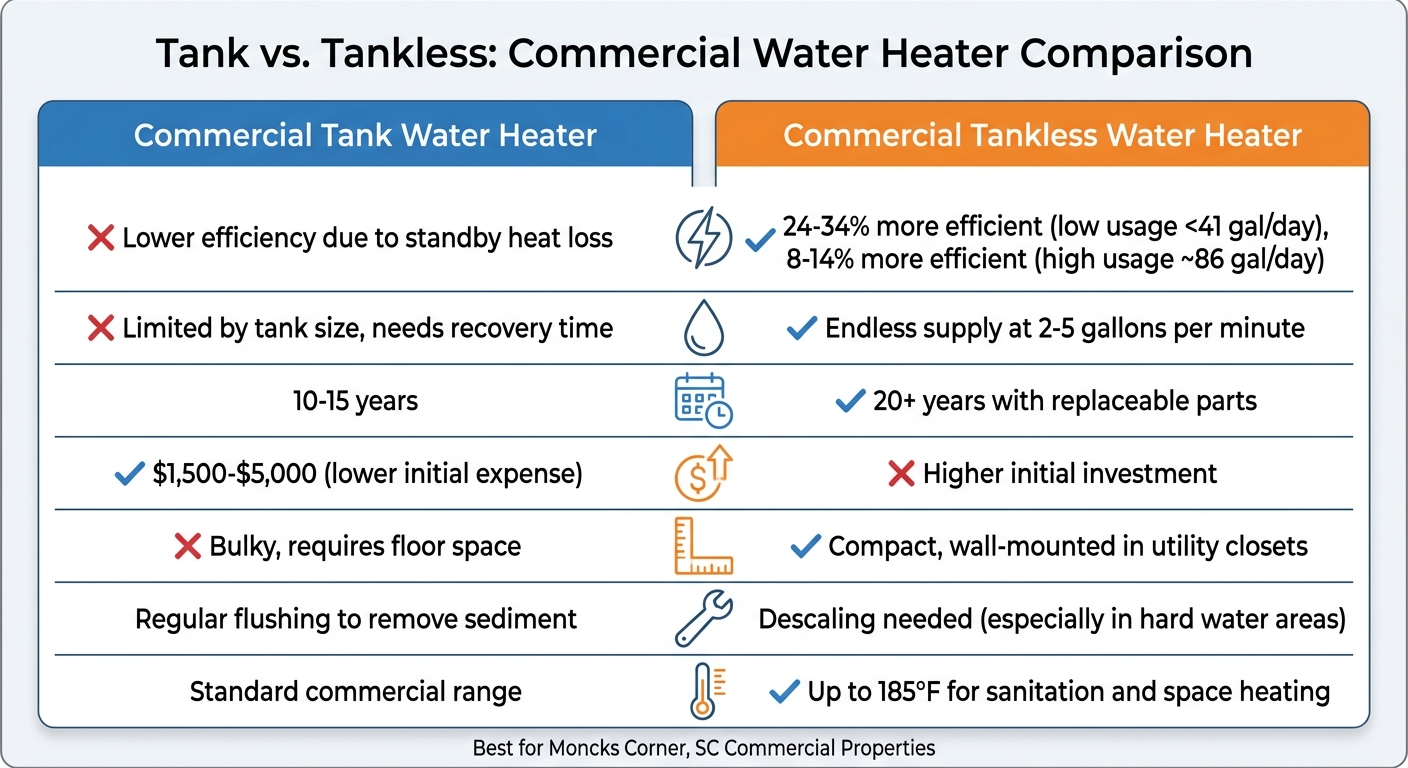
Commercial Tank vs Tankless Water Heater Comparison Chart
Once you’ve determined it’s time to replace your water heating system, the next step is picking one that fits your business needs. The two primary types – tank and tankless – work differently and cater to different demands. Understanding how they perform in practice can help you save on costs and ensure smooth operations.
Tank vs. Tankless: Side-by-Side Comparison
Tank water heaters store a set amount of water and continuously reheat it, while tankless systems heat water on demand as it flows through a heat exchanger.
| Feature | Commercial Tank Water Heater | Commercial Tankless Water Heater |
|---|---|---|
| Energy Efficiency | Lower due to standby heat loss | 24%–34% more efficient for low usage (<41 gal/day) and 8%–14% more efficient for higher usage (~86 gal/day) |
| Hot Water Supply | Limited by tank size; recovery time needed | Endless supply at 2–5 gallons per minute |
| Lifespan | 10–15 years | 20+ years with replaceable parts |
| Upfront Cost | $1,500–$5,000 (lower initial expense) | Higher initial investment |
| Space Requirements | Bulky; requires floor space | Compact; wall-mounted in utility closets |
| Maintenance | Regular flushing to remove sediment | Descaling needed, especially in hard water areas |
| Temperature Range | Standard commercial range | Up to 185°F for sanitation and space heating |
Tankless systems stand out by eliminating standby heat loss, as they heat water only when needed. Gas-powered tankless models offer higher flow rates compared to electric ones, making them ideal for businesses with multiple simultaneous water demands. Keep these differences in mind as you assess what works best for your operations.
What Moncks Corner Businesses Should Consider
Choosing the right system goes beyond tank versus tankless. It’s essential to match the system to your business’s operational and spatial requirements. For example, the nature of your business directly impacts your hot water needs. Restaurants serving three meals a day will need full GPH capacity, while smaller operations may only require 80% of that capacity. Establishments like hotels, hospitals, and large restaurants typically benefit from systems with higher flow rates to handle heavy demand.
Space is another major factor, especially in Moncks Corner’s historic districts or smaller commercial spaces where every square foot matters. Tankless units, with their compact design, can be mounted in utility closets or garages, freeing up valuable floor space.
Water quality also plays a crucial role. Moncks Corner’s varying water hardness levels can lead to mineral buildup in tankless heat exchangers, potentially lowering performance over time. Installing a water softener or filtration system can help protect your system and maintain efficiency. For tankless systems, ensure each sink receives a minimum 2 GPM flow rate to meet commercial standards, and verify that the unit can achieve a 60° temperature rise from an incoming 120°F water supply.
Lastly, think about future growth. If you’re planning renovations or expansions, opt for a system with extra capacity to handle increased demand. For gas-powered tankless units, confirm that your building can accommodate the necessary venting requirements. Taking these factors into account will help ensure uninterrupted operations and manage long-term costs effectively.
How to Complete a System Upgrade
Planning and Preparation
Before starting the installation, make sure to tackle these essential steps:
First, secure the necessary building or plumbing permit from the Town of Moncks Corner through their CommunityCore online platform. Also, ensure that you’re working with a contractor who holds a valid South Carolina LLR license.
Your contractor should provide a clear and detailed plan for the project. This should include the scope of work, the materials to be used, and a timeline for completion. During this stage, calculate the gallon capacity and recovery rate your business needs. Be sure to note your current unit’s tank capacity, model number, serial number, and any relevant electrical or gas specifications.
"A detailed written outline of the project expectations helps ensure that both parties are aligned and that there are no surprises along the way." – Charleston Plumber Service
Next, assess your building’s infrastructure. Gas-powered units typically demand a capacity of 150,000–200,000 BTU/hr, while electric systems may require 240V circuits rated at 150–200 amperes. If you’re switching from a traditional tank-style system to a tankless model, you may need to upgrade your gas line or electrical service. Additionally, if your supply line includes a backflow preventer or check valve, you’re required to install a thermal expansion tank as per IRC Section P2903.4.
When you’re ready to schedule inspections, submit requests via CommunityCore by 2:00 PM for next-day service. Inspections are conducted Monday through Friday, between 7:00 AM and 3:30 PM. If your business operates in a high-demand environment, like a restaurant or hotel, plan installations during quieter periods to minimize disruptions.
The Installation Process
Once everything is planned, it’s time to move on to the installation. Certified technicians will start by removing the old or malfunctioning unit and replacing any outdated pipes to ensure the new system complies with current building codes. The next steps involve mounting the new unit – whether it’s a tank or tankless system – connecting the gas or water lines, and installing additional equipment like commercial-grade sinks or backflow prevention devices.
For safety and compliance, temperature and pressure relief valve discharge pipes must be routed to within 6 inches of the floor. Gas-fired systems also require venting that adheres to NFPA 54 (National Fuel Gas Code). In the final stages, technicians will rigorously test the system to confirm it operates efficiently and meets all local health and building standards. This includes checking water flow, maintaining consistent temperature, and ensuring all safety mechanisms are functioning. Depending on the complexity of the project, installation costs typically range from $1,500 to $5,000.
"Our technicians use the latest tools, equipment, and techniques for faster, more accurate, and longer-lasting repairs." – Aptus Home Services
Once the installation and testing are done, your system is ready to go. Don’t forget to look into federal tax credits or local utility rebates that might be available for upgrading to an energy-efficient or ENERGY STAR® certified model.
Advantages of Energy-Efficient Commercial Water Heaters
For businesses in Moncks Corner, upgrading to an energy-efficient commercial water heating system isn’t just about cutting costs – it’s an investment in both profitability and sustainability. Traditional tank heaters constantly reheat stored water, even when your business isn’t operating, leading to wasted energy. In contrast, energy-efficient tankless models heat water only when needed, eliminating standby heat loss entirely. Plus, with Moncks Corner’s mild winters, these systems face less strain than in colder regions, which helps them last longer and maintain optimal performance year-round.
"Tankless units provide hot water only when needed, resulting in significant energy savings and reduced utility bills." – ALL Plumbing
Switching to energy-efficient systems also reduces your environmental footprint. These units use less energy than conventional heaters, and many are built with recyclable materials. Their longer lifespans mean fewer units end up in landfills, further minimizing waste. For businesses aiming to showcase their commitment to sustainability, this upgrade is a practical step toward greener operations.
Federal regulations are also shaping the future of commercial water heaters. Starting October 6, 2026, all newly manufactured gas-fired commercial water heaters must meet updated efficiency standards by using condensing technology. Upgrading now not only ensures compliance ahead of time but also allows businesses to take advantage of federal tax credits and local utility rebates available for ENERGY STAR® certified models. When shopping for a new unit, look for the Uniform Energy Factor (UEF) rating – higher UEF numbers mean better efficiency and lower annual operating costs.
In addition to utility savings, energy-efficient systems are designed to be more reliable, with fewer breakdowns over time. This means lower repair costs and less downtime, which is especially important for high-demand businesses like restaurants and hotels in Moncks Corner. Adding mechanical insulation to your piping can further reduce energy loss and protect against heat transfer, making your system even more efficient.
Keeping Your Commercial Water Heating System Running
Once you’ve upgraded your commercial water heating system, keeping it in good shape requires regular maintenance. This not only helps the system last longer but also ensures it stays energy-efficient and dependable. On average, commercial water heaters last between 8 and 12 years, depending on factors like water quality and maintenance routines.
Regular Maintenance Tasks
One key task is flushing the tank annually to remove sediment buildup. Minerals in Moncks Corner’s water supply can settle at the bottom of the tank over time, reducing its efficiency and potentially causing the tank to fail. If you hear popping, banging, or rumbling noises, it’s a sign that sediment buildup needs to be addressed immediately.
"Flush the water heater at least once a year to rid it of collected sediment that causes failure. This also increases efficiency." – A.O. Smith
You should also test the temperature and pressure relief valve to ensure it functions correctly. A malfunctioning valve can pose safety risks. Keep the thermostat set at 120°F for a balance of efficiency and safety. For gas-powered units, follow the manufacturer’s guidelines to clean air screens, which are vital for proper combustion and airflow. Additionally, pay attention to water clarity – brown or rusty water might indicate internal corrosion, which should be checked by a professional.
While these tasks are crucial, professional maintenance can provide an extra layer of protection for your system.
Why Professional Maintenance Plans Help
For high-demand facilities like restaurants, hotels, and hospitals in Moncks Corner, scheduling professional inspections every six months is recommended. Standard commercial properties typically need annual service. Professional inspections can catch small problems – like slow leaks, pipe corrosion, or uneven water pressure – before they turn into costly emergencies that might range from $300 to $1,500.
"A commercial plumbing system should typically be inspected at least once a year to ensure it is functioning properly and to catch potential issues before they become costly problems." – ALL Plumbing
In Moncks Corner, routine maintenance plans usually cost between $200 and $800 per year. This is a much smaller expense compared to emergency repairs that can disrupt your business. Professional technicians also help ensure your system meets local health and safety codes, which can further extend its lifespan.
Conclusion
Upgrading your commercial water heating system in Moncks Corner can lower energy costs, improve reliability, and reduce downtime. Modern tankless systems, with proper care, can last up to 20 years – nearly double the lifespan of traditional models. Plus, South Carolina’s 2026 rebate programs offer incentives ranging from $2,000 to $16,000, along with federal tax credits of up to $2,000 for heat pump water heaters. It’s a great time to make the switch.
For businesses like restaurants, hotels, and offices, having reliable hot water is essential. Regular maintenance and yearly professional inspections can help prevent costly breakdowns.
Since 1987, ALL Plumbing Services has been a trusted partner for the Moncks Corner and Charleston communities, offering expert advice on commercial water heating upgrades. Their team provides honest, personalized recommendations without upselling unnecessary services. With 24/7 emergency support and a 100% satisfaction guarantee, ALL Plumbing ensures your business stays up and running smoothly.
Looking to upgrade your commercial water heating system in Moncks Corner? <a href="https://allplumbingcompany.com/contact-us/">Reach out to our commercial team</a> for a free estimate or <a href="https://allplumbingcompany.com/contact-us/">schedule a consultation</a> today.
FAQs
What size water heater does my business need?
The size of your water heater should match your business’s hot water needs. For storage tank models, an 80-gallon unit is typically enough for 3–4 users. If your demand is higher, you’ll need a larger tank. With tankless systems, focus on the required flow rate (measured in gallons per minute or GPM) and the temperature rise needed to reach your target, such as 120°F. It’s a good idea to consult a professional to evaluate your specific requirements, especially if you’re considering commercial tankless systems or high-capacity setups, to ensure the unit is properly sized.
Can a tankless system support multiple fixtures at the same time?
Tankless systems can indeed handle multiple fixtures at the same time, particularly if you opt for a high-capacity model. Designed to deliver hot water on demand, these systems are especially well-suited for commercial environments where several water outlets may be in use simultaneously.
What upgrades might my building need for a tankless install?
Installing a tankless water heater often means making adjustments to your home’s existing systems. For instance, you might need to increase the capacity of your water supply lines to accommodate the heater’s demand. If you’re opting for an electric model, your electrical system may require upgrades to handle the additional load. Similarly, hot water piping might need to be modified to support higher flow rates.
For gas models, proper ventilation is crucial to ensure safe operation. A professional evaluation is the best way to pinpoint what changes are necessary, helping you set up a system that runs smoothly and efficiently.