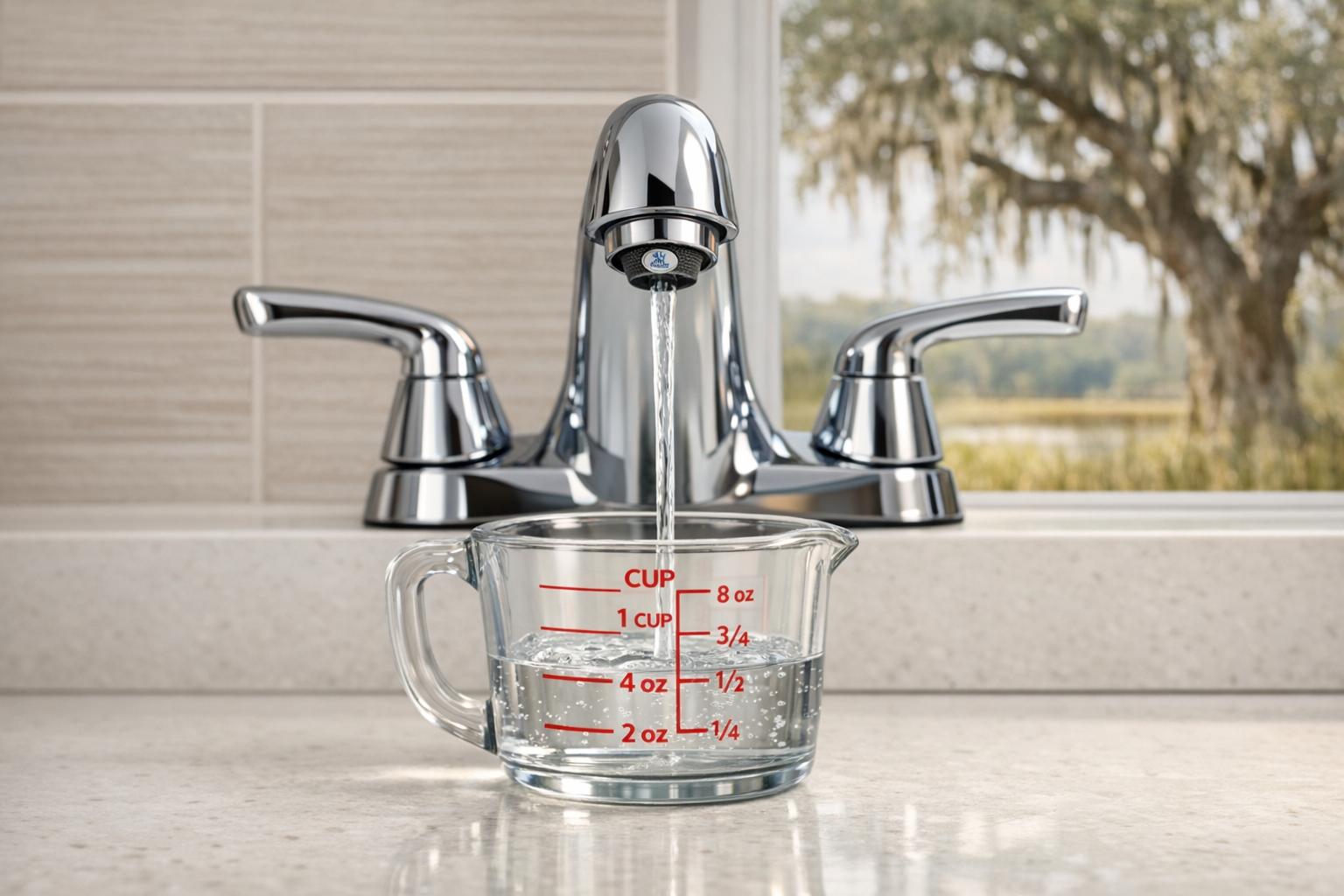
Reducing water usage in Bluffton, SC, not only saves you money but also helps preserve local resources. Here’s how you can make a difference:
- Fix Leaks Fast: A dripping faucet can waste over 3,000 gallons annually. Repairing leaks can cut your water bill by 10%.
- Upgrade Fixtures: Switch to low-flow showerheads and high-efficiency toilets to save thousands of gallons each year.
- Outdoor Efficiency: Water your lawn early morning, use rain sensors, and choose native plants to cut outdoor water use by up to 50%.
- Smart Tech: Install devices like leak detectors and smart sprinklers for better control and reduced waste.
- Routine Maintenance: Regular plumbing checks help catch hidden issues before they become costly.
Simple changes like these can lead to big savings and protect Bluffton’s ecosystem. Read on for detailed tips to lower your water usage and utility costs.
Water Conservation Statistics and Savings for Bluffton Homeowners
Find and Fix Plumbing Leaks
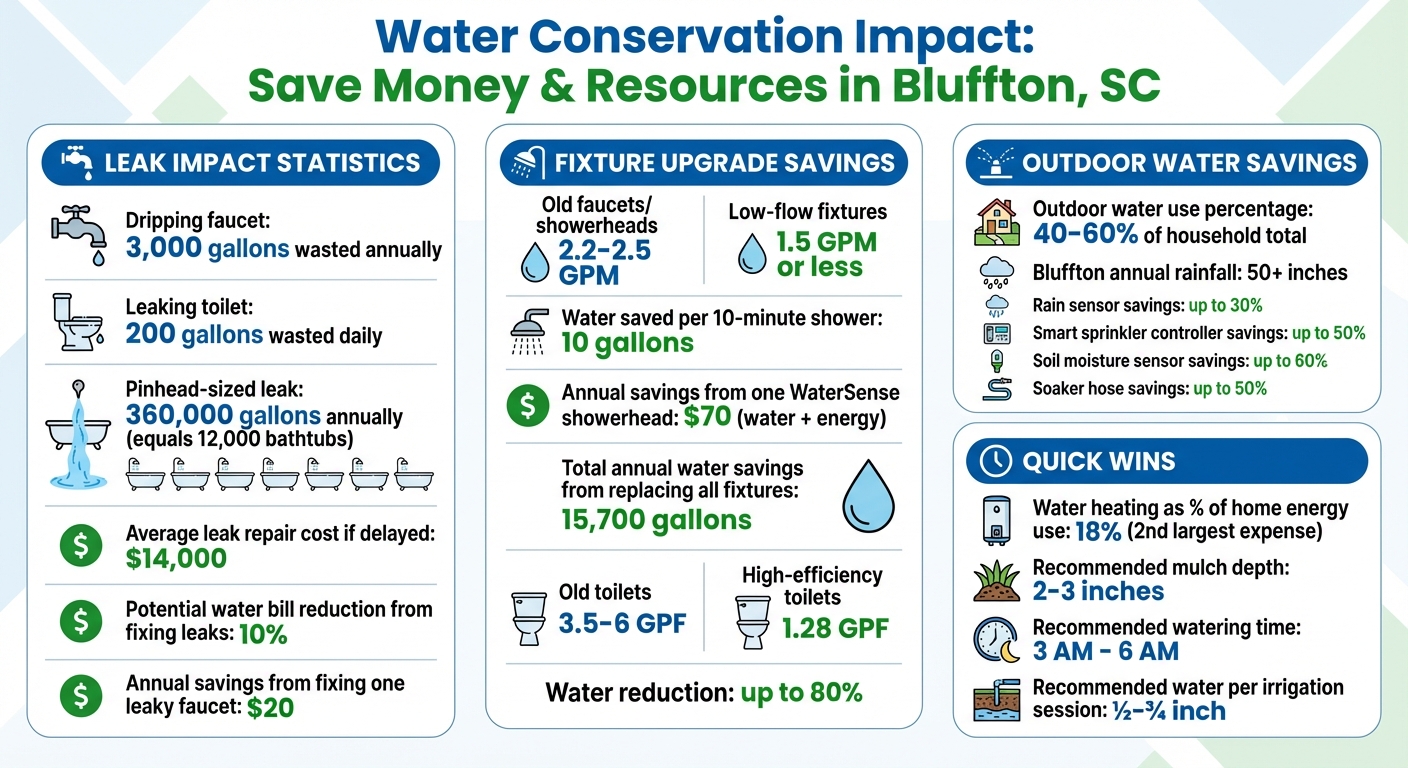
In Bluffton, where the coastal environment speeds up corrosion and shifting ground stresses plumbing systems, even the smallest leaks can lead to big expenses. For example, a dripping faucet can waste over 3,000 gallons of water a year, while a leaking toilet might lose up to 200 gallons daily. A tiny, pinhead-sized leak? That could waste 360,000 gallons annually – enough water to fill about 12,000 bathtubs.
How to Detect Hidden Leaks
Start by shutting off all water sources in your home. Then, check your water meter. If the meter moves within 30 minutes to 2 hours, you likely have a leak. For toilets, try this simple test: add food coloring or a dye tablet to the tank. If color shows up in the bowl within 15–30 minutes without flushing, your flapper valve is leaking.
Be on the lookout for physical signs of leaks, such as:
- Musty odors
- Bubbling paint or warped flooring
- Damp spots on walls or ceilings
- Outside, unusually green patches of grass or muddy areas near your foundation could indicate a broken pipe or irrigation leak.
- Warm spots on floors or the sound of running water when faucets are off might point to a slab leak under your foundation.
Once you’ve identified a leak, it’s important to act quickly to avoid further damage and higher costs.
Fix Leaks Quickly
After spotting a leak, repair it as soon as possible. Delaying can lead to structural damage, with repair bills averaging nearly $14,000. Fortunately, many small leaks are easy to fix yourself. For example:
- Replace the internal seal of a dripping faucet.
- Swap out a faulty toilet flapper.
- Tighten under-sink compression fittings using a wrench.
For hidden leaks, it’s best to call in the pros. ALL Plumbing Services uses advanced tools like acoustic sensors, infrared cameras, and moisture meters to locate leaks without tearing into walls or floors. Even fixing something as simple as a leaky faucet can save you up to $20 a year on your water bill.
Don’t let a small leak turn into a big problem – take action today!
sbb-itb-998eb83
Install Water-Efficient Fixtures
Making the switch to water-efficient fixtures is a practical upgrade for your Bluffton home. Not only can it lower your water bill, but it also cuts energy costs – especially since heating water accounts for about 18% of a typical home’s energy use, making it the second-largest energy expense. Even small changes can lead to noticeable savings over time. Here’s how specific fixture upgrades can help.
Low-Flow Faucets and Showerheads
Did you know that older faucets can use up to 2.2 gallons per minute (GPM) and older showerheads around 2.5 GPM? Low-flow fixtures bring that down to 1.5 GPM or less, all without compromising performance. Modern designs achieve this by mixing air into the water stream or using high-pressure engineering.
The savings are tangible. Replacing just one outdated showerhead with a WaterSense-labeled model can save a household about $70 annually in combined water and energy costs. For example, a ten-minute shower with a low-flow showerhead uses about 10 gallons less water compared to older models. If you replace all the fixtures in your home, you could save an average of 15,700 gallons of water each year.
When shopping for fixtures, look for the WaterSense label – it ensures the product meets strict efficiency and performance standards. Not ready to replace entire faucets? Add aerator attachments to your current taps for an affordable way to reduce water flow during tasks like washing hands or rinsing dishes. In Bluffton, where hard water can cause mineral buildup, it’s a good idea to check and clean your fixtures regularly to keep them working efficiently.
High-Efficiency Toilets
Toilets are often the biggest water users in a home, especially older models. Pre-1990s toilets can use 3.5 gallons per flush (GPF), and some even go up to 6 GPF. By contrast, modern high-efficiency toilets (HETs) use only 1.28 GPF – a reduction of nearly 80% compared to those older 6-gallon models.
"A WaterSense toilet uses less than 1.6 gallons per flush, saving you water and money over its lifetime." – Benjamin Franklin Plumbing
There are several types to choose from. Gravity-fed toilets rely on gravity to clear the bowl, making them quieter and easier to maintain. Pressure-assisted models use compressed air for a more powerful flush, which also helps prevent clogs while using less water. Dual-flush toilets give you the flexibility of using a lower-volume flush (around 1.1 gallons) for liquid waste and a full flush (1.6 gallons) for solid waste. When shopping, check the MaP (Maximum Performance) score to see how well a toilet handles waste. Additionally, some utility companies in South Carolina offer rebates for upgrading to WaterSense-certified models, so be sure to explore local incentives.
Modern Plumbing Technologies
For those looking to go beyond basic upgrades, advanced plumbing technologies offer even more ways to save water and energy. Tankless water heaters are a great example – they heat water on demand, eliminating the energy wasted by traditional water heaters. Pairing them with hot water recirculation systems ensures near-instant hot water at distant fixtures, reducing water waste.
Smart systems can take water efficiency to the next level. Devices like leak detectors, touchless faucets, and programmable timers help curb water waste automatically while offering added convenience and security. Thermostatic shower valves are another smart option, as they keep water temperature consistent, eliminating waste during adjustments.
Reduce Outdoor Water Usage
Outdoor water use can make up a hefty 40%–60% of a household’s annual water demand in this region. Yet, with over 50 inches of rainfall each year, the need for additional irrigation is often minimal.
"With Hilton Head Island receiving more than 50 inches of rainfall a year on average, the need to supplement with irrigation is often quite limited." – Hilton Head Public Service District
By fine-tuning outdoor watering habits, you can maintain a lush landscape while cutting down on water waste. These strategies work hand-in-hand with indoor conservation efforts to lower overall water use.
Adjust Your Irrigation System
Stick to local watering rules – on Hilton Head and in Bluffton, even-numbered addresses water on Tuesdays and Saturdays, while odd-numbered addresses water on Wednesdays and Sundays. To reduce evaporation, aim to water between 3 AM and 6 AM.
Set sprinklers to apply ½–¾ inch of water per session. This encourages deep root growth, making plants more resilient. Adding a rain sensor to your system can automatically stop watering after ½ inch of rain, cutting water waste by as much as 30%.
Adjust your watering schedule based on the season. For example, warm-season grasses only need about 1 inch of water during a three-week dry spell. Consider upgrading to smart sprinkler controllers that use real-time weather data to reduce water use by up to 50%. Alternatively, soil moisture sensors can prevent overwatering, saving as much as 60%.
Once your irrigation system is optimized, choosing plants suited to the local environment can further reduce water needs.
Choose Native and Drought-Tolerant Plants
Bluffton’s sandy soil and coastal climate make native species an excellent choice. Plants like Palmetto trees, Sweetgrass, Saw Palmetto, and Wax Myrtle thrive with minimal irrigation once established.
"Once established, if a native plant is the right plant for the right place, then little to no irrigation will be required." – Kimberly C. Morganello, Water Resources Associate, Clemson University
For a splash of color, go for drought-resistant flowering plants like Black-eyed Susan, Blanket Flower, Purple Coneflower, and Lantana. These plants not only conserve water but also attract pollinators. Hardy shrubs such as Yucca (Spanish Bayonet) and Beautyberry, along with groundcovers like Christmas Fern or succulents, are also great options. Group plants with similar water needs together to make watering more efficient and help pollinators locate them easily.
Steer clear of invasive species like Chinese Tallow and Japanese Honeysuckle, which can drain local water supplies and outcompete native plants.
Use Efficient Watering Methods
Pair efficient watering methods with smart irrigation practices and water-wise plant selections. Drip irrigation systems are one of the most effective options, cutting water use by up to 70% compared to traditional sprinklers. These systems deliver water directly to the roots, making them ideal for flower beds, vegetable gardens, and shrubs.
Soaker hoses are another great option. They release a slow, steady flow of water directly into the soil, reducing evaporation and runoff. This method uses up to 50% less water than conventional sprinklers and is especially useful for dense plantings or garden rows.
| Watering Method | Efficiency | Best For | Key Benefit |
|---|---|---|---|
| Drip Irrigation | Highest (up to 70% savings) | Flower beds, gardens, shrubs | Directly waters roots, minimizes evaporation |
| Soaker Hoses | High | Dense plantings, rows | Easy to install; reduces evaporation |
| Smart Sprinklers | Moderate to High (up to 50% savings) | Large lawns | Adjusts automatically to weather |
| Standard Sprinklers | Low | Lawns | Broad coverage but higher water loss |
For lawns, separate turf watering zones from plant beds since their water needs differ. Regular maintenance – like checking for leaks, clogs, and broken sprinkler heads – keeps your system running efficiently. Inspect your system each spring and fall to ensure it’s in top shape.
Use Landscaping to Retain Water
Efficient outdoor watering is just the beginning. By combining smart irrigation with thoughtful landscaping techniques, you can conserve water, reduce maintenance, and create a landscape that practically takes care of itself. These methods help lock moisture into the soil, ensuring your plants thrive while using less water year-round.
Apply Mulch Around Plants
Mulch is a simple yet powerful tool for water conservation. It acts as a barrier, reducing moisture loss, protecting plant roots from temperature extremes, and enriching the soil as it breaks down – particularly useful in Bluffton’s warm, humid climate.
"Mulch works like a blanket, retaining moisture in the soil for future use by your plants." – Kristie Smith, Local Life SC
To use mulch effectively, apply a 2- to 3-inch layer around established trees, shrubs, and flower beds. For seedlings or small vegetables, stick to a thinner 1-inch layer to avoid hindering growth. Extend the mulch to the drip line of trees or cover at least an 8-foot diameter area to shield most of the root system. Be sure to leave a gap – 12 inches for tree trunks and 2 inches for smaller plants – to prevent rot and discourage pests.
Timing is key: apply mulch after a good rain to trap moisture in the soil. When the mulch layer thins to less than 2 inches, add a fresh top layer and rake the older mulch lightly to prevent matting, which can block water and air from reaching the soil.
Different mulch types have their own advantages:
- Pine bark: Long-lasting, retaining most of its depth even after two years.
- Pine straw: Budget-friendly and stays in place well, though it settles faster and may need frequent replenishing.
- Fallen leaves: Free and nutrient-rich, but they decompose quickly – shred larger leaves to avoid matting.
Avoid inorganic options like rocks or shells. While they may look appealing, they don’t improve soil health and can actually raise soil temperatures.
Design Water-Efficient Landscapes
Smart landscape planning can drastically cut down your irrigation needs. Hydrozoning, for instance, groups plants with similar water requirements, ensuring efficient watering and preventing overwatering of drought-resistant species. This is especially helpful in Bluffton, where sandy soils typically hold less than an inch of water per foot of depth.
To improve sandy soil, mix 4 inches of compost into ornamental beds. This increases organic matter, helping the soil retain both water and nutrients so plants stay hydrated longer. Limit grass to high-use areas, and opt for drought-tolerant varieties like Bermudagrass, which thrives in coastal South Carolina.
Rain gardens are another fantastic option. These shallow, planted areas capture runoff from roofs, driveways, and other surfaces, allowing water to soak into the ground naturally. With Bluffton receiving 50 to 60 inches of rain annually, rain gardens help you make the most of this natural resource.
You can also replace traditional patios and pathways with permeable materials like mulch, rock, or permeable pavers. These materials let water filter into the soil instead of running off, which is especially important since urban landscapes can account for up to 60% of household water use.
"Research has shown that a landscape that has been well-planned and maintained will be healthier, less prone to insects and diseases, and will require less irrigation." – Gary Wade, Professor Emeritus, University of Georgia
Maintain Your System Year-Round
Efficient fixtures and mindful water usage are only part of the equation – keeping your plumbing and watering systems in top shape year-round is just as important. Regular maintenance ensures your systems run smoothly, helping you avoid costly repairs down the line.
"Preventive work is always cheaper than repairs. Consistent upkeep ensures efficiency, safety, and peace of mind." – Flow City Plumbing
Bluffton’s coastal environment poses unique challenges. The humid, salty air speeds up corrosion in metal pipes, while the area’s clay and sandy soils can shift, cracking underground lines over time. Regular inspections can catch these issues early, saving you up to 10% on water bills by addressing leaks before they worsen.
Schedule Regular Plumbing Inspections
Professional plumbing inspections are key to avoiding expensive surprises. Even something as small as a worn-out flapper valve can waste hundreds of gallons of water daily.
During an inspection, a plumber will:
- Look for moisture under sinks
- Check toilet performance
- Monitor water pressure for sudden changes
- Inspect outdoor fixtures, especially after winter, when freezing temperatures may have caused damage
They’ll also flush your water heater to clear out sediment that reduces heating efficiency.
Between these professional checkups, you can handle simple DIY tasks. For example, listen for hissing sounds from your toilet or keep an eye out for damp spots around fixtures. Before Bluffton’s heavy spring rains, test your sump pump by pouring water into its pit to confirm it activates properly.
Once inspections are complete, adjusting your maintenance routine to match the seasons will help keep everything running efficiently.
Make Seasonal Adjustments and System Checks
Bluffton’s subtropical climate means your maintenance needs will change throughout the year. Seasonal adjustments can prevent water waste and keep your systems performing well.
| Season | Key Tasks |
|---|---|
| Spring | Check outdoor faucets for winter damage, flush water heater, test sump pumps, and slowly increase irrigation |
| Summer | Inspect irrigation lines for leaks, clean AC condensation drains, and water plants during cooler times of the day |
| Fall | Disconnect and drain garden hoses, insulate exposed pipes, clean gutters, and reduce watering frequency |
| Winter | Let faucets drip during freezing nights, seal foundation gaps, and maintain minimal irrigation for dormant plants |
Using weather-based smart controllers for irrigation can make a big difference. These devices adjust watering schedules based on rainfall, potentially cutting water use by 30% or more. In summer, watch for soggy areas in your yard that could signal underground leaks. As fall approaches, gradually decrease watering as plants enter dormancy.
"Weather-based controllers can significantly improve the efficiency of your irrigation system… often resulting in water savings of 30% or more." – Patrick Malone, Hilton Head Landscapes
Performing regular pressure checks is another way to avoid unnecessary strain on your system, which can lead to hidden leaks and premature wear. If you’re a seasonal resident or travel often, consider installing a smart shut-off system. These devices detect unusual water flow and can automatically stop the supply, protecting your home from potential disasters while you’re away.
Conclusion
Practical fixes, efficient fixtures, and smarter irrigation can transform how you use water in Bluffton. Simple steps like repairing leaks, upgrading to WaterSense-certified fixtures, and fine-tuning your irrigation system can save you thousands of gallons of water annually – and significantly lower your utility bills. For example, addressing small leaks can reduce your water bill by about 10%, while replacing outdated fixtures could save up to 13,000 gallons each year.
Bluffton’s unique conditions, including its humid climate, hard water, and seasonal homeownership, require tailored solutions. Tools like smart shut-off systems and whole-home filtration systems not only reduce water waste but also combat the mineral buildup caused by hard water.
"Water conservation should not be for emergencies – it should be a way of life." – Hillsborough County Public Utilities
Regular maintenance is key to long-term efficiency. Annual inspections can help identify hidden problems before they escalate into costly repairs, while professional advice ensures you’re making upgrades that suit your specific needs. ALL Plumbing Services specializes in tackling Bluffton’s challenges, from managing coastal corrosion to addressing hard water issues. They offer advanced solutions like leak detection, tankless water heaters, and smart monitoring systems.
Start small – schedule an inspection, install a low-flow showerhead, or tweak your irrigation schedule. Even minor changes can lead to big savings for your wallet and the environment. Reach out to ALL Plumbing Services today to take the first step toward conserving water and cutting costs.
FAQs
How can I tell if I have a hidden water leak?
If you notice an unexpected spike in your water bill, damp spots on walls or floors, mold growth, or hear running water when no fixtures are in use, these could all signal a leak. Inspect exposed pipes, connections, and fixtures for signs like rust, moisture, or mineral deposits. For leaks that are harder to pinpoint, tools like moisture meters or acoustic sensors can help identify the problem without needing to tear into walls or floors.
Which water-saving upgrades pay off the fastest?
Quick water-saving upgrades that pay off include installing low-flow fixtures such as showerheads, faucets, and toilets. These reduce water usage significantly without compromising performance. Addressing leaks right away is another essential step, as even small drips can lead to substantial water waste over time.
For added savings, consider smart leak detectors and irrigation controls. These devices help prevent hidden water loss and ensure outdoor watering is done efficiently. Together, these changes offer a practical and cost-effective way to cut down on water bills.
How often should I run my sprinklers in Bluffton?
In Bluffton, SC, water conservation efforts include specific guidelines for watering schedules. Odd-numbered addresses are advised to water their lawns on Tuesdays, Thursdays, and Saturdays, while even-numbered addresses should stick to Wednesdays, Fridays, and Sundays.
To reduce strain on water resources, avoid watering during peak demand hours, which are between 3 a.m. and 9 a.m.. During dry periods, following this staggered schedule not only conserves water but also helps maintain the health of your lawn.