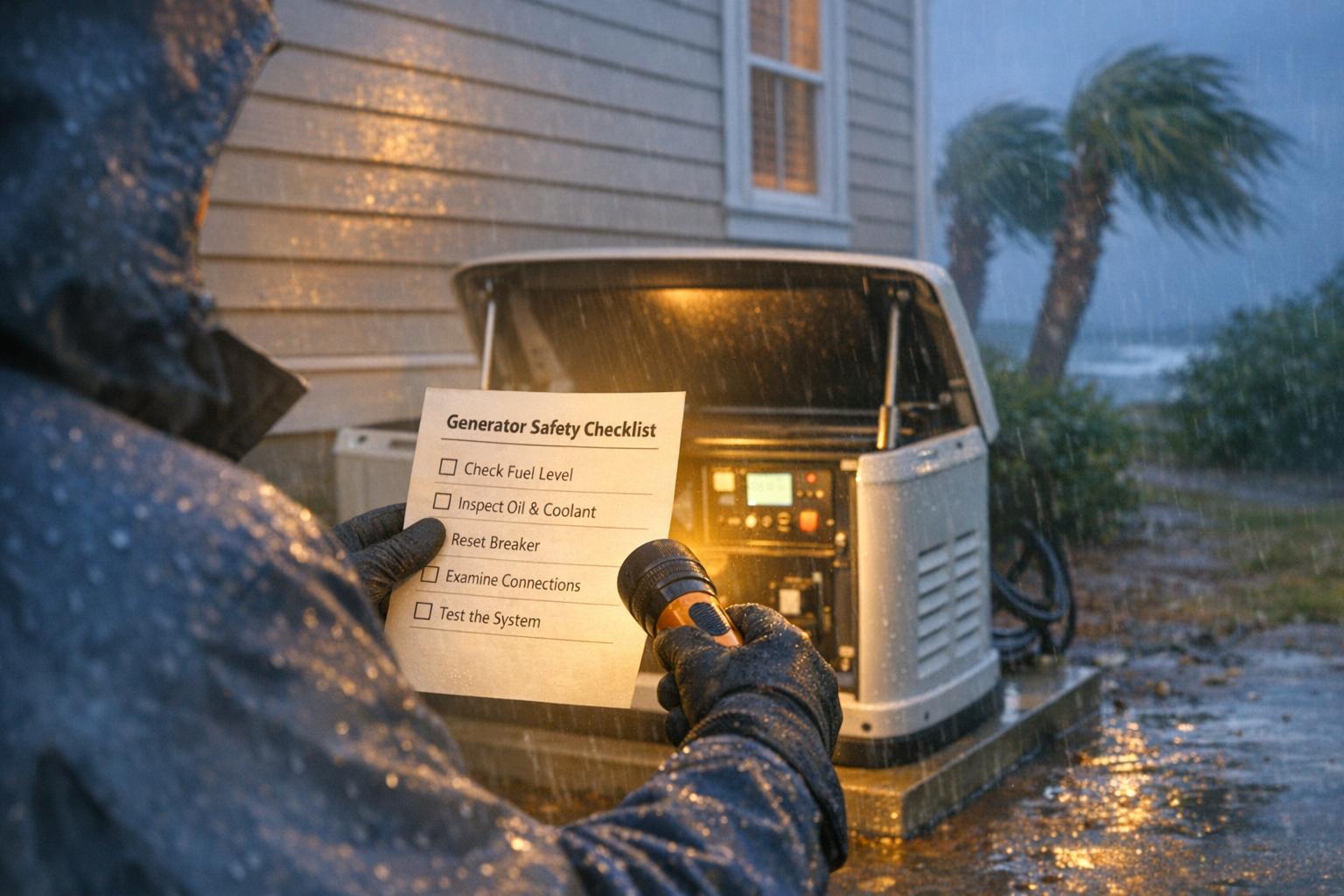
When your generator fails during a storm in Charleston, SC, safety and quick action are key. Here’s what you need to know:
- Start with safety checks: Inspect the area for hazards like downed power lines or flooding. Ensure the generator is in a safe, open location, away from enclosed spaces to prevent carbon monoxide risks.
- Check basics: Verify fuel levels, ensure the unit is set to "Auto", and inspect for visible damage or debris blocking vents.
- Troubleshoot common issues: Reset circuit breakers, clean battery terminals if corroded, and reduce appliance loads to avoid overheating.
- Avoid risky repairs: Don’t open internal panels or tamper with electrical components. Call a professional if error codes persist or if you notice unusual sounds, smells, or leaks.
Regular maintenance is the best way to avoid failures. Schedule annual inspections, run monthly tests, and prepare for hurricane season by May or June. If your generator still won’t work after basic troubleshooting, contact a certified technician to address deeper mechanical or electrical problems.
Stay safe, act quickly, and prioritize routine upkeep to ensure your generator is ready when storms hit.
Why Generators Fail During Charleston Storms
Charleston’s coastal environment creates unique challenges for generators, exposing them to salt-laden air, high humidity, and storm debris. As Billy Wingate, Master Electrician and Owner of WingatePower, explains:
"Salt air accelerates corrosion on enclosures and electrical terminals… Local data suggests generators in coastal areas like Charleston experience 15–20% higher failure rates compared to inland units".
This increased failure rate stems from moisture intrusion, which affects electrical connections, and storm debris – like leaves, twigs, and heavy pollen – that clogs air vents. These issues can cause engines to overheat and shut down automatically. Let’s explore the primary reasons generators fail during Charleston storms.
Fuel Supply Problems
One of the most common issues is fuel supply. Propane-powered generators often fail to start due to low or empty tanks. Additionally, propane can degrade after 30 days, cutting start reliability by 50%. To avoid this, experts recommend keeping propane tanks at least 30% full before a storm hits.
Natural gas systems, while typically dependable, have their own vulnerabilities. Service interruptions or storm debris blocking exterior shutoff valves can lead to fuel pressure problems. In these cases, the generator may start briefly but then shut down due to insufficient fuel flow.
Battery Failures
High humidity in Charleston’s coastal climate accelerates battery wear. Batteries in these environments often last only 2–3 years before needing replacement. A weak or dead battery is one of the most straightforward reasons a generator won’t start.
Overloads and Tripped Circuit Breakers
Overloading the generator by running too many appliances simultaneously can trip its circuit breakers, shutting down the system. Another potential issue is a malfunctioning automatic transfer switch (ATS), which is responsible for switching the power source during an outage. ATS problems account for 20–30% of residential generator service calls.
Physical damage caused by storms can also lead to electrical issues, further complicating generator operation.
Mechanical Problems and Storm Damage
Storm debris poses a significant threat to generators, as it can clog air vents and cooling systems, causing overheating. Flooding in Charleston’s low-lying areas can also damage internal electrical components. Generac offers this advice:
"Your generator needs some space for proper airflow… Clear away any obstructions (like trees, shrubs, bushes or snow) until your generator has at least three feet of clearance".
During prolonged outages, which are common during hurricane season, generators require close monitoring. Rapid oil consumption and clogged filters can cause failures if the system isn’t checked every 24 hours. Proper maintenance and preparation are critical to keeping generators running smoothly during storms.
sbb-itb-998eb83
Safety Checks Before You Start Troubleshooting
Before tackling any troubleshooting steps, take a moment to ensure the area is safe. Rushing to fix a generator during a storm without assessing potential risks can be dangerous. Between 2011 and 2021, at least 770 people in the U.S. lost their lives to carbon monoxide poisoning linked to portable generators. Safety should always be your top priority.
Check the Area for Storm Hazards
Begin by surveying the area around your generator from a safe distance. Look for downed power lines, which may be concealed under floodwater or debris. Avoid walking or driving through flooded zones, as they can hide live wires. Examine the generator pad for signs of flooding – water and electricity are a lethal combination.
Inspect the unit for anything blocking vents or cooling pathways, as such obstructions can lead to engine overheating. Check for loose panels, visible damage from flying debris, or signs of corrosion that may have resulted from storm exposure. Additionally, keep an eye out for animal nests or droppings near the generator, as pests often seek refuge in these areas during storms.
Confirm Fuel and Power Supply
Once the area is secure, check your fuel supply and power settings – without opening the generator enclosure. For propane-powered units, ensure the tank gauge reads above 30%, as fuel degradation after 30 days can significantly reduce the generator’s reliability. If you have a natural gas system, confirm that the service is active by testing other gas appliances in your home, like the stove or water heater. Make sure exterior gas shutoff valves are open.
Verify that the controller display is set to "Auto" rather than "Off" or "Manual". According to Billy Wingate, Master Electrician and Owner of WingatePower:
"Only simple, safe checks are appropriate DIY tasks – verifying fuel level, breaker position, the Generac status light, and confirming the unit is set to ‘Auto’ mode".
These straightforward checks can resolve 30% to 40% of no-start issues without needing professional assistance.
Keep the Generator Enclosure Closed
After addressing external hazards and fuel levels, keep the generator enclosure closed to safeguard its internal components. Never open the main housing or internal electrical panels during a storm. An open enclosure exposes sensitive components to rain, debris, and salt air, which can cause short circuits or permanent damage. Additionally, opening the unit during bad weather increases the risk of electric shock.
Limit your inspection to what can be observed from the outside, such as blocked vents, standing water, or loose panels. Many modern standby generators are equipped with a viewing window or external display for checking status lights and error codes without opening the housing. As Wingate emphasizes:
"Never open internal electrical panels, disconnect wiring, or attempt to bypass any Generac safety features. These tasks must be left to a certified technician".
Tampering with internal wiring not only bypasses safety features but can also void your manufacturer’s warranty.
How to Troubleshoot a Failed Generator
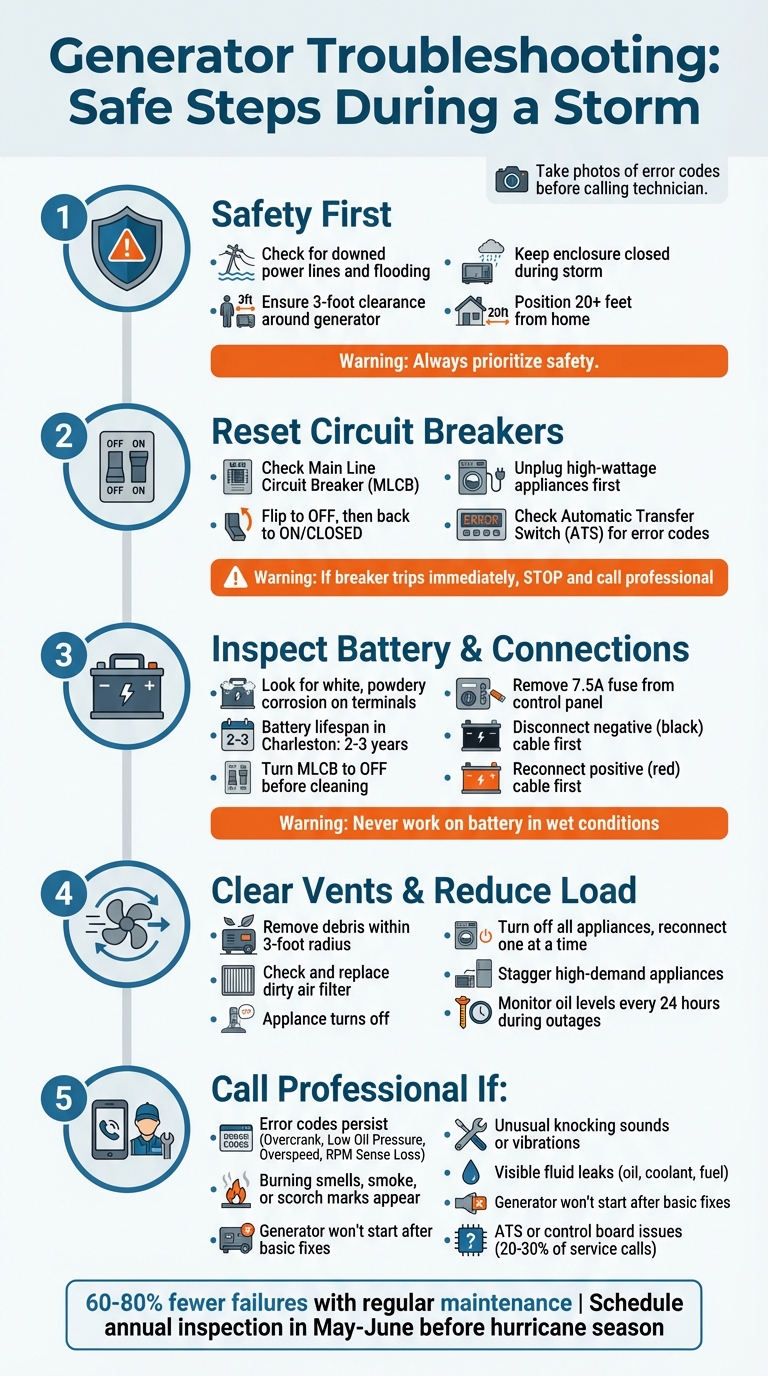
Generator Troubleshooting Steps During Charleston Storm Outages
Once you’ve confirmed basic safety measures, you can follow these steps to diagnose common generator issues. These focus on problems that homeowners can safely address during a storm. Work methodically to identify and resolve the issue.
Reset the Circuit Breakers
Start by checking two key areas: the generator’s Main Line Circuit Breaker (MLCB) and your home’s main electrical panel. If a breaker is in the "Open" position, flip it firmly to "OFF" to reset the mechanism, then switch it back to "ON" or "CLOSED".
Before resetting, unplug high-wattage appliances like HVAC systems or water heaters to prevent overloads. If the breaker trips immediately after resetting, stop troubleshooting – this could signal a short circuit or a faulty component that needs professional repair.
Additionally, check your Automatic Transfer Switch (ATS) for error codes. The generator’s digital controller may display messages such as "Overload" or "Voltage Regulation Fault." Relaying these details to a technician can speed up repairs.
If resetting the breakers doesn’t restore power, the issue may lie with the battery system.
Check the Battery and Connections
A weak or dead battery is one of the most common reasons for generator failure. In humid, salty environments like Charleston, batteries often last only 2–3 years before needing replacement. Inspect the battery terminals for white, powdery corrosion, which can disrupt electrical connections.
If corrosion is present and the weather is dry, you can clean the terminals. Start by turning the MLCB to OFF and pressing the OFF button on the control panel. Remove the 7.5A fuse from the control panel to prevent accidental starts. Always disconnect the negative (black) cable first, followed by the positive. When reconnecting, attach the positive (red) cable first, then the negative, and tighten the connections to 45–50 in-lbs. Be cautious not to bridge the battery posts with your wrench.
Avoid working on the battery in wet conditions. Handling a generator in rain or snow is extremely dangerous. If the control panel is completely dark or the generator fails its self-test, the battery may need replacement. Billy Wingate, a Master Electrician, emphasizes:
"A weak battery that could have been replaced for under $100 might leave your entire system dead during a hurricane".
Clear Air Vents and Reduce Appliance Load
Blocked air vents can cause overheating and power loss. Remove any debris, plants, or snow within a 3-foot radius of the generator to ensure proper airflow. Generac advises:
"Clear away any obstructions (like trees, shrubs, bushes or snow) until your generator has at least three feet of clearance".
If the generator is running but struggling, try reducing the electrical load. Turn off all connected appliances and reconnect them one at a time to pinpoint any that may be overloading the system. High-demand appliances like refrigerators or sump pumps should be staggered rather than operated simultaneously. Remember, some devices require up to three times more power to start than to run continuously.
Also, check the air filter. A clogged filter can restrict airflow and lower engine performance. Replace it if it appears dirty. During prolonged outages, monitor oil levels every 24 hours and check coolant levels in standby units. Low coolant can lead to overheating during extended use.
When to Call ALL Plumbing Services for Professional Help

Repeated Errors or Malfunctions
Seeing the same error codes over and over? That’s a clear sign it’s time to bring in the pros. If your generator’s controller displays fault codes like "Overcrank", "Low Oil Pressure", "Overspeed", or "RPM Sense Loss," it’s not something you can fix with basic troubleshooting. These codes often point to deeper mechanical or electrical problems that require specialized tools to diagnose and repair.
And it’s not just error codes that should catch your attention. If you notice flickering lights, burning smells, smoke, scorch marks, or excessive heat coming from your generator, shut it down immediately. Other red flags include unusual knocking sounds, strong vibrations, or visible fluid leaks (like oil, coolant, or fuel). These are all signs that you need professional help – fast.
Billy Wingate, a Master Electrician and Plumber, emphasizes the importance of acting quickly:
"Delaying necessary repairs can turn small issues like weak batteries or clogged filters into major failures right when a power outage hits your neighborhood".
Here’s a tip: Before calling for help, take a quick photo or video of the error codes on your generator’s display. This small step helps technicians arrive better prepared, speeding up the repair process. If the issues persist despite your initial checks, the root cause is likely more complex and requires expert attention.
Generator Still Won’t Work After Basic Fixes
If you’ve tried all the basic fixes – like making sure the generator is in "Auto" mode, checking the fuel supply, resetting breakers, and inspecting battery connections – but it still won’t start, you’re likely dealing with a more serious internal issue. Problems with the automatic transfer switch (ATS), control board, or voltage regulator are often to blame. In fact, these components account for 60–70% of stubborn no-start cases and are best left to professionals.
Transfer switch failures alone make up 20% to 30% of residential generator service calls. These high-voltage parts are not only tricky to repair but also pose serious safety risks, including electrical shock. Plus, attempting DIY repairs on these components could void your manufacturer’s warranty, which often covers parts for 5 to 10 years.
Complete Storm-Preparedness Plans
Generator repairs are just one piece of the puzzle when it comes to storm preparedness, especially for homes in coastal areas. ALL Plumbing Services offers maintenance plans that go beyond generators to address other critical systems. These plans can help prevent common issues like sump pump failures, water heater damage, and pipe corrosion, which are especially problematic in Charleston’s humid, salty air.
Investing in an annual maintenance plan ($200–$400) can save you big money – up to $1,000 or more – by avoiding major repairs like alternator or injector replacements. Regular maintenance also cuts the risk of generator breakdowns by 60% to 80%. To stay ahead of hurricane season, schedule your pre-storm inspection in May or June, before the Atlantic hurricane season reaches its peak.
How to Prevent Generator Failures in Charleston, SC
Keeping your generator in top shape is essential for ensuring your home stays powered during Charleston’s stormy weather. Beyond troubleshooting, consistent upkeep is key to avoiding breakdowns when you need your generator the most.
Schedule Regular Maintenance
Year-round care is a must for your generator. Professional inspections, ideally once a year, should include oil and filter changes, air filter and spark plug replacements, and battery voltage checks. Keeping detailed service records can also protect your warranty claims.
Charleston’s coastal environment poses unique challenges, like accelerated corrosion and battery wear. Professionals can spot issues like salt buildup, moisture intrusion, and pest damage – problems that often go unnoticed by homeowners.
Generators on a regular maintenance schedule are far more reliable, with 60% to 80% fewer failures than neglected units. Routine care can also extend your generator’s lifespan to 15–20 years, compared to just 10 years for poorly maintained systems.
Run Monthly Tests and Get Hurricane-Ready
Testing your generator monthly under load for about 30 minutes is crucial. Use appliances like a space heater or refrigerator during these tests to circulate oil, keep fuel fresh, and confirm battery strength.
As hurricane season approaches – starting June 1st – schedule a professional tune-up in May or early June. Check your fuel levels during this time. For propane users, keep tanks at least 30% full since fuel degradation can cut starting reliability by up to 50% after just 30 days. If you rely on gasoline, replace old fuel every few months and use a stabilizer to prevent carburetor issues. Many Charleston residents prefer propane because it stores indefinitely and isn’t affected by municipal gas supply interruptions during storms.
These monthly tests and pre-season preparations work hand-in-hand with annual maintenance to keep your generator reliable during hurricane season.
Use Maintenance Plans for Peace of Mind
ALL Plumbing Services offers maintenance plans that cover generators as well as other storm-sensitive systems like sump pumps, water heaters, and exposed pipes.
Annual plans, typically priced between $200 and $400, can save you significant costs by addressing small problems before they escalate. For example, catching an issue early can help you avoid major repairs like alternator replacements (over $2,000) or injector servicing ($500–$800). Another perk? Plan members get priority service during peak storm seasons. After hurricanes, when repair requests jump by 300% to 400%, maintenance plan members receive faster appointments.
| Maintenance Task | Frequency | What It Does |
|---|---|---|
| Oil & Filter Change | Annually or every 50–100 hours | Reduces engine wear and overheating |
| Battery Testing | Every 6 months | Ensures the unit starts during power outages |
| Spark Plug Replacement | Every 300 hours | Maintains engine efficiency and reliable ignition |
| Enclosure Inspection | Annually | Detects salt corrosion and pest damage |
| Transfer Switch Test | Annually | Verifies safe switching to backup power |
Between professional visits, make sure there’s at least three feet of clear space around your generator. Clear away shrubs, debris, and pollen to maintain proper airflow. If you live in a flood-prone area, consider installing your generator on an elevated platform. While custom wooden platforms cost around $3,000, they can keep your generator functional during storm surges.
Conclusion
When your generator fails during a Charleston storm, safety should always come first. Keep the unit out of wet or enclosed spaces, and position it at least 20 feet from your home to avoid carbon monoxide risks. Start troubleshooting by checking fuel levels, breakers, and ensuring the generator is set to "Auto" mode. If issues persist or you encounter repeated fault codes, burning smells, or unusual noises, stop immediately and call a certified technician.
Routine checks and maintenance play a key role in keeping your generator ready for storms. Regular upkeep can cut down the chances of breakdowns by as much as 80% while also extending the unit’s lifespan. Schedule annual inspections and monthly tests – especially ahead of hurricane season in May or June – to ensure your generator stays dependable. During extended outages, check oil levels daily and maintain a three-foot clearance around the unit for safe operation.
ALL Plumbing Services offers storm-preparedness plans that cover generators, sump pumps, water heaters, and other systems at risk during Charleston’s severe weather. Their regular service and annual maintenance plans can help reduce emergency repair costs and keep your systems running smoothly when you need them most. Plus, plan members get priority service, which is critical when repair requests surge by 300% to 400% after major storms.
Being prepared ahead of time is the best way to protect your home and keep it powered when storms hit. Take action now to stay safe and ready.
FAQs
How can I tell if my transfer switch is the problem?
If you suspect your transfer switch is behind your generator troubles, start by checking the manual handle. Make sure it’s set correctly to either utility power or generator power, depending on your needs. If the handle feels stuck or the switch doesn’t function properly during a power outage, it could indicate an issue. A faulty transfer switch often fails to properly shift power between the utility and the generator, disrupting the system’s operation.
What should I power first to avoid overloading my generator?
To make the most of your generator during a storm, focus on powering essential appliances such as refrigerators, medical devices, and lighting. These can be connected directly to the generator or through a proper transfer switch. Prioritizing critical devices ensures that vital systems keep running smoothly while reducing the risk of overloading your generator.
What storm prep should I do the day before a hurricane?
Getting ready for a hurricane means taking steps to protect your home and ensuring you have the essentials to stay safe. Here’s what you should do:
- Check Your Generator: Make sure your generator is in working condition and that you have the necessary keys and instructions handy. A functional generator can be a lifesaver if the power goes out.
- Secure Your Home: Set your refrigerator and freezer to the coldest settings to keep food fresh longer in case of a power outage. Fill bathtubs with water for washing or flushing toilets, and turn off propane tanks as a safety measure.
- Unplug and Charge: Unplug small appliances to avoid potential damage from power surges. Fully charge your phones and portable chargers so you can stay connected during the storm.
- Stock Up on Supplies: Gather emergency supplies like flashlights, batteries, non-perishable food, water, medications, and a first aid kit. Being prepared can make a big difference if you’re stuck indoors for an extended period.
- Review Your Emergency Plan: Go over your evacuation routes and ensure everyone in your household knows the plan. Stay updated on storm developments through reliable news sources or weather apps.
Taking these precautions can help you weather the storm more safely and with less stress.