Tankless water heaters are becoming a popular choice for Bluffton homeowners, and here’s why:
- Lower Energy Bills: These systems heat water only when needed, reducing energy use by 24%–34% for smaller households and up to 14% for larger ones. This can save families over $100 annually.
- Endless Hot Water: Unlike tanks that run out, these units provide a steady supply of hot water for back-to-back showers or simultaneous use across appliances.
- Space-Saving Design: Wall-mounted and compact, they free up utility space, making them ideal for homes with limited room.
- Longer Lifespan: Lasting 20–25 years, nearly double the lifespan of tank models, they offer better long-term value.
- Durability in Hard Water Areas: With proper maintenance, they resist buildup and scaling, common issues in Bluffton’s hard water.
If you’re tired of high energy costs, running out of hot water, or bulky tanks taking up space, a tankless water heater might be the right upgrade for your home.
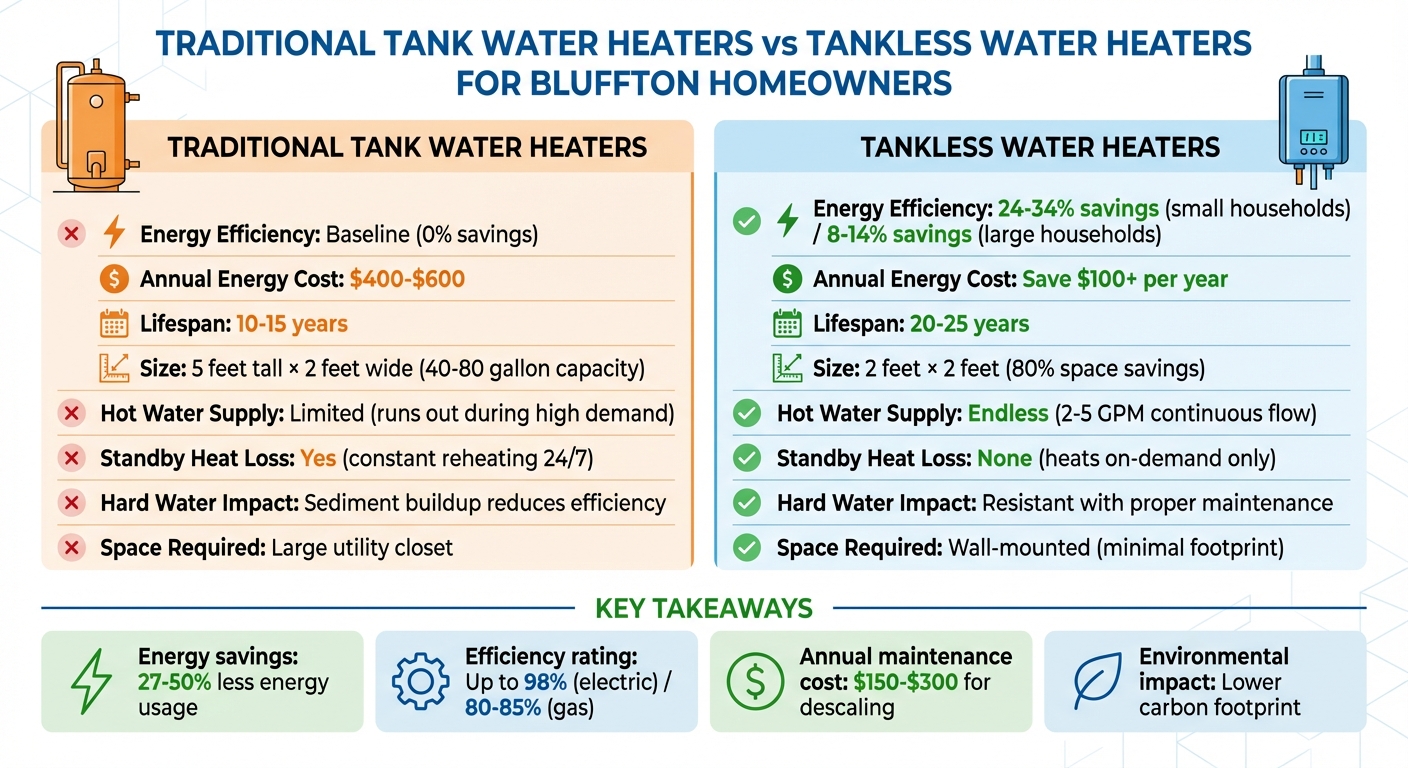
Traditional vs Tankless Water Heaters: Cost, Efficiency, and Lifespan Comparison
Water Heating Problems in Bluffton Homes
In Bluffton, traditional water heaters are becoming a growing concern for homeowners due to their impact on budgets, energy consumption, and space. This has led many to explore tankless systems as a better alternative.
High Utility Bills and Energy Waste
Traditional water heaters hold 40–80 gallons of water and keep it hot around the clock, even when it’s not being used. This constant reheating – called standby heat loss – is a major energy drain that inflates utility bills.
Bluffton’s hard water compounds the issue by accelerating sediment buildup inside the tank. This sediment forces the heater to work harder, especially during colder months, leading to inefficiencies. Over time, typically 8–12 years, corrosion and sediment buildup can significantly reduce performance, costing homeowners between $400 and $600 annually. Beyond the financial impact, this inefficiency also means less hot water is available when you need it.
Running Out of Hot Water
Another common frustration with traditional water heaters is running out of hot water. Sediment buildup reduces the tank’s capacity and heating efficiency, leaving less usable hot water.
"Accumulated sediment leaves less space for hot water, which is why you run out of it fast. It’s a clear symptom of your hot water heater going bad." – Constellation
For families, this problem becomes even more apparent as daily demand increases. A tank that once worked fine may struggle to keep up with frequent use – up to 20 times a day. On top of that, issues like broken dip tubes or faulty thermostats can make matters worse, resulting in lukewarm water instead of the hot water you expect.
Space Limitations in Bluffton Homes
Traditional water heaters are not just inefficient – they also take up a lot of space. A standard 50-gallon tank can dominate an entire utility closet, and newer models with thicker insulation are even bulkier. In Bluffton’s newer homes and renovations, where every square foot matters, this can be a big drawback. The space used by a large water heater could often be better utilized for storage or other purposes. Additionally, these tanks require solid flooring and enough clearance for maintenance, further limiting where they can be installed.
sbb-itb-998eb83
Benefits of Tankless Water Heaters
Tankless water heaters tackle common household challenges like high energy costs, running out of hot water, and tight spaces. Instead of storing water in a tank, these systems heat water on demand as it flows through the unit, delivering hot water almost instantly.
Continuous Hot Water Supply
Say goodbye to running out of hot water. Unlike traditional 40- or 50-gallon tanks that can empty during back-to-back showers, tankless systems use a heat exchanger to provide a steady supply of hot water, typically delivering 2–5 gallons per minute. For larger households in Bluffton, where multiple showers or appliances might be running at the same time, additional units or point-of-use heaters can handle the extra demand.
"Tankless water heaters have a lot going for them. They’re also a great choice for homes with limited space, plus, you never run out of hot water, which is great for larger households." – Myles Robinson, Home Expert
This design ensures a reliable flow of hot water even during peak usage. Plus, since water isn’t stored in a tank, there’s less risk of sediment or bacteria buildup.
Lower Energy Bills
Tankless systems are designed to eliminate standby heat loss, making them 24%–34% more energy-efficient for homes that use 41 gallons of water or less daily. This translates to monthly energy savings of 20%–30%, with typical families saving over $100 annually. For households with higher water usage, efficiency gains of 8%–14% are still achievable.
The U.S. Department of Energy highlights these benefits:
"Tankless water heaters, also known as demand-type or instantaneous water heaters, provide hot water only as it is needed. They don’t produce the standby energy losses associated with storage water heaters, which can save money."
Electric models achieve efficiency levels of 98% or higher, while gas-fired options range from 80%–85%. These systems also boast a lifespan of 20 years or more – nearly double the 10–15 years of traditional tanks – cutting replacement costs over time.
Compact Size Saves Space
Traditional 50-gallon water heaters can take up significant room, measuring about 5 feet tall by 2 feet wide. By comparison, tankless units are wall-mounted and typically measure around 2 feet by 2 feet, saving up to 80% of the space. This compact design reduces the risk of water damage and fits perfectly under sinks, inside cabinets, or on exterior walls – ideal for Bluffton’s warm climate.
Freeing up utility space means you can use that area for storage, additional appliances, or other purposes, making tankless systems a practical choice for modern homes.
Choosing the Right Tankless Water Heater for Your Bluffton Home
To enjoy the benefits of a tankless water heater, it’s important to pick the right model tailored to your needs.
Sizing Based on Household Demand
When choosing a tankless water heater, size matters. Start by calculating the flow rates of the fixtures you’ll use at the same time. For example:
- A shower head typically uses 2.5–3.0 GPM.
- A kitchen faucet uses about 0.5–1.5 GPM.
- A dishwasher requires around 1.0–2.0 GPM.
Add these together to determine your required capacity. If you’re running a 2.6 GPM shower and a 0.75 GPM faucet simultaneously, you’ll need a unit with a minimum capacity of 3.35 GPM.
Temperature rise is another key factor. In Bluffton, groundwater temperatures usually hover between 50°F and 55°F. To reach the standard 120°F output, your water heater will need to handle a temperature rise of about 65°F to 70°F.
Gas vs. Electric Models
The choice between gas and electric models depends on your household’s needs and setup:
- Gas models: These provide higher flow rates, making them ideal for homes with higher water demand. However, they require specialized venting systems and gas line connections.
- Electric models: Easier to install and highly efficient (up to 98%), electric units are a good option for homes without access to natural gas. Keep in mind, though, that they may require upgrades to your electrical panel to handle the increased amperage.
"If you have a large household with high demand, a gas tankless water heater is likely your best bet." – Jeff O’Hara, Nick’s Plumbing
Given Bluffton’s hard water, installing a water filtration or softening system alongside your tankless unit is a smart move to protect it from mineral buildup.
Professional Installation and Local Plumbing Codes
Proper installation is critical – not just for safety but also for protecting your warranty. Manufacturers often void warranties if the installation isn’t handled by a licensed professional. Mistakes during installation can lead to gas leaks, electrical hazards, and code violations.
"Water heater installation should always be handled by a licensed plumber. Improper installation can lead to code violations, safety hazards, or damage to your home." – R.S. Andrews
In South Carolina, professional plumbers – like those at ALL Plumbing Services – ensure installations meet local building codes. This includes correctly sizing gas lines, ensuring proper venting clearances, and meeting electrical bonding requirements. For homes in areas like Palmetto Bluff, where slab foundations are common, experts use advanced leak detection tools to manage complex installations without causing structural issues. They’ll also check if your gas meter or electrical panel needs an upgrade before starting the job.
Long-Term Advantages and Maintenance for Bluffton Homeowners
Durability and Lifespan
Tankless water heaters are built to last significantly longer than traditional tank models. When properly maintained, these systems can provide reliable hot water for decades. One reason for their longevity is their design, which reduces exposure to water-based corrosion. Todd Bradbury, Overseer of Retail Operations at Bradbury Brothers, highlights this advantage:
"Tankless water heaters are less exposed to water-based corrosion than regular water heaters, which are exposed to moisture 24/7".
Unlike traditional models that store water constantly, tankless units heat water only when needed. This on-demand approach minimizes wear and tear. Another plus? Many tankless systems have replaceable parts, so you can extend their lifespan without replacing the entire unit. However, Bluffton homeowners need to be cautious of the area’s hard water, which can lead to mineral buildup and scaling. If left unchecked, this could shave two or more years off the unit’s lifespan. Still, the long-lasting nature of these systems also means they have a lower environmental footprint over time.
Eco-Friendly Benefits
For homeowners aiming to reduce their energy usage, tankless water heaters offer a clear advantage. By eliminating the need to keep a large tank of water constantly heated, these systems use 27% to 50% less energy than traditional models. High-efficiency tankless units can reach energy factors of up to 95, meaning nearly all the fuel they consume is converted into usable heat. This translates into significant monthly energy savings and aligns with sustainability goals.
Routine Maintenance for Best Performance
To enjoy these long-term benefits, regular maintenance is a must – especially in Bluffton, where hard water can pose challenges. An annual system flush helps remove mineral deposits and sediment that can build up in the heat exchanger. This routine step prevents scale from damaging internal components and keeps the system running efficiently.
"The best way to extend your water heater’s service life is with regular maintenance to keep it clean and operating at peak efficiency." – R.S. Andrews
Installing a water softener or filtration system can further protect your tankless unit by reducing the scale before it even forms. Be on the lookout for signs like low water pressure, strange noises, or unexpected increases in utility bills – these could indicate it’s time for professional servicing.
For routine upkeep, consider reaching out to ALL Plumbing Services. Their licensed experts can handle annual inspections, ensure compliance with local plumbing codes, and address minor issues before they turn into costly problems. Professional descaling services typically range from $150 to $300 per year, a worthwhile investment to keep your system running smoothly for decades.
Conclusion
Bluffton faces some unique challenges when it comes to water heating, but tankless water heaters stand out as a smart solution. By heating water only when you need it, these systems cut out standby energy loss, provide an endless supply of hot water, and save space with their sleek, wall-mounted design.
On top of that, they can trim energy costs by 27% to 50%, potentially saving you over $100 annually. With a lifespan of 20 to 25 years – almost double that of traditional water heaters – they offer long-term value. Even in Bluffton’s hard water conditions, regular descaling (which typically costs $150 to $300) and professional installation keep them running smoothly and up to code.
If you’re ready for lower energy bills, unlimited hot water, and more space, ALL Plumbing Services has you covered. Their licensed professionals handle everything from selecting the right size to installation and ongoing maintenance, ensuring your system stays efficient for years. Whether you’re in Bluffton or Palmetto Bluff, their team understands the specific water heating needs of the Lowcountry.
Make the switch to a tankless water heater for efficiency, consistent hot water, and lasting comfort.
FAQs
How do tankless water heaters help lower energy bills compared to traditional water heaters?
Tankless water heaters are designed to heat water only when you need it, unlike traditional models that keep a storage tank of water heated constantly. This on-demand system eliminates standby energy loss, which can lead to noticeable savings on your utility bills. In fact, these systems can boost energy efficiency by 27%–50%, depending on how much hot water your household uses.
Since they use less energy overall, tankless water heaters not only help lower your expenses but also make your home more environmentally friendly. Over time, the money saved on energy bills can help balance out the upfront cost, making these systems a practical option for many homeowners.
What kind of maintenance does a tankless water heater need in Bluffton’s hard water conditions?
In places like Bluffton, where hard water is common, keeping your tankless water heater in good shape requires regular upkeep. Mineral buildup, primarily from calcium and magnesium, can impact efficiency and even cause damage over time. To combat this, annual descaling is essential. This process involves flushing the system with a solution, such as white vinegar or a commercial descaler, to clear out those deposits. If the water is particularly hard, you might need to do this more than once a year.
It’s also smart to schedule a yearly professional inspection. During this checkup, a technician will examine key components like the heat exchanger, burners, sensors, and valves. They’ll also clean the cold-water inlet filter and air intake screen to maintain proper flow and efficiency. Many Bluffton homeowners go a step further by installing a water softener or filtration system. These systems reduce the mineral content in the water before it reaches the heater, which can significantly extend its lifespan.
By sticking to these maintenance practices, you can keep your tankless water heater running smoothly and ensure it performs reliably, even in the face of hard water challenges.
What should I consider when deciding between a gas and electric tankless water heater?
When deciding between a gas or electric tankless water heater, start by evaluating your home’s fuel options and installation requirements. Gas models need access to a natural gas or propane line and proper venting, which can drive up installation costs. In contrast, electric heaters only require a high-capacity electrical circuit, making them a simpler choice for homes without gas connections.
Next, weigh the cost and energy efficiency of each option. Gas units usually have a higher upfront price but can be more economical in areas where natural gas is inexpensive. Electric models are often less expensive to buy but might result in higher operating costs if electricity rates in your area are steep. Gas heaters generally perform better in colder climates and offer higher flow rates, while electric ones are smaller, easier to maintain, and more space-efficient.
Lastly, think about your household’s hot water demands and long-term plans. Gas heaters typically have a longer lifespan (20–25 years) compared to electric units (15–20 years) and can handle larger water usage more effectively. On the other hand, electric models are a practical option for smaller households or anyone looking for lower maintenance. By considering these factors, you’ll be able to choose the right water heater for your home and budget in Bluffton.