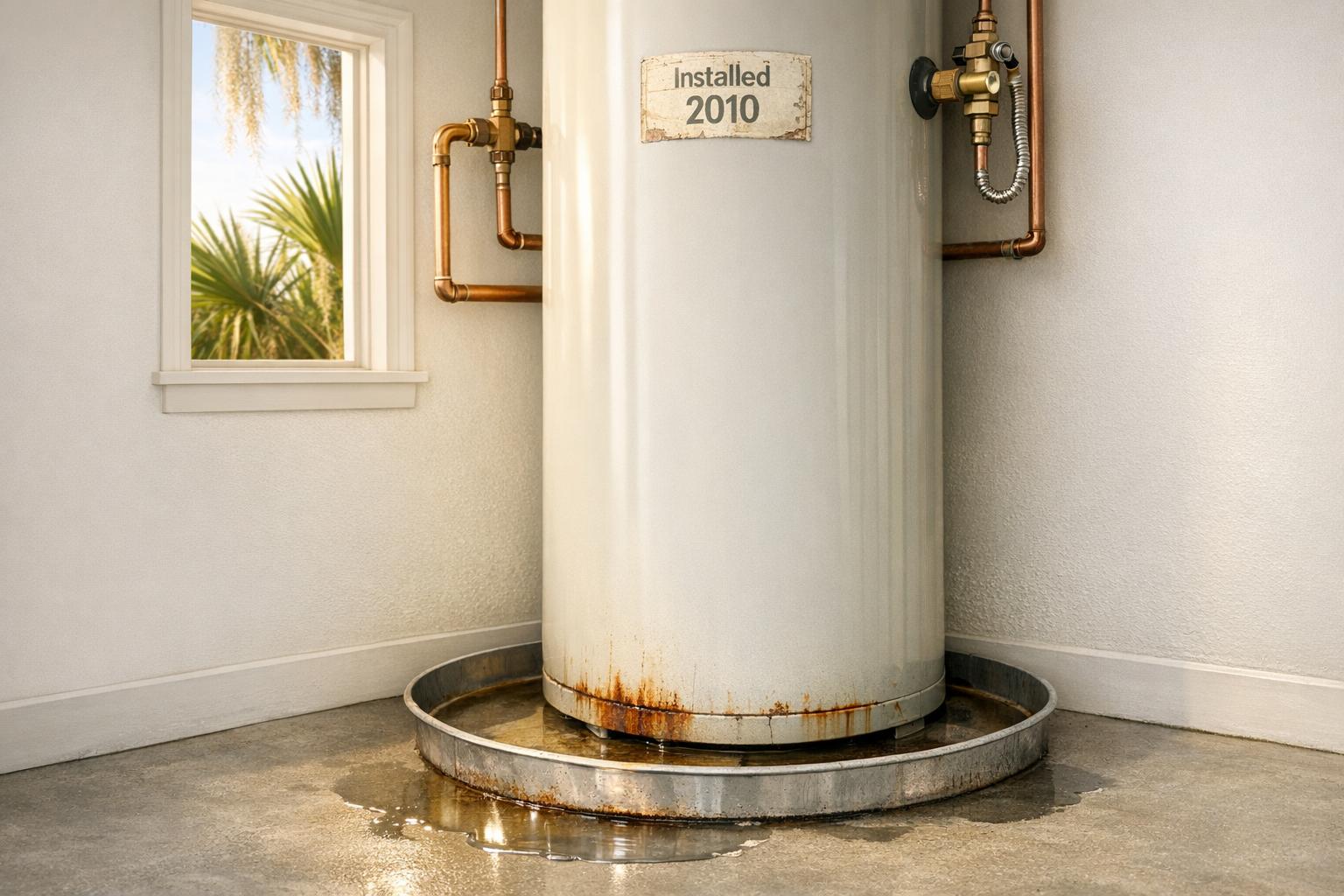
Your water heater won’t last forever, especially in James Island, SC, where salty air, high humidity, and hard water can speed up wear and tear. Here’s how to know when it’s time for a replacement:
- Age: Most tank water heaters last 8–12 years, while tankless models can go up to 20. If yours is over 10 years old, start planning for a replacement.
- Leaks: Water pooling around the unit or leaking from the tank is a serious sign. If it’s the tank itself, repairs are rarely possible.
- Rusty Water: Discolored or rusty hot water often signals internal corrosion, especially if the anode rod is depleted.
- Noises: Popping or banging sounds indicate sediment buildup, which reduces efficiency and can damage the tank.
- Temperature Issues: Lukewarm water, inconsistent temperatures, or long recovery times could mean your heater is failing.
Quick Tip: If repairs cost more than 50% of a new unit, replacement is often the smarter choice. Upgrading to a modern, energy-efficient water heater can save you money on utility bills and eliminate the hassle of unexpected breakdowns.
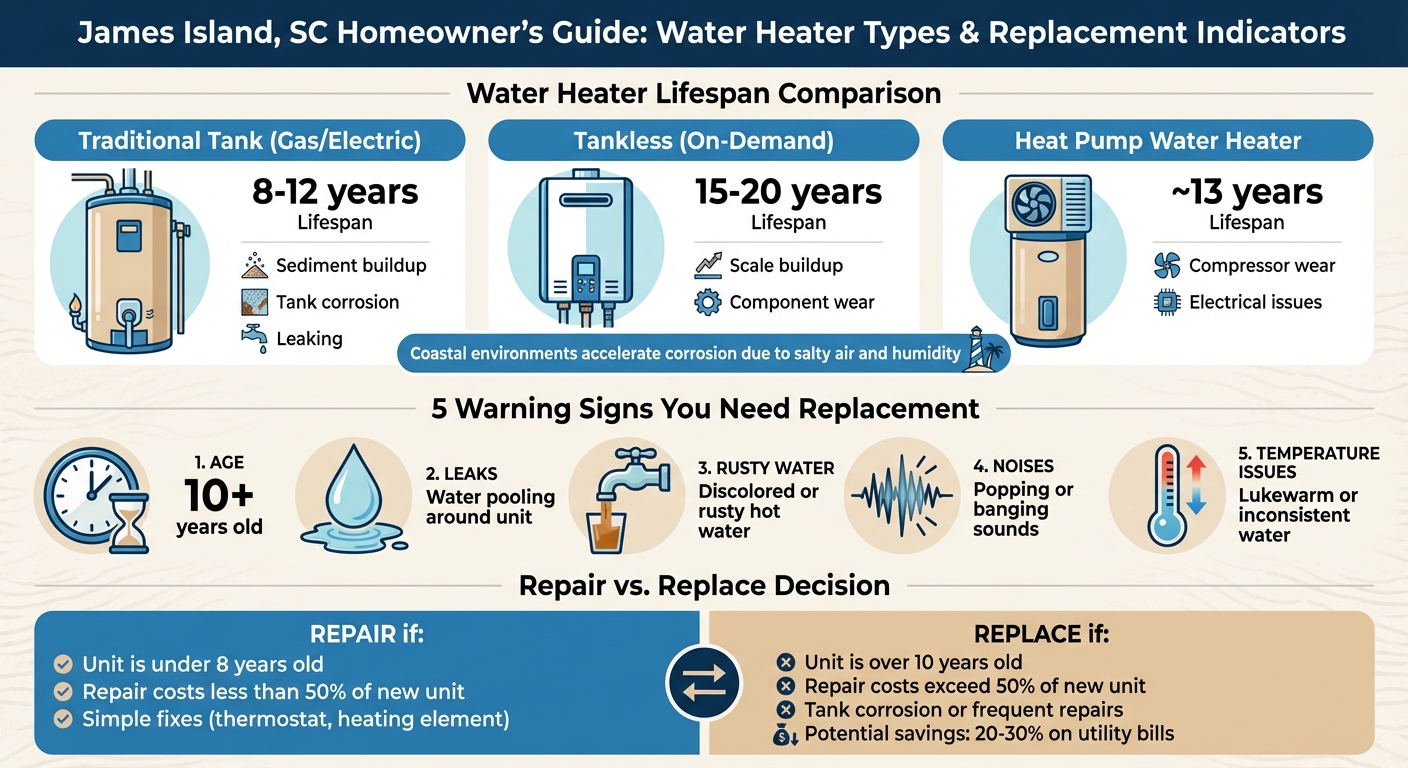
Water Heater Lifespan and Replacement Signs Comparison Chart
How Age Affects Your Water Heater
Expected Water Heater Lifespan
The age of your water heater is one of the clearest indicators of when it’s time to think about a replacement. On average, traditional tank-style water heaters last about 8 to 12 years, while tankless models can keep going for 15 to 20 years if maintained properly.
To determine your water heater’s age, look for the manufacturer’s sticker on the upper part of the tank. The serial number usually contains the manufacture date – for example, "A10" would mean January 2010. Keep in mind that not all manufacturers use the same format, so you may need to check their website or use tools like the Building Intelligence Center’s decoder for clarification.
"If your water heater is more than 10 years old – it is time to consider replacing it before you’re left with an emergency decision", advises Nate Jutras from ENERGY STAR.
On James Island, the coastal environment adds an extra layer of stress to water heaters. The salty air, high humidity, and mineral-heavy water speed up corrosion on both the outside and inside of the unit. This means water heaters in such areas often have a shorter lifespan. If your unit is nearing 8 years old, it’s wise to start planning for a replacement now to avoid the hassle and expense of an emergency breakdown.
As water heaters age, their performance declines steadily, leading to a range of efficiency and reliability problems.
Problems That Develop with Age
Older water heaters face a variety of issues that can impact their efficiency and functionality. Beyond the challenges of environmental factors, the natural wear and tear of time takes its toll.
One major issue is sediment buildup. Over time, minerals from hard water settle at the bottom of the tank and harden, forming a layer that insulates the heating element. This reduces the unit’s efficiency and makes it harder to heat water.
Another common problem is internal corrosion. The tank’s protective anode rod is designed to corrode first to protect the tank itself. Once this rod is fully depleted, the tank begins to rust from the inside. This often leads to rusty or discolored water and, eventually, structural damage like cracks or leaks.
As sediment accumulates and components age, the water heater requires more energy to maintain the desired temperature, which can drive up utility bills. Additionally, critical parts like heating elements, thermostats, and valves wear out over time, causing inconsistent temperatures and slower recovery times.
| Water Heater Type | Expected Lifespan | Primary Aging Issues |
|---|---|---|
| Traditional Tank (Gas/Electric) | 8–12 Years | Sediment buildup, tank corrosion, leaking |
| Tankless (On-Demand) | 15–20 Years | Scale buildup, component wear |
| Heat Pump Water Heater | ~13 Years | Compressor wear, electrical issues |
sbb-itb-998eb83
Water Temperature Problems
Why Your Water Temperature Changes
If you’ve been dealing with lukewarm showers or sudden cold bursts, your water heater might be struggling to keep up – something that’s not uncommon in places like coastal James Island.
One common culprit is sediment buildup. Over time, minerals settle at the bottom of the tank, creating an insulating layer that blocks heat transfer, making it harder for your water heater to do its job effectively.
Another issue could be a faulty thermostat. When the thermostat can’t accurately sense the water’s temperature, it might shut off the heating cycle too soon. For electric models, a burned-out heating element could be the problem, preventing the heater from producing any heat. Gas models, on the other hand, might face challenges like low gas flow or a burner that shuts off prematurely.
Sometimes, the problem isn’t with the heater itself. Running multiple appliances that use hot water at the same time can overload the system, causing noticeable drops in temperature. If you’re also seeing rusty or discolored water, it could point to internal corrosion – a sign that your water heater might need replacing.
These temperature issues can help you decide whether a quick fix will do the trick or if it’s time to consider a replacement.
When to Repair vs. Replace
Temperature problems don’t always mean you need a new water heater. Repairs can often extend the life of your unit, especially if it’s relatively new.
For units under eight years old, repairing parts like thermostats (costing between $150 and $300) or heating elements ($200 to $300) can solve most issues. Regular maintenance, like flushing the tank annually, can also help prevent sediment buildup and keep your heater running smoothly.
However, there comes a point when repairs might not be worth the cost. If your water heater is over 10 years old or the cost of repairs exceeds 50% of the price of a new unit, replacing it is likely the better option. As A.O. Smith explains:
"If your water heater is more than 10 years old, leaks around the base of the tank or operates erratically, it’s probably time to replace your water heater."
Signs that replacement is the smarter choice include frequent repairs, ongoing temperature issues, or rusty water. Upgrading to a modern, energy-efficient water heater can save you money in the long run, improving efficiency by 20% to 30% annually while eliminating the hassle of unpredictable water temperatures.
Leaks and Water Damage
What Causes Water Heater Leaks
Leaks are often a clear warning sign that your water heater needs attention – or even replacement. If you notice water pooling around the unit, it’s time to investigate.
One major cause is tank corrosion. Inside your water heater, an anode rod works to prevent rust by attracting corrosive elements. But over time, this rod wears out, allowing rust to eat through the tank lining. Once corrosion sets in, leaks are inevitable, and the damage is usually beyond repair.
Another common issue is sediment buildup, especially in areas like James Island, where hard water is prevalent. Minerals from the water settle at the bottom of the tank, creating hot spots that weaken the metal over time. These weakened areas can crack, leading to leaks. Additionally, excessive pressure or thermal expansion can stress the tank, causing leaks at the temperature and pressure (T&P) valve.
Not all leaks spell disaster, though. Some may come from fittings or connections – like loose pipes, a faulty drain valve, or corroded points at the top of the unit. These types of leaks are often repairable. The key is figuring out whether the problem lies in a replaceable component or the tank itself.
Understanding these causes can help you determine whether a simple fix will do or if it’s time for a full replacement.
When Leaks Mean Replacement
If water is leaking from the tank body or pooling at the base, it’s a strong indicator that your water heater is beyond saving. Licensed plumber Aaron Stickley explains:
"If the tank has ruptured and is leaking, the water heater cannot be fixed and it must be replaced."
The location of the leak can help you diagnose the problem. Leaks from the top of the unit might be as simple as tightening a fitting or replacing a connection. Similarly, a leaking T&P valve can often be swapped out. However, if the water is coming from the bottom or directly from the tank, it’s usually a sign of internal corrosion or cracks, which can’t be safely repaired.
The age of your water heater also plays a role. Units over 10 years old that start leaking are typically more cost-effective to replace than repair. A.O. Smith emphasizes this point:
"A water leak coming from the base of the heater is often the first indication of a serious problem… it’s usually more practical and cost-effective to replace than repair."
If you discover a leak, act quickly. Shut off the water supply at the cold water inlet valve and turn off the power or gas to the unit. Then, call a professional to assess the situation. Delaying action could lead to flooding and costly water damage.
Strange Noises and Sediment Problems
If your water heater is making loud popping, boiling, or gravel-like sounds, sediment buildup from James Island’s hard water may be the culprit. Minerals like calcium and magnesium, common in hard water, settle at the bottom of the tank over time. When water gets trapped beneath this hardened layer, it heats up, turns to steam, and bursts through the sediment, causing those distinct popping and banging noises. Home repair expert Timothy Dale explains:
"The sound is created when steam bubbles form under the sediment and burst as the water heats up."
A hissing or sizzling noise, on the other hand, often means the lower heating element is buried in sediment.
These unusual noises, like earlier signs of temperature issues or leaks, often indicate that your water heater is nearing the end of its usable life.
How Sediment Reduces Efficiency
Sediment buildup doesn’t just create noise – it also impacts your water heater’s efficiency. Acting like an insulating barrier, sediment forces the heater to work harder. In severe cases, a 50-gallon tank may only provide 35-40 gallons of hot water. Additionally, the buildup can create hot spots that weaken the tank over time. Tommy Stricklin, Chief Water Specialist at Springwell Water, highlights the risks:
"Sediment in water poses a grave threat to a water heater’s performance, efficiency, and lifespan, causing issues from weird sounds and less warm water to increased energy usage and reduced water flow."
Excessive sediment can even cut your water heater’s lifespan in half.
When Flushing Won’t Fix the Problem
Flushing your water heater regularly can help remove loose sediment and improve its performance. However, if flushing doesn’t stop the noises, it’s a sign that the sediment has hardened and permanently damaged the tank lining. Holy City Heating & Air, LLC explains the consequences:
"A thick layer of sediment can insulate the water from the heating element, causing the heater to work harder to achieve the desired temperature… driving up energy costs."
If your water heater is over 10 years old and still makes loud popping or banging sounds after a professional flush, replacing the unit is usually the smarter choice. Persistent sediment buildup points to advanced wear and tear that repairs can’t resolve. Master Plumber Lewis Hartman from ProsWay Plumbing & HVAC underscores the risks:
"The layer of minerals forces the heating element or gas burner to work harder, raising the risk of overheating. This stress both increases your energy bills and speeds up corrosion inside the tank."
When regular maintenance no longer solves the problem, it’s a clear signal that repairs won’t be enough to keep your water heater running efficiently.
Bad Smells and Discolored Water
Beyond temperature fluctuations and leaks, strange smells or discolored water are telltale signs of deeper problems with your water heater. These issues often hint at internal corrosion, which can affect both water quality and safety.
Rusty or Cloudy Water
If your hot water has a reddish, orange, or brown tint, it’s likely due to rust inside the steel tank of your water heater. This happens when the tank’s protective lining deteriorates or the sacrificial anode rod – designed to corrode instead of the tank – has been fully used up. Carroll Plumbing & Heating Inc. explains the process clearly:
"As soon as you start seeing rusty or muddy-looking water, you know that your anode is probably gone, and as a result, your tank is corroding."
To confirm the water heater is the issue, run cold water from your tap. If the cold water is clear but the hot water remains discolored, the problem lies in the heater. Once rust takes hold inside the tank, it’s irreversible. Angi emphasizes:
"Due to the fact that rust cannot be reversed, water heater replacement is usually recommended."
Another warning sign to watch for is a sulfur-like smell, which signals a different kind of issue.
Sulfur or Rotten Egg Smell
A "rotten egg" or sulfur smell in your hot water typically comes from hydrogen sulfide gas. This gas forms when sulfur-reducing bacteria interact with the magnesium or aluminum anode rod inside the tank. It’s a common problem in homes using well water, which often has lower oxygen levels and lacks the chlorine found in municipal water supplies. As Jon Harrod notes:
"The ‘rotten egg’ odor, hydrogen sulfide (H2S) gas, seems to show up almost exclusively in rural homes on well-water systems."
If the smell is limited to your hot water, the issue is likely confined to the water heater. A plumber can often fix this by replacing the magnesium anode rod with an aluminum-zinc alloy rod, which typically costs between $25 and $75. However, if the smell persists after replacing the rod or if the heater struggles to maintain water temperature, it might be time for a replacement. For water heaters over 10 years old with ongoing odor issues, upgrading to a new unit is often the most practical choice.
Selecting a New Water Heater
Once you’ve noticed your water heater is no longer performing as it should, the next step is finding a replacement that meets your household’s needs. For homes in James Island, this means considering factors like your family’s hot water usage and the impact of local water quality.
Tank vs. Tankless Water Heaters
Your first decision is whether to go with a traditional tank water heater or a tankless system. Tank water heaters store and heat 40–80 gallons of water continuously, ensuring a supply of hot water but with the drawback of standby energy loss. On the other hand, tankless water heaters heat water only as needed, eliminating standby energy loss but requiring a higher upfront investment.
In coastal areas like James Island, the environment adds another layer of complexity. Salt air and high humidity can speed up corrosion, particularly in units installed in garages or crawl spaces. This makes it even more important to choose a water heater designed to perform well under these conditions while also offering long-term savings.
| Feature | Traditional Tank | Tankless |
|---|---|---|
| Lifespan | 10–15 years | 20+ years |
| Hot Water Supply | Limited to tank size | On-demand, endless |
| Energy Efficiency | Lower (standby loss) | 24%–34% more efficient |
| Average Installed Cost | $1,950 | $4,300 |
| Footprint | Large floor space | Compact, wall-mounted |
| Coastal Durability | More prone to corrosion | Easier to protect, but sediment-sensitive |
Tankless models can cut water heating energy costs by up to 40% and typically last twice as long as traditional tanks. However, their higher initial cost means you’ll need to stay in your home long enough to offset the investment with energy savings.
Given the coastal climate and potential for hard water, it’s crucial to pick a system that can handle these challenges. Think about your household’s specific hot water needs to decide which option is best for your home.
What to Consider When Choosing
Capacity is a key consideration. For traditional tanks, look at the First Hour Rating (FHR) to ensure the unit can meet your peak hot water demand. For example, a family of four typically needs a 50-gallon tank. If you’re leaning toward a tankless unit, you’ll need to calculate your peak Gallons Per Minute (GPM) demand. Add up the flow rates of fixtures you might use at the same time – showers average 2–2.5 GPM, and kitchen faucets about 2 GPM. In many James Island homes, this means choosing a unit that can deliver at least 5–8 GPM.
Temperature rise is another critical factor. During the colder months in the Lowcountry, groundwater temperatures can drop to 50°F. To reach the standard 120°F output, your water heater must handle a 70°F temperature rise. Gas-fired tankless models often handle this better than electric ones, as they can provide higher temperature rises at faster flow rates.
Energy efficiency impacts your utility bills significantly, as water heating accounts for about 18% of residential energy use. Look for units with a high Uniform Energy Factor (UEF). For instance, heat pump water heaters have UEF ratings of 3.3–4.1, compared to 0.63–0.95 for standard tanks. ENERGY STAR-certified heat pump models can save a family around $550 annually on electric bills, and federal tax credits of up to $2,000 are available through 2032.
Infrastructure requirements are another aspect to consider. Tankless gas models might require a gas line upgrade to handle higher BTU demands, while electric models may need an electrical panel upgrade for high-amperage needs. Additionally, tankless systems require dedicated direct-vent systems rather than relying on existing chimneys. Heat pump models need about 1,000 cubic feet of airspace and a condensate drain.
Finally, professional installation is essential to ensure compliance with local codes, proper venting, and any necessary utility upgrades. Licensed installers in James Island and Charleston must obtain permits and follow safety standards.
For homes with hard water, maintenance is crucial. Tankless systems may need annual descaling to prevent mineral buildup in heat exchangers, or you might consider installing a water softener. Insulating hot water pipes is another smart move, as it helps maintain water temperature and reduces energy loss in humid coastal environments.
Conclusion
Spotting the warning signs of a failing water heater early can save you from expensive emergency replacements and the stress of water damage. Indicators like visible rust, strange noises, leaks, or fluctuating water temperatures suggest it might be time to replace your unit. Waiting until it completely fails often leads to higher costs and more significant problems.
"Replacing your water heater before it’s too late can help you avoid a major headache when it fails." – Nate Jutras, Energy Star
Acting now also gives you the chance to explore energy-efficient options that could cut your utility bills by 20–30% annually. For example, ENERGY STAR-certified heat pump water heaters can provide noticeable savings, and federal incentives may help offset the cost. This proactive approach ensures you select a system tailored to your home’s needs.
Having local expertise on your side makes all the difference. ALL Plumbing Services, a trusted name in the community since 1987, understands the unique challenges of coastal living – like hard water and high humidity – that can wear down water heaters. They specialize in installing and maintaining traditional tank models, tankless systems, and energy-efficient heat pump water heaters. With free estimates and a satisfaction guarantee, their team ensures your system is properly sized and installed to handle the area’s specific water conditions.
Don’t wait for a disaster. Call ALL Plumbing Services today for a professional inspection and expert advice on whether to repair or replace your water heater.
FAQs
How can I tell if a leak is repairable or means the tank is failing?
If you’re trying to figure out whether a leak can be repaired or if it points to a failing tank, start by assessing the damage. A small, localized leak is often fixable. However, if the leak stems from internal damage, like rust or corrosion, it’s usually a sign the tank needs to be replaced. Watch for warning signs such as discolored water or persistent leaks near the base – these often indicate more severe issues.
What size water heater do I need for my household?
The size of your water heater should match your household’s hot water needs and the number of people living in your home. For smaller households with 1-2 people, a 30-40 gallon tank is typically enough. If you have 3-4 people, a 40-50 gallon tank is a better fit. Larger households with 5 or more people might need a tank in the 50-80 gallon range.
Keep in mind any specific requirements, like running multiple fixtures at the same time or using appliances that consume a lot of hot water. Consulting a professional can help you choose a water heater that meets your needs while running efficiently.
Are tankless water heaters worth it in James Island’s hard water?
Tankless water heaters are a smart choice for homes in James Island, SC, providing perks like on-demand hot water, improved energy use, and a compact design that saves space. That said, the area’s hard water can lead to mineral buildup inside the system, which might affect its performance and longevity over time. To counter this, regular maintenance – like descaling and flushing – is key to keeping the unit in top shape. With consistent care, tankless water heaters can continue to deliver dependable and efficient performance, even with the challenges posed by hard water.