If you live in Bluffton and have noticed brown tap water, a bitter taste, or stubborn scale buildup, you’re not alone. Many residents are turning to water treatment systems to address ongoing issues like hard water, chemical contaminants, and unpleasant odors. Here’s why:
- Recent Water Quality Issues: A pump failure in 2025 caused widespread discoloration, and tests in 2024 showed contaminants like Total Trihalomethanes (TTHMs) at 53x recommended levels.
- Health Concerns: Contaminants such as lead, manganese, and PFAS ("forever chemicals") pose risks, including skin irritation, memory issues, and even more serious long-term effects.
- Hard Water Problems: High calcium and magnesium levels lead to scale buildup, clogged pipes, and reduced appliance lifespans.
To combat these problems, homeowners are installing solutions like whole-home filtration systems, water softeners, and reverse osmosis units. These systems not only improve water quality but also protect appliances, reduce maintenance costs, and enhance daily living. Testing your water is the first step to finding the right solution for your home.
Water Quality Problems in Bluffton Homes
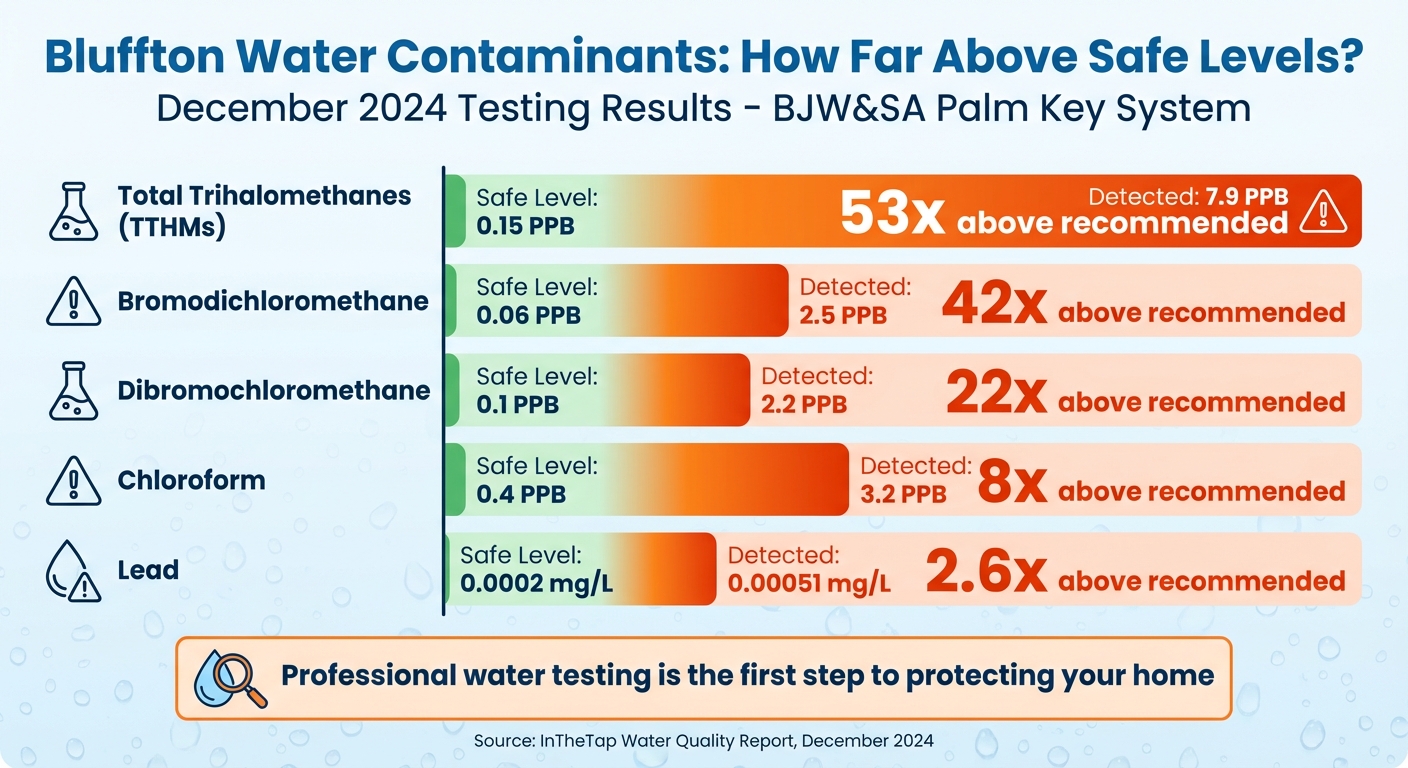
Bluffton Water Contaminants Exceeding Health Guidelines 2024
Bluffton residents face several water-related challenges that go beyond simple discoloration. These issues affect daily activities like cooking, cleaning, and maintaining household appliances, raising concerns about both convenience and health.
Hard Water and Scale Buildup
Bluffton’s water contains high levels of calcium and magnesium, which lead to hard water and the formation of scale deposits throughout homes. This results in a chalky, white residue on faucets, showerheads, and dishes, as well as persistent soap scum in bathrooms. Over time, these deposits can clog pipes and reduce the efficiency of appliances like water heaters and dishwashers, leading to higher energy bills and shorter appliance lifespans. Hard water also reduces the effectiveness of soaps and detergents, meaning you may need to use more product to achieve less-than-satisfactory results.
But hard water isn’t the only issue. Contaminants and odors add another layer of complexity to Bluffton’s water quality problems.
Contaminants and Odors
Chemical contaminants and unpleasant odors are common in Bluffton’s tap water. For example, a bleach-like smell often comes from chlorine used in disinfection, while a sulfur odor is typically caused by hydrogen sulfide gas. These are just the issues you can smell – many contaminants are invisible but far more alarming.
In December 2024, testing of the BJW&SA Palm Key system revealed five contaminants exceeding Health Guidance Levels. Among them, Total Trihalomethanes (TTHMs) were detected at 7.9 PPB, which is 53 times higher than the recommended level of 0.15 PPB. Additionally, manganese deposits, which can dislodge during pressure changes or hydrant testing, often turn the water brown or yellow. A November 2025 pump malfunction at the Purrysburg Water Treatment Plant caused widespread discoloration in neighborhoods like Old Town Bluffton, Hampton Lake, and Sun City. BJWSA spokesperson Jeff La Rue cautioned:
"The water authority advises residents to not drink any discolored water, as the high levels of manganese give it an unpleasant, bitter taste."
Local businesses also felt the impact. Conner Millen, General Manager at Nectar Farm Kitchen in Old Town, described the situation:
"The sink water is a little off color. I’ve heard worse is going around, ours is pretty mild."
These contaminants not only create inconvenience but also pose serious health risks.
Health Risks from Untreated Water
Even though municipal water meets federal standards, some contaminants still present health concerns. Tests have detected bromodichloromethane at 2.5 PPB (42 times the Health Guidance Level), dibromochloromethane at 2.2 PPB (22 times the level), and chloroform at 3.2 PPB (8 times the level). Lead concentrations were also measured at 0.00051 mg/L, which is 2.6 times the recommended level. These substances, including disinfection byproducts and heavy metals, can accumulate in the body over time.
Chlorine in shower water, for instance, can strip natural oils from skin and hair, leading to dryness and irritation. This can exacerbate skin conditions like eczema. Long-term exposure to manganese has been linked to memory and attention issues. For families with infants, nitrate contamination – often from fertilizers – poses an immediate danger, as it can cause "blue baby syndrome", a condition that reduces oxygen levels in the blood.
The following table highlights the detected levels of key contaminants compared to their health guidance levels:
| Contaminant | Detected Level | Health Guidance Level | Times Above Recommended |
|---|---|---|---|
| Total Trihalomethanes (TTHMs) | 7.9 PPB | 0.15 PPB | 53x |
| Bromodichloromethane | 2.5 PPB | 0.06 PPB | 42x |
| Dibromochloromethane | 2.2 PPB | 0.1 PPB | 22x |
| Chloroform | 3.2 PPB | 0.4 PPB | 8x |
| Lead | 0.00051 mg/L | 0.0002 mg/L | 2.6x |
Source: InTheTap Water Quality Report for Bluffton, SC (December 2024)
These findings underline the importance of addressing water quality concerns to ensure safety and comfort in Bluffton homes. Proper water treatment systems can help eliminate these contaminants before they reach your tap, offering peace of mind for families.
sbb-itb-998eb83
Water Treatment Systems and What They Do
Bluffton faces unique water challenges, and a variety of treatment systems are available to tackle these issues. These systems are designed to improve water quality, whether for your entire home or specific taps.
Whole-Home Water Filtration Systems
Point-of-entry filtration systems treat all the water entering your home before it reaches your faucets. Using technologies like activated carbon and multi-stage filters, these systems remove chlorine, sediment, heavy metals, and volatile organic compounds (VOCs). They also eliminate unpleasant odors caused by chlorine and hydrogen sulfide, ensuring fresh water from every tap.
"A whole-home water filtration system is an excellent way to ensure every tap in your house delivers clean, great-tasting water." – Dyess Air & Plumbing
Advanced four-stage systems can handle up to 1,000,000 gallons of water, utilizing media such as KDF55 and catalytic carbon for superior filtration. For targeted solutions, shower filters can remove over 90% of chlorine and treat around 10,000 gallons before needing a cartridge replacement.
While these systems provide comprehensive filtration, hard water issues require a different approach.
Water Softeners
If you’re dealing with the white, chalky residue on faucets and showerheads, water softeners are the solution. These systems use ion exchange to remove calcium and magnesium, the minerals responsible for hard water. By addressing the root cause, water softeners prevent scale buildup, helping extend the life of appliances like water heaters and dishwashers. They also improve soap lathering and make bathing more enjoyable.
For drinking water, point-of-use systems offer targeted purification.
Reverse Osmosis Systems
Reverse osmosis (RO) systems provide clean, safe water for drinking and cooking. Installed at the kitchen sink, these systems use a semi-permeable membrane with an incredibly fine pore size – about 0.0001 micron – to remove contaminants such as lead, arsenic, fluoride, nitrates, and bacteria. Most RO systems can produce up to 15 gallons of purified water daily, ensuring high-quality water for your family.
Although municipal water systems are regulated by the EPA to manage around 90 contaminants, substances like PFAS "forever chemicals" and pharmaceuticals often remain. Combining filtration systems like RO with whole-home solutions offers comprehensive protection against Bluffton’s water quality concerns.
How Water Treatment Protects Your Home and Reduces Costs
With Bluffton facing persistent water quality issues, a water treatment system can safeguard your plumbing and trim down long-term expenses. One of its standout benefits? It helps your household appliances last longer.
Making Appliances Last Longer
Hard water is tough on appliances, causing mineral deposits to build up and compromise their efficiency. This extra strain leads to more frequent breakdowns and shorter lifespans.
"Hard water can cause mineral buildup, which leads to clogged pipes, reduced water flow, and damaged appliances. This buildup can result in costly repairs and replacements."
– Dyess Air & Plumbing
For example, water heaters without filtration typically last around 7–10 years. With treated water, that lifespan stretches to 15–20 years. Dishwashers see a similar improvement, jumping from 5–7 years to over 12 years when using filtered water. This protection doesn’t stop there – washing machines avoid scale-related issues, and your plumbing system stays clear of mineral blockages, ensuring smoother water flow.
But it’s not just about preserving appliances. Water treatment systems can also help you save money in your day-to-day life.
Reducing Maintenance and Energy Bills
The savings go beyond avoiding appliance replacements. Families can cut energy bills by as much as 30% and use 50% less detergent, which adds up to about $400 in annual savings.
Selecting the Right Water Treatment System
When it comes to choosing a water treatment system, the first step is always testing your water.
Testing Your Water Quality
Some water quality issues are easy to spot – think rotten egg odors, rust stains, or cloudy water. But the more dangerous contaminants, like lead, nitrates, and heavy metals, often go unnoticed because they don’t change the taste or appearance of your water. That’s why professional lab testing is so important.
"Many contaminants are undetectable by taste or look yet harm your health." – UGA Extension
In Bluffton, water quality can vary significantly. If you’re on municipal water, check your annual Consumer Confidence Report to see what’s been detected in your supply. Private well owners should test their water annually for coliform bacteria, nitrates, lead, and pH levels. Always use a lab certified by the National Environmental Laboratory Accreditation Program to ensure accurate, unbiased results. Here’s a helpful tip: test for iron and manganese before installing a water softener, as these minerals can affect its performance.
Once you know what’s in your water, you can choose the right system to address your specific needs.
Matching Systems to Your Home’s Needs
Bluffton residents face a range of water challenges, and the right system can make all the difference. For hard water, a water softener can remove calcium and magnesium from your main water line. If you’re looking for pure drinking water, reverse osmosis systems can eliminate up to 99% of dissolved solids and heavy metals. For whole-home issues like chlorine odors or sediment, a whole-home filtration system treats all the water entering your house.
Here’s a quick guide to common water problems, their causes, and the systems that can help:
| Symptom | Likely Cause | Recommended System |
|---|---|---|
| Rotten egg smell | Hydrogen sulfide | Chemical oxidation or aeration |
| Scale buildup/Soap scum | Hard water (calcium/magnesium) | Water softener |
| Rust stains | Iron or manganese | Oxidizing filter or water softener |
| Bleach smell | Chlorine or chloramines | Activated carbon filtration |
| Cloudy appearance | Sediment or turbidity | Mechanical or sediment filtration |
In some cases, combining systems can improve performance. For example, a sediment pre-filter can protect a reverse osmosis membrane, extending its lifespan. Reverse osmosis systems typically produce up to 15 gallons of purified water per day, making them ideal for drinking and cooking.
Working with Licensed Plumbers
Once you’ve picked the right system, proper installation is crucial. No single system can remove every contaminant, so it’s important to ensure that your chosen solution integrates seamlessly into your home. Licensed plumbers can help by maintaining optimal water pressure, ensuring compatibility with your plumbing, and meeting local building codes.
"Our NATE-certified technicians will install your new system into your home’s plumbing with precision and care, ensuring it operates at peak efficiency and complies with all local codes." – Dyess Air & Plumbing
At ALL Plumbing Services, we offer on-site water testing to measure hardness and chlorine levels specific to your home. We also recommend systems certified by the National Sanitation Foundation (NSF) or the Water Quality Association (WQA) for reliable performance. To keep your system running smoothly, we provide guidance on maintenance tasks like filter replacements and system flushes, helping you protect your investment for years to come.
Conclusion
Water treatment systems bring clear advantages to Bluffton homeowners by removing harmful contaminants, extending the lifespan of appliances, and cutting down on energy costs. These systems not only safeguard your health but also help maintain the integrity of your home’s plumbing and infrastructure.
They also improve everyday living by addressing issues like skin irritation, unpleasant odors, and bad-tasting water while reducing the need for single-use plastic bottles.
"A whole-home system provides purified water from every single tap. This protects not only what you drink, but also your pipes, fixtures, and expensive appliances like water heaters and dishwashers from the damaging effects of hard water scale." – Dyess Air & Plumbing
Given these benefits, it’s crucial to select a system that matches your home’s specific needs. Professional water testing and expert advice play a key role in making the right choice. At ALL Plumbing Services, we provide on-site water testing and install systems certified by the National Sanitation Foundation (NSF) or the Water Quality Association (WQA), ensuring precise installation that complies with local regulations.
Take the first step toward better water quality and home protection. Contact ALL Plumbing Services today for a consultation!
FAQs
Do I need a water softener, a filter, or both?
If you’re dealing with hard water in Bluffton, a water softener can help by reducing mineral buildup. On the other hand, a filtration system is ideal for removing contaminants and improving overall water quality. The best solution depends on the specific issues in your water. Testing your water is the key step to figuring out whether you need a softener, a filtration system, or both to meet your home’s needs effectively.
What’s the fastest way to test my water at home?
The fastest way to check your water quality at home is by using a DIY water test kit. These kits are designed to measure essential factors like water hardness, pH levels, and even detect contaminants such as lead or bacteria. However, if you’re looking for more precise and dependable results, you might want to send a sample to a certified lab for professional testing.
Will these systems reduce my water pressure?
Water treatment systems, when appropriately sized and installed, generally won’t affect your water pressure. The key lies in selecting the right system with the proper flow rate and capacity to ensure steady performance and consistent pressure across your home.