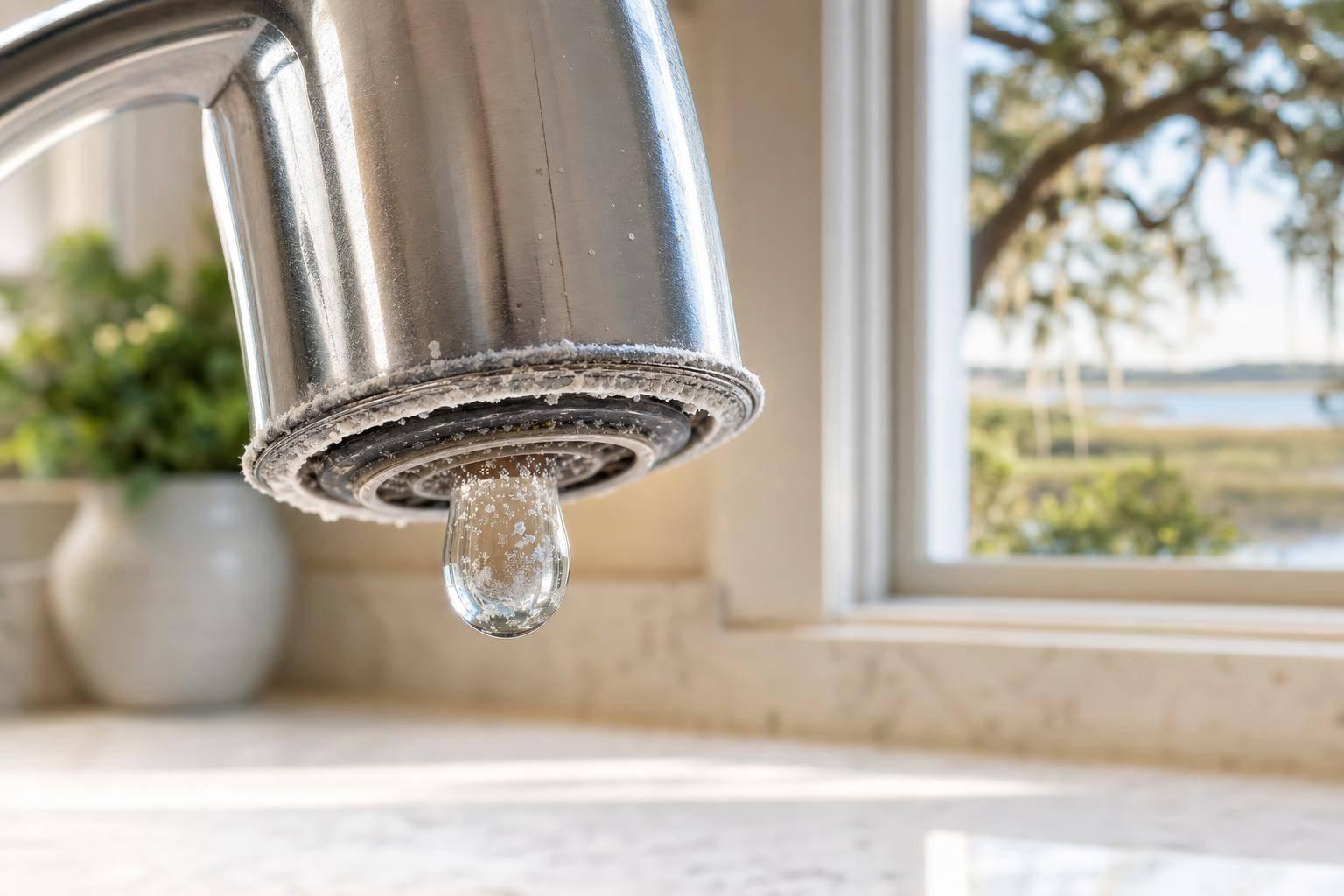
In most Bluffton homes, hard water comes from calcium and magnesium in the local water supply. That can leave white scale, spotty dishes, dry skin, and lower water pressure. In this area, municipal water is often in the 2 to 4 GPG range, and some water supplies may also contain iron and sediment.
If I wanted the short answer, here’s what I’d know right away:
- Main cause: calcium and magnesium in the water
- Common signs: chalky buildup, cloudy glassware, soap scum, dry hair/skin
- Homes at higher risk: private well homes in places like Okatie and Pritchardville
- Big cost areas: water heaters, tankless units, fixtures, and plumbing
- Best first step: test the water before choosing a system
- Common fixes: softeners, salt-free scale control, and carbon filtration for taste or odor
A few numbers stand out:
- 2 to 4 GPG is a common hardness range for local municipal water
- $1,200 to $2,800 is a common installed cost for a salt-based softener
- $1,000 to $2,200 is a common installed cost for a salt-free conditioner
- $1,800 to $3,500 is a common installed cost for a combined softener and carbon filter
| Option | What it does | Best for |
|---|---|---|
| Salt-based softener | Removes calcium and magnesium | Homes with scale buildup or tankless heaters |
| Salt-free conditioner | Helps stop scale from sticking | Municipal water users who want less upkeep |
| Carbon filter | Cuts taste and odor issues | Homes dealing with chlorine or chloramines |
| Softener + carbon | Handles hardness and taste/odor | Homes with more than one water issue |
Bottom line: if you see scale on fixtures or spots on dishes, the issue is often hard water, and a water test is the first step to picking the right fix.
What hard water is and why it appears in Bluffton homes
Hard water is water that contains a lot of calcium and magnesium. As water moves through soil and rock, it picks up those minerals before it ever reaches your plumbing. In Bluffton homes, that mineral load is what leaves scale on fixtures and slowly wears on pipes and appliances over time.
Calcium and magnesium are the main cause
Calcium and magnesium are the minerals behind hard water. When that water dries out or gets heated, those minerals stick around as scale on fixtures, dishes, and heating elements. That chalky buildup is scale from calcium and magnesium.
If you notice odor or rust-like stains, that’s usually a different water problem. Hard water is mostly about mineral deposits. And once scale starts to build, you tend to notice it in normal day-to-day use.
Why Bluffton and Lowcountry water tends to carry more minerals
Bluffton’s municipal water is a mix of surface water and groundwater, which can cut down hardness but doesn’t get rid of it. BJWSA water usually falls between 2 and 4 grains per gallon (GPG).
Homes in places like Okatie and Pritchardville can experience higher mineral levels in their water supply. Add Lowcountry humidity to the mix, and minerals can dry into scale faster.
That combo is why Bluffton homeowners often spot the early signs on dishes, fixtures, skin, and water flow first.
sbb-itb-998eb83
How to spot hard water signs before damage gets worse
Hard water tends to leave a trail around the house. Once mineral scale starts forming, the next move is to spot the signs early before it starts clogging pipes and wearing down appliances.
Visible signs on dishes, fixtures, and showers
Most people first notice hard water in the kitchen or bathroom. White, chalky deposits on faucet aerators, showerhead nozzles, and glass shower doors usually point to hard water. That crusty stuff is mineral scale from calcium and magnesium.
Cloudy or spotty glassware coming out of the dishwasher is another common clue. So is soap scum that sticks to shower walls and won’t rinse off easily.
Want a simple check? Tie a plastic bag filled with vinegar over a scaled showerhead and leave it overnight. If the deposits soften or start to dissolve, mineral buildup is the likely cause.
Daily use problems: dry skin, poor lather, and lower water pressure
Hard water doesn’t just show up on surfaces. You can feel it too. Dry skin, rough hair, and weak lather are all common because calcium and magnesium get in the way of how soap and shampoo foam up and rinse away.
Lower water pressure can also be a sign. Scale often narrows pipe openings and clogs faucet aerators. If pressure drops at one fixture but not others, check the aerator first.
Laundry can give it away as well. Clothes washed again and again in hard water often start to feel stiff or look dull over time.
Appliance warnings homeowners should not ignore
Scale can cut the lifespan of dishwashers, washing machines, ice makers, and water heaters. Tankless water heaters are hit especially hard because scale can build up fast on the heat exchanger.
These signs matter because scale doesn’t stop on its own. It keeps building inside pipes and appliances, and once it gets that far, the cost starts showing up in lower efficiency and repair bills.
The long-term cost of untreated hard water
Once the signs of hard water show up, the problem doesn’t just sit there. It keeps working behind the scenes. Scale keeps building inside pipes, valves, and appliances, and that slowly turns into more repair bills and earlier replacements.
How mineral buildup damages pipes and fixtures over time
As scale builds up inside pipes, it slowly shrinks the space water can move through. That means your plumbing system has to work harder just to keep water pressure where it should be. Faucet aerators and showerheads clog more often, and fixtures wear out earlier than expected. In smaller openings, especially in low-flow fixtures, scale piles up even faster and parts wear down sooner.
A lot of the cost shows up in two places: plumbing performance and water heating.
Higher energy bills and shorter water heater life
Water heaters usually take the biggest hit. Scale forms a layer over heating elements and heat exchanger surfaces, which makes it harder for heat to move into the water. So the unit has to run longer and use more energy to hit the same temperature. With tank-style heaters, that often means a shorter lifespan and energy bills that keep creeping up. Tankless units are even more exposed because scale can build fast inside the heat exchanger.
Treating hard water helps cut the strain on water heaters and lowers long-term operating costs.
The next step is choosing the right treatment for your home.
Hard water treatment options for Bluffton, SC homes
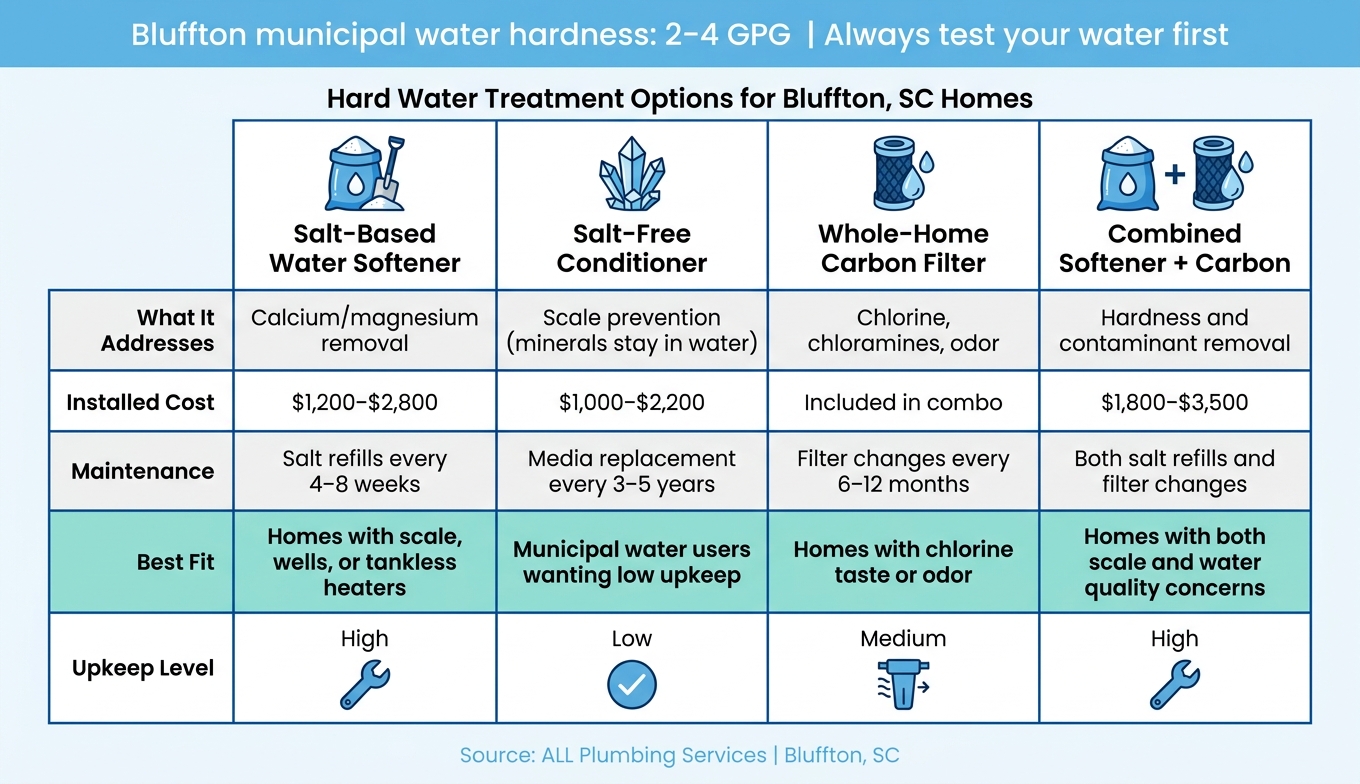
Hard Water Treatment Options for Bluffton, SC Homes
Once scale starts showing up on fixtures and inside water heaters, it’s time to pick the right fix. In Bluffton, SC, hard water problems usually call for one of three paths: softening, scale control, or filtration. The best place to start is simple: test for hardness first, and if needed, test for chlorine too. Then match the system to what your water is actually doing.
When a water softener is the right choice
A salt-based water softener is the most direct fix when calcium and magnesium are the main issue. It uses ion exchange to swap those minerals for sodium before the water moves through your pipes and appliances.
That matters because hard water doesn’t just leave spots on faucets. It builds up inside the stuff you depend on every day. And tankless water heaters are hit especially hard, since scale can pile up fast without softening.
Newer high-efficiency systems also use less salt and water than older units. Installed cost usually falls between $1,200 and $2,800. If you want to dig into setup choices, you can learn more about water softener installation options here.
Where conditioners and scale-control systems fit in
A salt-free water conditioner takes a different approach. It doesn’t remove minerals from the water. Instead, it changes how they act.
Using a process called template-assisted crystallization, it turns calcium and magnesium into a form that’s less likely to stick to surfaces and create scale. For many municipal water users, that can be a good match, especially if low upkeep is high on the list.
The media usually lasts 3 to 5 years before replacement is needed, and installed costs often land between $1,000 and $2,200. If scale control is your main concern, the Flow-Tech system is one option worth a look for Lowcountry properties.
When whole-home filtration is also needed
Sometimes hard water isn’t the only issue. If the water also has a chlorine taste or smell, filtration may need to work alongside softening.
A carbon filter can help with taste and odor. But there’s an extra detail here: BJWSA uses chloramines for disinfection, and standard carbon often doesn’t do enough. Catalytic carbon works better for chloramines.
That’s why some Bluffton homes need two systems working together:
- A softener for mineral content
- A carbon filter for taste and odor
Combined systems usually cost $1,800 to $3,500 installed.
Here’s how the main options compare:
| System | What It Addresses | Maintenance | Best Fit |
|---|---|---|---|
| Salt-based water softener | Calcium/magnesium removal | Salt refills every 4–8 weeks | Homes with scale, hard water, or tankless heaters |
| Salt-free conditioner | Scale prevention (minerals stay in water) | Media replacement every 3–5 years | Municipal water users wanting low upkeep |
| Whole-home carbon filter | Chlorine, chloramines, odor | Filter changes every 6–12 months | Homes with chlorine taste or odor |
| Combined softener + carbon | Hardness and contaminant removal | Both of the above | Homes with both scale and water quality concerns |
You can explore the full range of water filtration options to find what fits your home’s specific water conditions.
Conclusion: What causes hard water and how to protect your plumbing
Hard water in Bluffton, SC comes from calcium and magnesium in the local water supply. In Bluffton, average water hardness is about 115 PPM (6.7 GPG), which falls into the slightly hard range.
You can usually spot the signs without much guesswork. Think spotty glassware, scale on showerheads, dry skin, and buildup inside pipes, water heaters, and household appliances. That buildup points to scale, and scale problems usually start the same way: with water that hasn’t been tested.
The first step is a water test. Once you know what’s in the water, it’s much easier to pick the right treatment. A professional test checks hardness and looks for chloramines, iron, and other contaminants so the system can be sized the right way for the home.
With those results in hand, matching the right system to the house becomes far more straightforward. ALL Plumbing Services offers water quality consultations and water treatment installation for Bluffton and the Lowcountry, including:
If you have a tankless water heater, a water softener can help protect the heat exchanger from scale buildup.
FAQs
Is hard water dangerous to drink?
Hard water is not considered dangerous to drink. Calcium and magnesium occur naturally, and hard water is simply water with more of those minerals. In plain terms, water hardness tells you about mineral levels, not whether the water is safe.
If you’re worried about the quality of your home’s drinking water, check your utility’s Consumer Confidence Report. And because softened water can contain more sodium, some homeowners add a point-of-use reverse osmosis system at the kitchen sink for drinking and cooking.
How do I know if I need a softener or a conditioner?
It comes down to your water and how much upkeep you want to deal with.
A water softener removes calcium and magnesium from the water. That makes it the best pick if you’re seeing common hard water problems like chalky buildup, spotty dishes, and soap that just won’t lather well.
A conditioner works a bit differently. It helps stop minerals from clinging to pipes and appliances, and it does so without salt or added chemicals. For Bluffton homes, the best way to figure out which one makes sense is with an in-home water test.
Can hard water damage a tankless water heater?
Yes. Hard water can harm a tankless water heater because calcium and magnesium can pile up fast inside its narrow heated passages. That scale makes the unit work harder, cuts efficiency, slows water flow, and can shorten the life of the heat exchanger.
To help protect the system, pair it with a water softener or water conditioning system. It also helps to schedule annual professional descaling so buildup doesn’t turn into a bigger problem.