

I’d start with leaks, toilets, faucets, showers, and tankless water heaters – because those upgrades can cut water use, trim energy waste, and lower the odds of a big repair bill. In many homes, leaks alone waste huge amounts of water, and smart monitors can spot problems as small as one drop per minute. Low-flow smart faucets can drop usage from 2.2 gpm to as low as 0.35–0.5 gpm, and dual-flush toilets can use about 0.8 or 1.28 gpf instead of wasting the same amount every time.
If I were choosing where to spend first, I’d focus on:
- Smart faucets for touchless use and lower flow
- Smart shower systems to limit run time and cut warm-up waste
- Smart toilets with dual-flush controls
- Leak detectors and shutoff valves to stop hidden water loss
- Whole-home water monitors to track usage in real time
- Tankless water heaters to heat water only when needed
Quick Comparison
| Upgrade | Main job | Water/energy impact | Typical cost |
|---|---|---|---|
| Smart faucet | Runs water only when needed | Can cut flow to 0.35–0.5 gpm | About $415–$1,155 |
| Smart shower | Cuts shower flow and run time | Less daily water waste | Varies; often higher install cost |
| Smart toilet | Uses less water per flush | About 0.8/1.28 gpf dual flush | About $1,000–$8,000+ |
| Leak detector | Alerts you to leaks | Helps avoid water damage | About $30–$100 |
| Whole-home monitor | Tracks flow and spots hidden leaks | Users may cut use by 15%; some systems report up to 90% waste reduction | About $149–$600 |
| Tankless water heater | Heats water on demand | Cuts standby heat loss | About $1,000–$2,500 |
Bottom line: I see smart plumbing as a step-by-step way to waste less water, use less hot-water energy, and catch leaks before they turn into a $12,500 insurance claim.
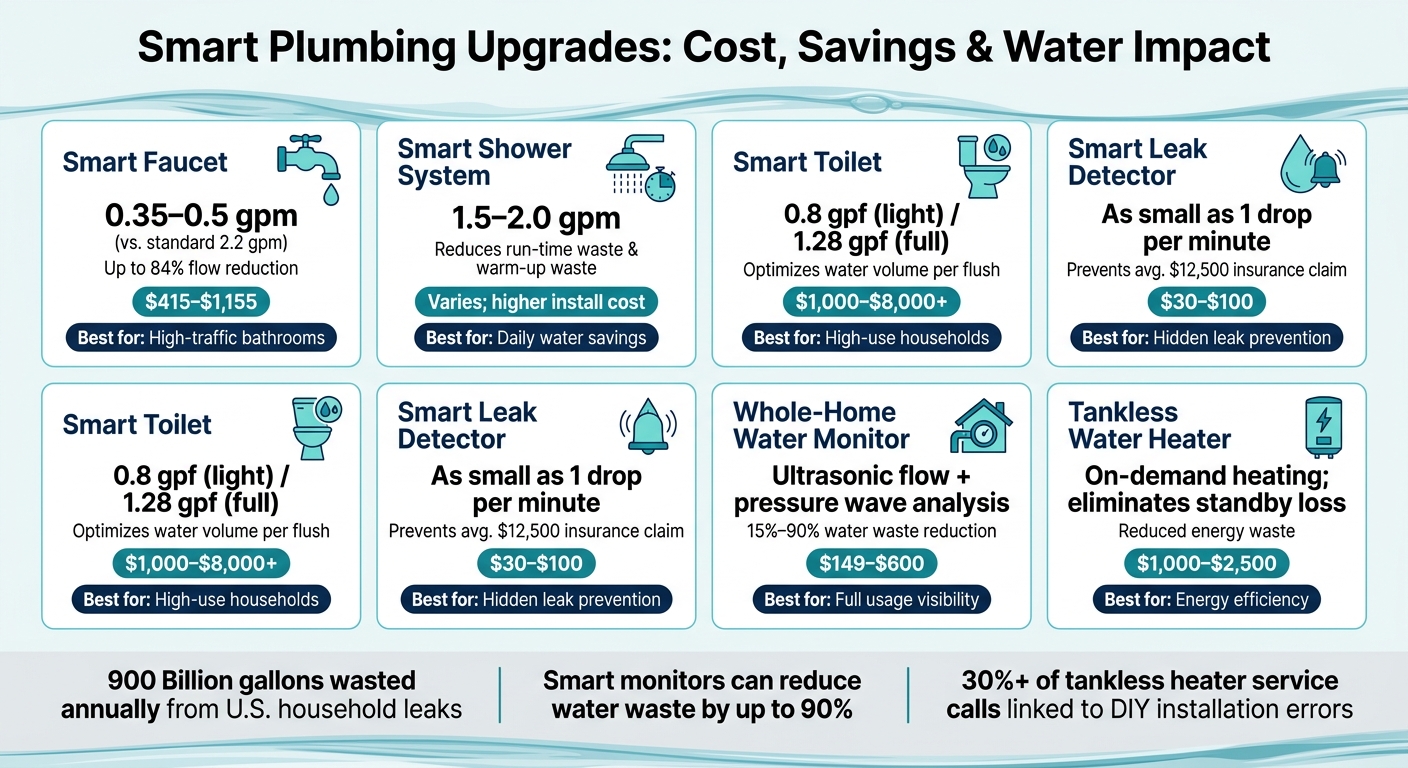
Smart Plumbing Upgrades: Cost, Savings & Water Impact Compared
Best smart fixtures for daily water savings
Smart faucets with touchless controls and low-flow aeration
Touchless faucets help cut waste in a simple way: water runs only when your hands are under the spout. That means no water pouring out while you lather up or pause to rinse.
Low-flow aerators also make a big difference. They keep water pressure usable while cutting flow to 0.35–0.5 gpm. For context, a standard faucet uses 2.2 gallons per minute, while high-efficiency smart options such as the American Standard Paradigm can bring that down to 0.35 gpm.
The American Standard NextGen Selectronic runs at 0.5 gpm and has a built-in auto shut-off after 55 seconds, which helps stop accidental waste. Its sensor also self-calibrates based on the surrounding environment and lighting, so it needs fewer manual tweaks.
Some faucets use hydropower. In plain English, the water flow itself powers the sensor, so you don’t need outside power or frequent battery swaps.
In the kitchen, smart features can get even more precise. Voice controls and measured dispensing help you use only what you need. For example, the Delta VoiceIQ Trinsic can dispense an exact amount when you say, "pour one cup", which helps avoid extra water use. Smart kitchen faucets usually run at 1.8 gpm.
Smart showers and high-efficiency showerheads
Showers are another good place to save water every day. High-efficiency showerheads cut flow to 1.5–2.0 gpm without a noticeable drop in pressure.
Smart shower systems go a step further by adding run-time controls and digital temperature presets. That helps reduce the common habit of letting water run while waiting for it to heat up.
Smart toilets with high-efficiency flushing
Toilets save water one flush at a time, which makes them a strong first upgrade. Smart toilets often use dual-flush controls, with a lighter flush of about 0.8 gpf for liquid waste and a full flush of 1.28 gpf for solid waste.
Models like the Kohler Numi 2.0 use this dual-flush setup to send the right amount of water for each type of use. It’s a simple idea, but it cuts waste where it adds up fast.
Here’s a quick side-by-side look at the main fixture types in this section:
| Fixture Category | Typical Flow/Flush Rate | Main Smart Feature | Primary Sustainability Benefit | Approx. Upfront Cost (USD) |
|---|---|---|---|---|
| Smart Bathroom Faucet | 0.35–0.5 gpm | Touchless sensor / Hydropower | Prevents water running during tasks | $415–$940 |
| Smart Kitchen Faucet | 1.8 gpm | Voice control / Measured dispensing | Precise pouring; reduces manual waste | $1,100–$1,300 |
| Smart Toilet | Dual-flush (0.8 / 1.28 gpf) | Dual-flush controls | Optimizes water volume per use | $1,000–$8,000+ |
sbb-itb-998eb83
Smart leak detection, water monitoring, and tankless water heaters
Beyond faucets and toilets, smart leak detection and water heating can cut waste that usually stays hidden. In many homes, the biggest wins come from spotting leaks early and reducing hot-water loss at the source.
Smart leak detectors and automatic shutoff valves
Leaks add up fast. U.S. households waste an estimated 900 billion gallons of water each year from leaks alone, and there are about 14,000 water leak emergencies every day across the country. On top of that, the average home insurance claim for water damage is about $12,500. So yes, early detection can save a lot of stress and money.
Point-of-use detectors are the simple option. They sit under sinks or near appliances and alert you as soon as moisture shows up. When you pair them with an automatic shutoff valve, the system can stop water flow before the mess spreads.
Whole-home monitors do more than that. Installed on the main water line, they use ultrasonic flow sensors and pressure wave analysis to spot leaks as small as one drop per minute. Some systems can cut household water waste by up to 90%. If you’re in Charleston or Bluffton, ALL Plumbing Services handles leak detection and repair and can help you figure out which setup makes sense for your home’s plumbing layout.
There’s also a money angle that people often miss: many insurance providers offer premium discounts of 5% to 15% for homes with automatic shutoff systems. It’s smart to ask your insurer before or after installation.
Whole-home water monitors that track usage in real time
If you want to see more than a single leak alert, whole-home monitors give you a live view of how water is used across the property.
The Moen Flo Smart Water Monitor, installed on the main supply line, tracks water use by fixture type and runs daily “microleak” tests to catch small issues before they turn into big ones. The Flume 2 works differently. It straps onto your current water meter, so there’s no pipe cutting involved. That makes it a solid starting point for homeowners who want a less invasive setup, with pricing around $149–$269.
That kind of visibility can change behavior. On average, users of smart water monitors reduce total water use by 15%. That’s especially useful for seasonal homes and businesses watching monthly costs closely.
Smart tankless water heaters for on-demand hot water
Tankless systems heat water only when you need it, which helps avoid standby heat loss. They’re also usually wall-mounted, so they can open up floor space in a utility area. Before installation, a licensed plumber should confirm the right unit size and make sure the setup meets local code.
Here’s a quick side-by-side look at the three system types in this section:
| Device Type | Installation Area | Core Function | Potential Savings | Typical Price (USD) |
|---|---|---|---|---|
| Smart Leak Detector | Near appliances, under sinks | Detects local moisture; can trigger shutoff | Prevents localized property damage | $30 – $100 |
| Whole-Home Water Monitor | Main water supply line or meter | Tracks flow, flags leaks; some models auto-shut off | 15% – 90% water waste reduction | $149 – $600 |
| Smart Tankless Water Heater | Utility room / wall-mounted | On-demand heating; reduces standby loss | Reduced energy waste | $1,000 – $2,500 |
Once you know where water or energy is slipping away, it gets much easier to decide what to upgrade first.
How to choose the right smart plumbing upgrades for your property
Start with the fixtures that use the most water
After looking at the main fixture types above – faucets, showers, toilets, leak monitors, and tankless heaters – the best next step is simple: pick the upgrade tied to your biggest source of water waste.
Start with your latest water bills. If usage is climbing, the problem often comes from toilets, showers, or sinks that get heavy daily use. And if your bill jumps for no clear reason, that’s usually a sign of a leak or some other drain on your system. For busy sinks, smart faucets can cut flow to as low as 0.5 gpm.
Match smart features to your home or small business needs
Not every smart plumbing upgrade fixes the same issue. The better approach is to match the device to the problem first, then look at price and install effort.
| Upgrade Type | Best Use Case | Upfront Cost | Installation |
|---|---|---|---|
| Whole-Home Shutoff Valve | Preventing major damage; potential insurance discounts | $400–$2,600+ | Professional install |
| Under-Sink Monitor | Tracking specific fixture usage | ~$300 | DIY-friendly |
| Smart Faucet | High-traffic bathrooms; daily water savings | ~$500–$1,155 | Moderate |
| Smart recirculating shower | Eco-focused renovations | High | Professional install |
| Smart Tankless Water Heater | On-demand hot water; reducing standby energy loss | $1,000–$2,500 | Professional install |
If high water bills or repeat leaks are your main problem, whole-home monitors can help a lot. They track usage by fixture type and can flag silent leaks, like a toilet that keeps running.
Plan installation around plumbing compatibility and local code
Before you buy, check the nuts and bolts. A little prep here can save you time, money, and a lot of frustration.
Whole-home shutoff valves need to match your main water line diameter. In most homes, that means 0.75", 1", 1.25", or 1.5" – so measure first. Many smart monitors also need an AC outlet within 10 to 25 feet of the install point. If there isn’t one nearby, you may need electrical work before installation. Another option is to look at battery-powered or hydropowered models, such as the TOTO EcoPower faucet, which uses water flow to run its sensor system.
Some smart monitors, including Phyn, require a Pressure Regulating Valve (PRV) to help with accuracy and to guard the plumbing against pressure spikes. More advanced systems, like smart recirculating showers, often need specific subfloor cutouts and drain layouts. That makes them a better fit for new construction or full bathroom remodels than for simple retrofits.
If you’re in Charleston or Bluffton, ALL Plumbing Services can assess your current pipe condition and handle installation of smart leak detection systems, fixture upgrades, and tankless water heaters. That kind of upfront check helps make sure the upgrade fits your plumbing setup and local code.
Conclusion: Building an eco-friendly plumbing system step by step
The upgrades that cut the most water and energy waste
Start with the fixtures that waste the most water, then move to leak protection and better water heating. The biggest savings usually come from toilets, showers, faucets, leak detection, and tankless water heating. Smart toilets and low-flow fixtures can trim daily water use, leak detection can stop hidden waste before it adds up, and tankless water heaters cut standby energy loss.
That said, those savings don’t happen by magic. They depend on proper installation and regular maintenance.
Why professional installation protects long-term performance
That’s why professional installation matters. Even a smart fixture with great features can fall short if it’s installed the wrong way. Sizing, placement, and pressure matching all affect how well the system works.
More than 30% of service calls for tankless water heaters are linked to improper DIY installation, and that often voids the manufacturer’s warranty at the same time. Regular inspections help keep smart plumbing running well and can extend the life of the system.
ALL Plumbing Services offers eco-friendly fixture installation, smart leak detection, tankless water heater setup, and routine maintenance in Charleston and Bluffton. Emergency plumbing service is also available in Charleston and Bluffton.
FAQs
Which smart plumbing upgrade should I install first?
It comes down to your main goal: stopping leaks or cutting day-to-day water use.
If leak prevention is at the top of your list, a smart leak detection system or smart water shutoff valve is a solid first move. These devices watch your plumbing 24/7 and can help stop major water damage before it gets out of hand.
If you want to save water right away, WaterSense-certified toilets or faucet aerators are an easy win. They can cut water use and trim your utility bills without much effort.
ALL Plumbing Services can look at your home, walk you through the options, and help you choose the best fit.
Do smart leak detectors need professional installation?
It depends on the type of system.
Whole-home smart monitors and automatic shutoff valves connect to the main water line. Because of that, they usually need professional installation.
Point-of-use sensors are much simpler. They’re battery-powered, standalone devices that homeowners can place near appliances without special tools.
ALL Plumbing Services can install whole-home systems and help make sure everything is set up the right way.
Will smart plumbing upgrades really lower utility bills?
Yes. Smart plumbing upgrades can cut utility bills by using less water and less energy.
For example, WaterSense-labeled toilets, faucets, and showerheads can reduce household water use by 20% to 60%. That’s a simple change, but it can make a clear difference on your monthly bill.
Smart leak detection can also help in a big way. Even a small leak can waste a lot of water over time and lead to expensive repairs. Catching those issues early helps you avoid both wasted water and costly damage.
Tankless water heaters are another solid option. They can lower energy costs by up to 50%, which makes them a smart pick for many homeowners.
ALL Plumbing Services offers these eco-friendly upgrades in Charleston and Bluffton, SC.
