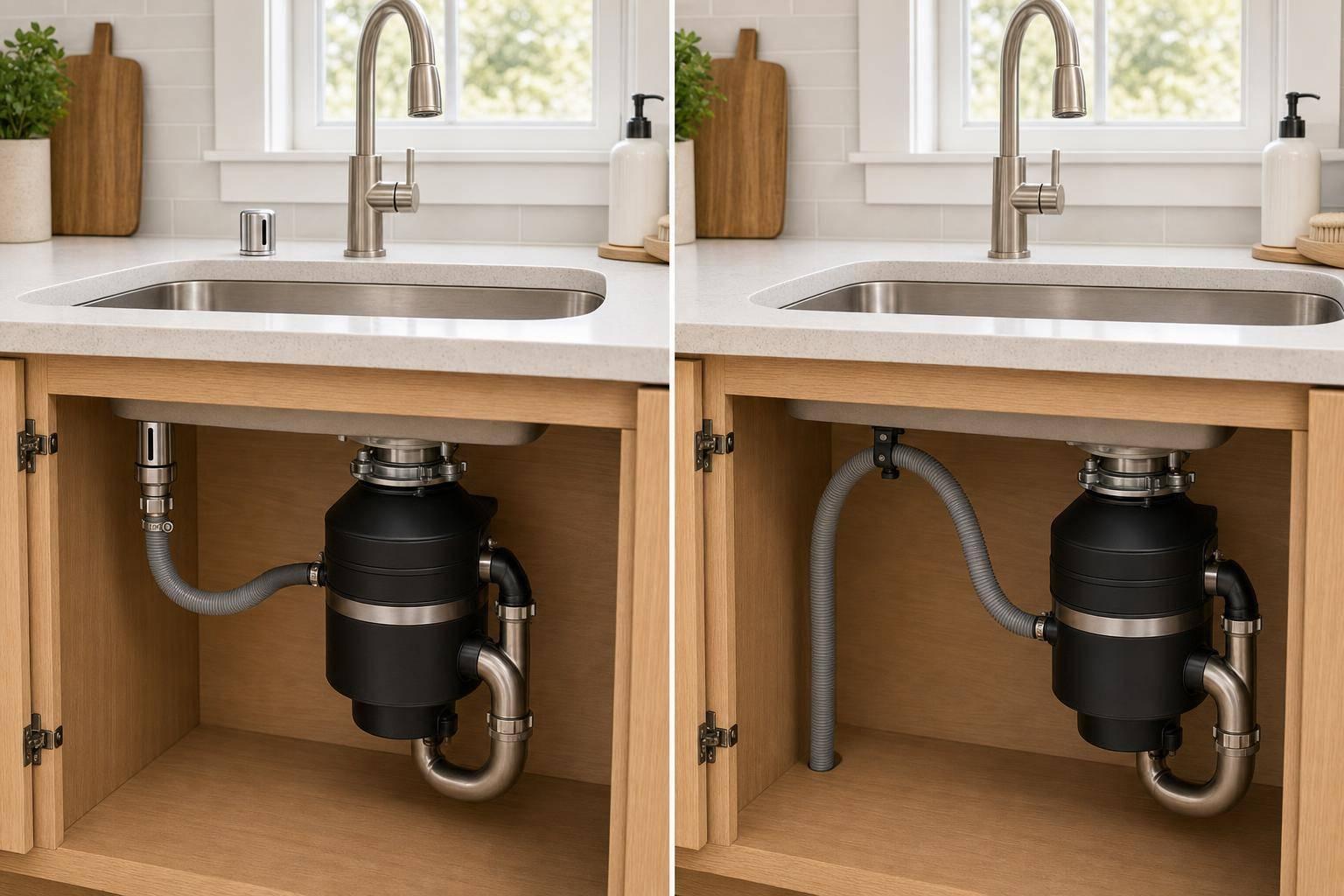
If you want the safest dishwasher drain setup, I’d pick an air gap. It gives the strongest block against dirty water flowing back into the dishwasher. A high loop can work too, but only if local code allows it and the hose stays mounted high under the sink.
Here’s the short version:
- Air gap: strongest backflow protection because it uses a physical air break
- High loop: lower-cost and hidden inside the cabinet, but it depends on hose height and the dishwasher’s check valve
- Code matters most: some areas allow both, while UPC areas often require an air gap
- Common install detail: a high loop is often fastened at least 32 inches above the floor
- Cost: air gap parts often run $15 to $40; high loop parts can be $0 to $8
- Watch-outs: air gaps can spill onto the counter if there’s a clog downstream; high loops can fail if the hose sags
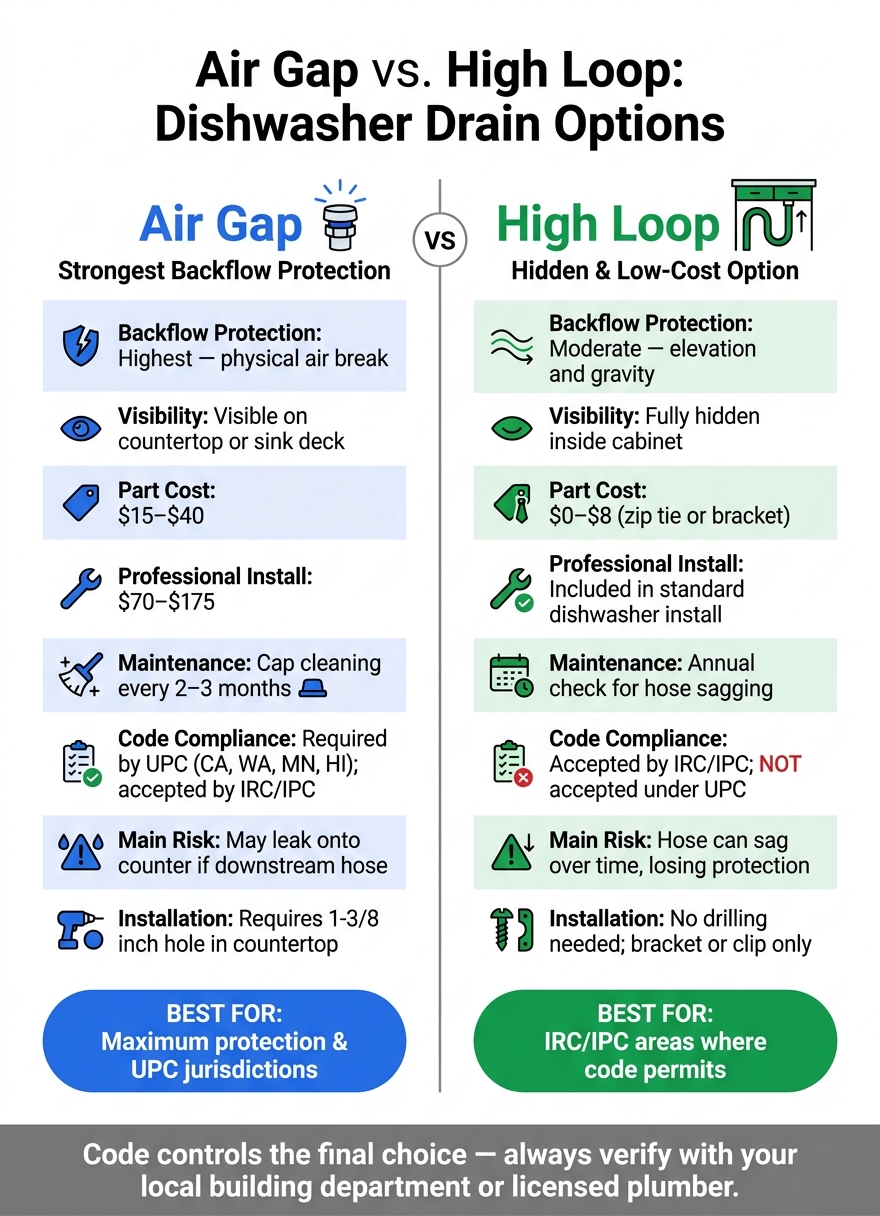
Air Gap vs. High Loop: Dishwasher Drain Comparison
Quick Comparison
| Option | How it blocks backflow | Best point | Main downside | Typical part cost |
|---|---|---|---|---|
| Air gap | Open air break between drain lines | Strongest protection | Visible on sink or counter | $15–$40 |
| High loop | Hose routed high under sink | Hidden and low cost | Less protection if hose drops or sink backs up | $0–$8 |
If you’re choosing between the two, I’d keep it simple: use an air gap when code requires it or when you want the most protection; use a high loop only where it’s allowed and installed the right way.
sbb-itb-998eb83
2. Air gap: how it works, where it installs, and when to use it
An air gap is a small fitting mounted on the countertop or sink deck that keeps the dishwasher drain hose physically separate from the drain line. Instead of sending wastewater straight into the garbage disposal or drain tailpiece, it forces that water to pass through an open break first. That gap matters. It stops back-siphoning even when the sink backs up.
For it to work the way it’s supposed to, the air gap has to sit above the sink flood rim. It installs in a dedicated hole in the sink deck or countertop, and the hose has to run to the drain within the limits set by the manufacturer.
How an air gap stops contamination
When the dishwasher drains, the pump pushes wastewater up through the drain hose and into the air gap’s inlet port. Inside the fitting, the water moves across an open air break, then drops through a second hose into the garbage disposal or sink tailpiece.
Because the inlet side and outlet side never connect directly, dirty water can’t siphon back into the dishwasher through the gap. That’s the whole point: a simple physical break that backflow can’t jump.
Air gap pros and cons
One of the biggest upsides, beyond backflow protection, is that an air gap makes clogs easy to spot. If the drain line after the air gap gets blocked, water will spurt out of the cap and onto the countertop during a cycle. Messy? Yes. But it also tells you right away that the blockage is somewhere downstream of the air gap.
The tradeoff is pretty straightforward. The fitting stays visible on top of the counter, and some homeowners don’t love that look. It also needs light upkeep. Pulling off the cap every 2 to 3 months and clearing out grease or food bits with a small bottle brush helps keep it draining the way it should.
| Feature | Detail |
|---|---|
| Backflow reliability | Highest; physical air break cannot be bridged by siphoning |
| Clog detection | Visible – water leaks onto counter if the drain is blocked |
| Installation requirement | Dedicated hole in countertop or sink rim |
| Maintenance | Cap cleaning every 2 to 3 months |
| Kit cost | $15 to $40 at hardware stores |
| Professional installation | $70 to $175 for a licensed plumber |
Air gaps are required by code in places that follow the Uniform Plumbing Code (UPC), including California, Washington, Minnesota, and Hawaii. In areas where high loops are allowed, the next step is weighing that simpler setup against the air gap’s stronger backflow protection.
3. High loop: how it works, where it installs, and its limits
A high loop routes the dishwasher drain hose as high as it can go under the sink, usually up to the underside of the countertop, before it drops down to the garbage disposal or drain tailpiece. It stays out of sight inside the cabinet and helps cut down on back-siphoning through elevation. But here’s the key point: it does not create a true air break. Where local code allows it, a high loop is the simpler option compared with an air gap.
How a high loop reduces back-siphoning
The hose runs upward from the dishwasher to its highest point, then slopes back down to the drain connection. That rise-and-fall setup helps limit dirty water from moving backward.
But the whole setup depends on one small detail: the fastener. The hose needs to be secured at its highest point, at least 32 inches above the floor where that height is accepted, using a hose bracket, copper strap, or heavy-duty zip tie. Give that fastener a look once a year to make sure the hose hasn’t started to droop. If the hose sags, the backflow protection disappears.
High loop pros and cons
The biggest upside is simple: it’s cheap and hidden. Parts usually cost $0 to $8, and in many cases all you need is a zip tie or a universal mounting bracket. Nothing sits on the countertop, so the sink area keeps a clean look.
The tradeoff is that a high loop depends in part on the dishwasher’s internal check valve, and that valve is still a mechanical part that can wear out. If the sink backs up badly enough and the water level rises above the top of the loop, dirty water can still make its way into the dishwasher. An air gap blocks that by physically separating the drain path.
Code is another sticking point. Some areas that follow IRC or IPC allow high loops in certain setups, while UPC areas often require an air gap instead.
| Feature | Detail |
|---|---|
| Backflow mechanism | Elevation and gravity; relies on the dishwasher’s internal check valve |
| Minimum height required | 32 inches above the floor where accepted |
| Visibility | Fully hidden inside the cabinet |
| Maintenance | Annual check for sagging |
| DIY parts cost | $0 to $8 (zip tie or bracket) |
| Code acceptance | Accepted by IRC and IPC; often rejected by UPC and some state codes |
4. Air gap vs. high loop: code compliance, performance, and best fit
Side-by-side comparison: safety, code, cost, and maintenance
An air gap creates a true air break. A high loop depends on hose height. That one difference matters a lot, because an air gap gives stronger protection against backflow.
If your local code allows both, it helps to compare them on a few practical points: safety, appearance, upkeep, and what it takes to install each one.
| Feature | Air Gap | High Loop |
|---|---|---|
| Backflow protection | Highest – physical air break | Moderate – elevation and gravity |
| Code compliance | Required by UPC; accepted by IRC/IPC | Generally accepted by IRC/IPC; not accepted under UPC and some state codes |
| Visibility | Visible fixture on countertop or sink deck | Hidden inside the cabinet |
| Maintenance | Periodic cleaning of the cap and ports | Minimal, but the hose must stay securely fastened |
| Main risk | May leak onto the counter if the downstream hose clogs | Can sag over time and lose protection |
| Installation effort | Requires a 1-3/8-inch hole in the countertop or sink rim | Requires a bracket or clip; no drilling needed |
| Typical cost | Air gap kit: $15–$40, plus possible drilling labor | Bracket or clip: $3–$8; heavy-duty zip ties are under $1 |
When each option is the better choice
An air gap is the better pick when you want the strongest backflow protection or when code says you need one. It’s the stricter setup, but for many homeowners, that extra layer of separation is worth it.
A high loop makes sense only when local code permits it and the drain hose can be fixed in place for the long term without sagging. If that hose drops over time, the setup loses some of the protection it was supposed to provide.
In Charleston-area homes, the final call still comes down to local code interpretation and the sink setup already in place. Rules can vary by jurisdiction, so check the accepted drain method with your local building department or a licensed plumber from ALL Plumbing Services before you replace a dishwasher or start a remodel.
5. Final decision for Charleston-area properties
The choice comes down to two things: code and how much backflow protection you want.
Air gaps and high loops both help stop dishwasher backflow, but they work in different ways. An air gap creates a physical break between the dishwasher drain line and the plumbing system. A high loop depends on the drain hose being routed high enough to help keep wastewater from flowing back.
In Charleston-area homes, local code and the AHJ decide whether a high loop is allowed or whether an air gap is required. In some cases, local inspectors may still require an air gap for rental properties or certain remodels. Before you start kitchen work, check with your local building department.
Key takeaways
For Charleston-area homeowners, the day-to-day choice is pretty simple:
- Air gap: strongest backflow protection – a physical separation that wastewater cannot bridge
- High loop: simpler, hidden, and dependent on local code
- Code controls the final choice. If your jurisdiction requires an air gap, a high loop is not a valid substitute.
If your setup doesn’t match code or keeps backing up, have it checked before the next dishwasher cycle. ALL Plumbing Services can inspect and correct dishwasher drain connections in Charleston and Bluffton. Professional installation typically runs $100 to $200.
FAQs
How do I know which option my local code allows?
Check which plumbing code your area uses by calling your local building department or visiting its official website. Ask if your jurisdiction follows the UPC, which usually requires a physical air gap, or the IRC/IPC, which often allow a secured high loop.
It’s also smart to ask about any local amendments. City or county rules can override state-level code and require stricter standards.
Can I switch from a high loop to an air gap later?
Yes. You can switch from a high loop to an air gap later, especially if local code requires it or if you want extra backflow protection.
That swap usually means drilling a 1-3/8-inch hole in the countertop or sink deck, then rerouting the dishwasher drain hose through the air gap.
Because plumbing codes vary by state and city, check your local requirements first.
What are signs my dishwasher drain setup is failing?
Common signs include dirty or cloudy water sitting in the dishwasher after a cycle, a bad smell that sticks to “clean” dishes, water backing up into the sink, or water leaking from the air gap cap while the dishwasher drains.
It also helps to check a few simple things. The drain hose may have slipped out of its high position, gotten kinked or pinched, or the disposal knockout plug may still be in place if it was never removed.