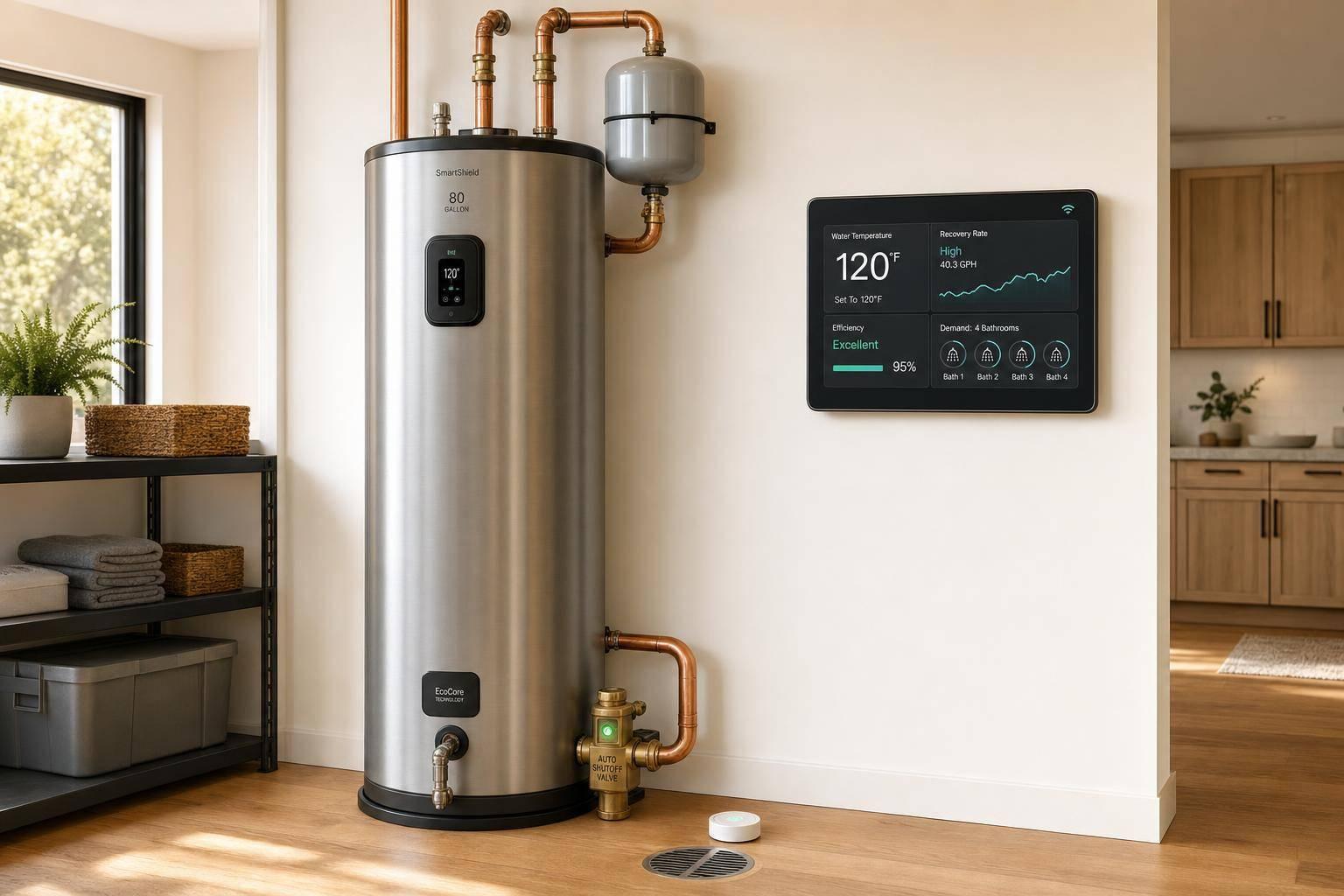
If you live in a large Charleston home, the best smart water heater is the one that matches your peak hot-water use, recovers fast, cuts wasted energy, and warns you about leaks right away. A basic unit often falls short when several showers, laundry, and the dishwasher run in the same hour.
Here’s the short version:
- Start with sizing. For big households, look at First Hour Rating (FHR) for tank models and GPM for tankless units.
- Tank size alone is not enough. A 60- to 80-gallon tank or a tankless unit in the 8–11+ GPM range is often where large homes land.
- Recovery speed matters. Gas tanks usually recover faster than electric tanks.
- Heat pump models can cut power use. Water heating can make up about 30% of home energy costs, and some heat pump units can trim annual costs by 50% to 70% compared with standard electric resistance tanks.
- Smart controls help with timing. Wi-Fi apps, scheduling, high-demand modes, and vacation settings help line up hot water with your routine.
- Leak shutoff matters in big homes. A smart alert is helpful, but an auto shut-off valve can help limit water damage when no one is home.
- Long pipe runs need extra attention. Recirculation support helps get hot water to far bathrooms with less waiting.
- Charleston conditions matter. Salt air, humidity, and mineral buildup can wear parts down, so maintenance alerts and descaling access are worth checking.
If I were comparing options for a large home, I’d focus on these 10 points first:
- Professional sizing and installation support
- High tank capacity or tankless output
- Strong FHR and fast recovery
- Heat pump or high-efficiency performance
- Wi-Fi app control and remote monitoring
- Leak detection and automatic shut-off
- Demand-response and time-of-use support
- Smart scheduling and vacation modes
- Recirculation support for long pipe runs
- Maintenance alerts and diagnostic tools
Quick comparison:
| Type | Best for | Main thing to check | Main tradeoff |
|---|---|---|---|
| Smart tank | Straightforward replacement | FHR and recovery rate | Can run low during heavy use |
| Hybrid heat pump | Lower power bills in Charleston | Tank size, room space, app features | Slower recovery than gas |
| Smart tankless | High simultaneous demand | Peak GPM and temp rise | Install setup can cost more |
In other words: if you want steady hot water in a large house, don’t shop by gallons alone. Match the heater to your household’s busiest hour, your plumbing layout, and your install setup.
Why Large Charleston Homes Need More Than a Basic Water Heater
In a large Charleston home, a basic water heater can run out of steam fast. If you have four or more people under one roof, the morning rush puts a lot of strain on the system. Tank size matters, sure. But FHR matters more, because it tells you how much hot water the unit can deliver during one busy hour.
Recovery rate is a big part of that picture. Basic electric tanks usually recover about 12–20 gallons per hour, while gas models recover about 30–40 gallons per hour. That gap can make a big difference when multiple people are showering, running sinks, or using appliances at the same time.
Charleston adds its own set of problems. Salt air and mineral buildup can wear down metal parts faster, especially if the unit sits in a garage or crawl space. Over time, that extra wear can shorten the life of parts that already work hard every day.
Then there’s the layout of the house. In multi-story homes, long pipe runs mean hot water takes longer to reach upstairs bathrooms. So you end up waiting, and water goes down the drain while the system catches up. It’s frustrating, and in a bigger home, it happens more often than people expect.
That’s where features like smart controls, fast recovery, and leak protection start to matter. They’re not bells and whistles in a house with heavy hot-water demand. They help the system keep up.
A simple sizing check can narrow the field:
| Household Size | Recommended Tank Capacity | Tankless GPM Need (Simultaneous Use) |
|---|---|---|
| 3–4 People | 46–56 Gallons | 8–11 GPM |
| 5+ People | 60–80+ Gallons | 11+ GPM |
Charleston’s cool incoming water can lower hot-water output, which hits tankless systems in particular. That’s why GPM capacity matters so much in larger homes, and why sizing and installation support should come first.
sbb-itb-998eb83
1. Professional Sizing and Installation Support
Sizing matters most when the home’s plumbing, fuel, and electrical systems can support the unit. In plain English: the “right size” on paper won’t help if the home’s setup can’t handle it.
Correct sizing works only when the unit matches the home’s plumbing, fuel, and electrical layout. That’s why professional support matters here. It’s not just about picking a model. It’s about making sure the whole house can work with it.
Household Hot-Water Demand
For tankless systems, a professional matches output to peak simultaneous demand so showers, laundry, and dishwashing can run at the same time without a hot-water drop.
That peak-use window is the part that trips people up. A unit might seem fine for one shower. But add a second shower, a washing machine, and the dishwasher, and the story changes fast.
Power, Gas, and Venting Requirements
Gas models may need larger gas lines and dedicated venting. Electric models may need a high-amperage circuit.
This is where installation can get tricky. A homeowner may choose a unit based on price or brand, then find out the gas line is too small or the electrical panel needs more capacity. That changes cost, timing, and setup.
Water Quality and Code Compliance
Charleston’s mineral-rich water can justify a descaling plan or water softener, and a licensed plumber in Charleston can handle permits and code compliance.
That matters more than it sounds. Hard water can wear on a tankless system over time, so planning for maintenance from the start can save a lot of hassle later. And when permits and code rules are part of the job, having a licensed plumber keeps the process on track.
Once the system is sized and installed correctly, capacity and recovery speed become the next decisions.
2. High Tank Capacity or Tankless Output
Once the system is sized for the home, the next thing to check is output. In plain English: can the unit keep up during peak demand? In a large home, that usually comes down to either tank gallons or tankless flow rate (GPM).
For tank water heaters, focus on First Hour Rating (FHR) instead of tank size alone. FHR tells you how much hot water a full tank can deliver in the first hour. That matters because a big tank doesn’t always mean better performance when everyone showers, runs laundry, and uses the dishwasher around the same time.
Large households usually need:
- a 60–80+ gallon tank, or
- an FHR around 67–80
For tankless systems, size the unit based on peak simultaneous use. Large Charleston homes often need 8–11 GPM. That number matters even more when incoming water starts cold. Charleston’s groundwater averages about 50–60°F, so water often needs a 60–70°F temperature rise to reach a standard 120°F setting.
| Household Size | Tank Capacity | Tankless Output (GPM) |
|---|---|---|
| 3–4 people | 40–60 gallons | 8–10 GPM |
| 5+ people | 60–80+ gallons | 9–11+ GPM |
Charleston’s hard water can speed up scale buildup, which is bad news for performance over time. Easy-access descaling ports or a water softener can help protect the heat exchanger. Once capacity is matched, efficiency becomes the next feature worth comparing.
3. Strong First-Hour Rating and Fast Recovery
After sizing, the next thing to check is whether the heater can keep up when everyone needs hot water at once.
FHR, or First-Hour Rating, shows how a tank-style heater performs during peak use. It measures how much hot water the unit can supply in the first hour, starting with a full tank. For larger homes, FHR matters more than tank size by itself.
A family of four will usually need an FHR of 60 to 80 gallons, while homes with five or more people should look for more than 80 gallons.
Once the tank starts running low, recovery rate matters just as much. This tells you how much water the heater can bring back to temperature per hour, based on a standard 90°F rise. In plain English, it shows how fast the unit bounces back after a heavy stretch of use.
Some premium smart electric models use dual heating elements and electronic thermostats to help hold water temperature during heavy demand.
That’s where smart controls come in handy. Many smart heaters include a "High Demand" mode, which you can switch on in the app during back-to-back showers, laundry, and dishwashing. The tradeoff is simple: you use more energy for a while, but you get faster recovery.
For large Charleston homes, having that option built in can make a big difference.
4. Heat Pump or High-Efficiency Operation
Once capacity is set, efficiency is the next lever. It helps large homes handle heavy demand without pushing utility bills through the roof. The big win here is simple: lower running costs, while still keeping hot water on hand.
How Heat Pumps Work
A heat pump water heater doesn’t make heat the way a standard resistance tank does. Instead, it pulls heat from the air around it and moves that heat into the tank.
That shift matters. Heat pump water heaters use much less electricity than standard resistance models.
Energy Efficiency in Charleston’s Climate
Charleston’s mild winters make heat pump water heaters a strong match for larger homes. Local temperatures usually stay above 40°F to 45°F, which helps these systems run well throughout the year.
There’s another plus, too. These units cool and dehumidify the area around them, which can be a nice bonus in a humid South Carolina garage or utility room. In a place like Charleston, that’s not a small detail.
A family of four may save about $600 per year on utility bills by moving to an ENERGY STAR certified heat pump model. And as of 2026, federal tax credits cover 30% of the project cost, up to $2,000, for qualifying ENERGY STAR heat pump water heaters.
Sizing Up for Large-Home Demand
There is one tradeoff: heat pumps usually recover more slowly than gas units. So if a lot of people are using hot water in the same home, the tank often needs to be bigger.
For a household of five or six people, that usually points to a 65- to 80-gallon hybrid unit.
Space and Safety Requirements
Heat pump units need enough room to pull in air and do their job. The install area should have at least 700 to 1,000 cubic feet of unconditioned air space – about a 10′ × 10′ room – plus a condensate drain to handle the moisture the system removes from the air.
Mixing valves also play an important role. They let the tank hold hotter water while still sending a safe 120°F to the tap.
5. Wi-Fi App Control and Remote Monitoring
After capacity and efficiency, smart control can make a big home much easier to run. In a large Charleston home with several bathrooms, a laundry room, and a busy kitchen, hot water use can swing a lot over the course of the day. A Wi-Fi-connected water heater gives you a simple way to change settings, track use, and catch problems from your phone.
Managing Household Hot Water Demand
The morning rush is often when large homes feel the most pressure. If multiple showers, the dishwasher, and the washing machine are all running at once, the app can show you when hot water demand is getting close to the unit’s GPM limit during those peak hours.
Improving Energy Efficiency
Heating water accounts for roughly 30% of residential energy expenses in Charleston households. Remote monitoring lets homeowners spot usage patterns and set the heater to match them, such as running for peak-demand periods and switching to eco mode during quieter midday hours.
Connected Safety Features
Some smart models also include leak alerts and automatic shutoff. If a sensor detects moisture near the unit, the app sends an instant alert to your phone. It’s smart to choose models with local control, so schedules and shutoff still work during internet outages.
Large-Home Plumbing Compatibility
In larger homes, smart apps can also work with recirculation systems. When the app detects demand, it can signal the recirculation pump to move hot water to distant fixtures more quickly.
That same connection can also help with leak protection, which matters even more in larger homes.
6. Leak Detection and Automatic Shut-Off
Large homes store more water. That means even a small leak can turn into a messy, expensive problem before anyone sees it. A leak alert helps, sure. But an automatic shut-off does the heavy lifting when nobody’s home.
Protecting Against Water Damage
Some smart water heaters use a 360° sensor system that can spot leaks as small as a few drops, both inside and outside the unit. That’s a big step up from a standard tank, which can leak for hours before anyone notices.
Once moisture shows up, an integrated auto shut-off valve cuts the incoming water supply to help limit the spill.
Connected Safety Features
The shutoff valve handles the water itself. Wi-Fi alerts make the system much more useful in day-to-day life.
If a leak is detected, the unit can send an immediate alert to your phone, so you can act fast whether you’re at home, at work, or out of town. In a large household, that kind of instant notice can save a lot of hassle.
Large-Home Plumbing Compatibility
In Charleston, humidity and salt air can speed up corrosion, especially in garages and crawl spaces. Because of that, a factory-installed shutoff valve should rank above a sensor by itself.
Annual flushing also helps keep sensors working as expected and helps the heater stay efficient.
Once leak protection is covered, the next thing to look at is how well the heater lines up with household demand and local energy rates.
7. Demand-Response and Time-of-Use Compatibility
App control is nice. But for many large households, the bigger win is when the heater runs.
Some smart heaters can react to utility pricing and grid signals. So if your electric rate changes by time of day, you can heat water during cheaper off-peak hours and use that stored hot water later, like during a packed morning when everyone seems to need a shower at once.
Off-Peak Storage
A smart tank can preheat water during off-peak hours and hold that hot water for morning use. In areas where off-peak electricity costs much less than peak power, TOU scheduling can save a household $150–$300 per year.
That stored hot water does double duty. It can cut energy costs, and it can also make the home a better fit for utility demand-response programs.
Demand-Response Enrollment
Some models can join utility demand-response programs. That may earn bill credits while still keeping enough hot water on hand for a busy home. For larger households, a tank with an FHR of 80+ gallons gives you more room to ride through periods when the heater cycles off during peak demand.
Think of it like charging up before the rush hits. The tank stores hot water ahead of time, then the household uses that buffer when the grid is under strain.
Keep Tank Temperature at 120°F or Higher
Do not schedule the tank below 120°F. If you need safer tap temperatures, mixing valves can help by letting the tank store hotter water while keeping water at the tap at a safer level.
8. Smart Scheduling and Vacation Modes
Rate-based control helps, but smart scheduling handles the day-to-day side of hot water use.
These systems can learn when your household tends to use the most hot water and heat up ahead of time. That could mean the morning rush, a weekend laundry cycle, or a house full of holiday guests. The goal is simple: have hot water ready before people need it, not after. You can also change settings in the app. High Demand mode makes sense when more people are staying over, while Energy Saver mode dials things back during quieter parts of the day.
That timing matters. Instead of keeping water hot around the clock, the heater can avoid extra standby runtime when no one is using it. With proper scheduling, a smart hybrid heat pump model can cut annual water heating costs by 50–70% compared with a standard resistance tank.
Vacation mode takes the same idea a step further. When the house is empty, the heater stays connected but drops to a lower hold temperature, usually around 50°F to 70°F, which helps reduce standby heat loss without shutting the system off. You can set a return date in the app, and the unit will heat back up before the family gets home. At the same time, Wi-Fi and leak sensors stay on, so you can still get alerts while you’re away.
Large-Home Plumbing Compatibility
Bigger tanks, especially 60–80+ gallon models, lose more standby heat because they store more hot water. So if you have a larger home, vacation mode can save more than you might expect.
There’s another piece to watch: plumbing layout. Long pipe runs or a recirculation loop can make the system cycle more often than it should. Smart monitoring helps you spot that pattern before it turns into wasted energy.
For homes with long pipe runs, the next concern is getting that stored hot water to distant fixtures fast.
9. Recirculation Support for Long Pipe Runs
With long pipe runs, recirculation matters just as much as capacity. In large Charleston homes, it keeps hot water moving through long lines so far-away fixtures warm up faster. That pairs well with a high FHR and smart scheduling, because the goal isn’t just a bigger tank. It’s hot water at the tap with less waiting.
Here’s the basic idea: recirculation keeps hot water moving through the loop, so wait times can drop a lot at distant fixtures. Many smart tankless units come with integrated recirculation pumps that you can control in a Wi-Fi app. That makes it simple to run circulation during peak use, like morning showers.
Recirculation works best when the system is already sized for peak simultaneous use.
Energy Use
To keep energy use in check, schedule recirculation only during morning and evening peaks. It also helps to insulate long hot-water runs so less heat escapes along the way.
Connected Safety Features
Digital controls can help keep loop temperature steady and lower scald risk.
Very Large Home Layouts
In very large homes, distant fixtures may still need a dedicated recirculation loop to cut wait time even more. Once hot water gets to those fixtures faster, the next step is spotting problems early with maintenance alerts.
10. Maintenance Alerts and Diagnostic Tools
Smart maintenance tools help large homes catch problems early, before a small issue turns into a cold shower or a big repair bill. In larger homes, those alerts matter more because heavy daily use puts extra strain on the system. When several bathrooms and appliances run every day, even a slight dip in performance tends to show up sooner. More people in the house means more run time, so these tools become more useful over time, not less.
Real-Time Energy Monitoring
A sudden jump in energy use, even when hot-water habits haven’t changed, can point to sediment buildup or a failing heating element. Real-time dashboards make those unusual spikes much easier to spot, which gives you an early warning before output starts to slip.
Sediment, Scale, and Heating-Element Alerts
For high-output electric tanks, smart diagnostics can flag uneven heating or a failed heating element before hot-water output drops. They can also spot mineral buildup, which can cut efficiency and lead to rumbling or popping noises.
For tankless and hybrid models, apps may send reminders for routine service. That’s a big help in Charleston, where hard water can lead to scale over time. Regular descaling helps tankless units keep running well.
Connected Safety Features
Leak sensors can detect moisture at the base of the unit, send an instant alert, and trigger automatic shutoff. That kind of warning can save you from a mess that grows quietly behind the scenes. Smart dashboards also show these fault signals in the app, so you can check the unit’s status at a glance instead of walking over to inspect it yourself.
Service Reminders and Faster Repairs
Smart apps can track anode rod age and send service reminders, which is especially helpful in coastal environments like Charleston. Diagnostic codes also help a technician find the issue faster. In plain terms, that can mean less guesswork, less downtime, and a smoother repair visit.
These alerts can also make it easier to sort through tank, hybrid, and tankless smart models when you’re comparing features.
Next, compare which smart tank, hybrid, and tankless models fit these features best.
Smart Water Heater Types: Side-by-Side Comparison
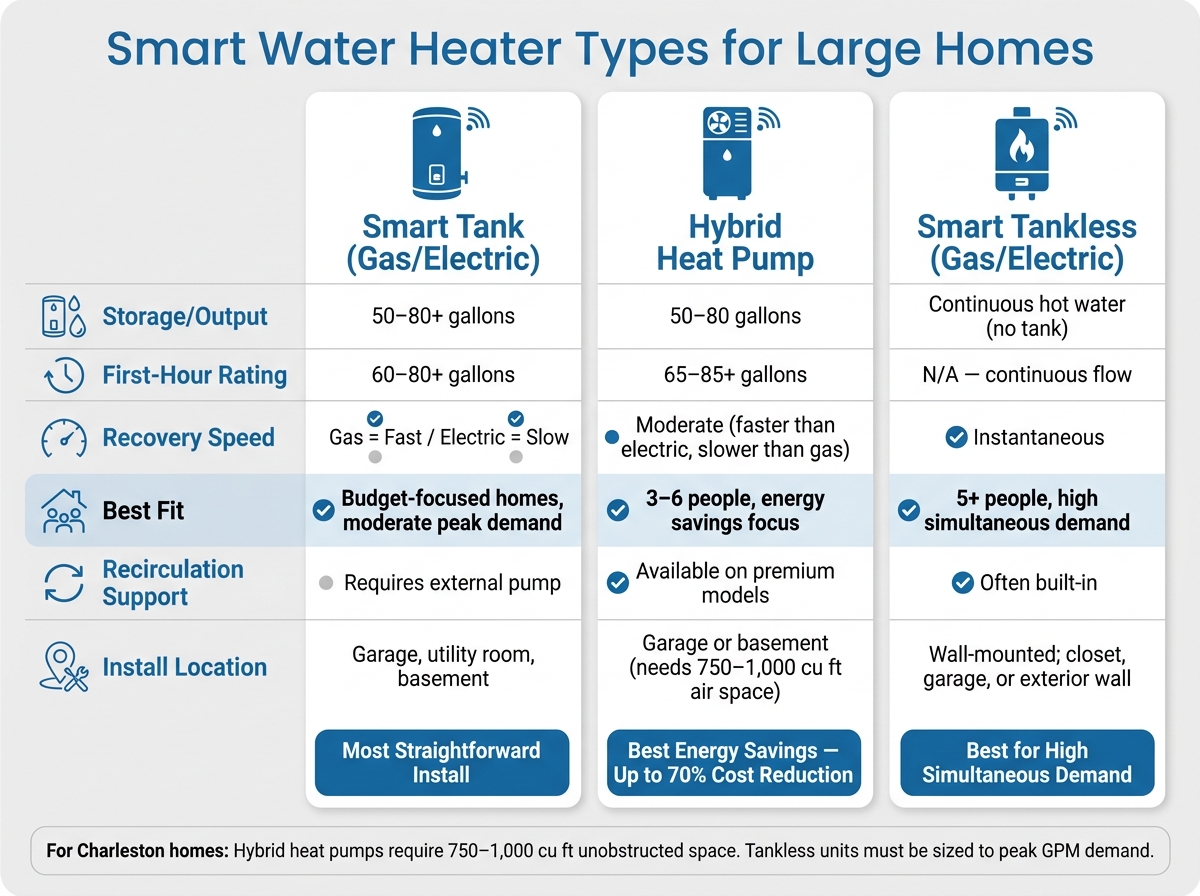
Smart Water Heater Types for Large Homes: Side-by-Side Comparison
Here’s how the three main smart water heater types stack up for large Charleston homes, especially when multiple bathrooms and appliances are running at the same time. Tank, hybrid, and tankless systems handle demand in different ways, so it helps to look at them side by side before picking a direction.
| Feature | Smart Tank (Gas/Electric) | Hybrid Heat Pump | Smart Tankless (Gas/Electric) |
|---|---|---|---|
| Storage Capacity / Output | 50–80+ gallons | 50–80 gallons | Continuous hot water; size by peak GPM |
| First-Hour Rating (FHR) | 60–80+ gallons | 65–85+ gallons | N/A – continuous flow |
| Recovery Speed | Gas: fast; Electric: slow | Moderate; faster than electric resistance, slower than gas | Instantaneous |
| Best Fit (Household Size) | Budget-focused homes with moderate peak demand | 3–6 people | 5+ people with high simultaneous demand |
| Recirculation Support | Often requires external pump | Supported on premium models | Often built-in |
| Typical Install Location | Garage, utility room, basement | Garage or basement (needs 750+ cu ft) | Wall-mounted; closet, garage, or exterior wall |
A few things jump out from this comparison.
Hybrid heat pump models are the top pick for energy savings in Charleston’s mild climate, but they do need room to breathe. Most require at least 750–1,000 cubic feet of unobstructed air space to run the way they should.
Tankless units make the most sense for homes with heavy hot-water use, especially when several fixtures may run at once. But sizing is everything. The unit’s peak GPM has to match your home’s simultaneous fixture demand, or you’ll feel the shortfall fast.
Smart tank models are the most straightforward upfront option. And within that group, gas has a clear edge on recovery speed. It rebounds much faster than electric, which matters when your household goes through one wave of hot water and then jumps right into another.
Use this comparison to narrow your options before lining up features with your household’s day-to-day hot-water pattern.
Which Features Matter Most for Charleston Households
Use the comparison above to figure out which features matter most for your home. Not every item on this list matters the same amount in every house. What should come first depends on your household size, floor plan, and utility bills.
If you have 5 or more occupants, put flow rate and recovery speed at the top of the list. For a tankless system, size for peak simultaneous demand and aim for a unit rated at 8–10 GPM so you have some breathing room. If you’re leaning toward a tank or hybrid system, look for a First Hour Rating of at least 85–100 gallons.
If you host guests on a regular basis, Wi-Fi scheduling and vacation modes are worth a close look. They let you boost output before guests arrive, then dial it back after they leave. That helps keep energy use under control without leaving anyone stuck with cold water.
If your home has long plumbing runs, move recirculation support near the top of your list. Without it, far-away bathrooms can waste a lot of water while everyone waits for hot water to show up. In a busy household, that waste adds up fast.
If your main goal is a lower operating cost, start with efficiency. For utility-bill control, hybrid heat pump models deserve a hard look in Charleston’s mild climate.
If you want help matching these features to a specific home, local installation support matters. For sizing, tankless installation, leak detection, and maintenance in Charleston or Bluffton, ALL Plumbing Services can help.
Conclusion
A large home needs a water heater that can keep up with peak demand, recovery rate, and pipe layout, not just tank size. In plain English: don’t judge a unit by gallons alone.
What matters most comes down to a short list: capacity, recovery speed, efficiency, app control, and leak protection. Once you know which features fit your household, make sure your home can support the unit you want.
Before you buy, check peak demand first. Then confirm the basics: electrical service, gas line, venting, and the space available for installation.
For sizing and installation help in Charleston and Bluffton, ALL Plumbing Services handles water heater assessment and installation.
Choose the model that fits your home’s demand, layout, and daily hot-water routine.
FAQs
How do I know what size smart water heater my home needs?
The right size depends on the system type.
For tank models, match the unit to your household size and the times when hot water use spikes. A common guide looks like this:
- 30–40 gallons for 1–2 people
- 40–60 gallons for 3–4 people
- 60–80+ gallons for larger households
Also, check the First Hour Rating. That tells you how much hot water the unit can deliver during your busiest times, like when someone’s showering while the dishwasher is running.
For tankless models, sizing works a bit differently. It’s based on GPM and the temperature rise the unit needs to handle, including Charleston’s typical 65–70°F incoming water temperature.
Is a heat pump water heater powerful enough for a large household?
Yes – if it’s sized the right way.
Heat pump water heaters usually recover more slowly than gas models. So if you have a larger household, you may need a bigger tank. For example, 80 gallons is often a better fit for homes with five or more bedrooms.
It also helps to pick a model with hybrid mode for times when hot water demand spikes. And installation matters more than many people expect. These units need about 700 cubic feet of surrounding air space to run well.
Do I need recirculation if my bathrooms are far from the heater?
If your bathrooms are a long way from the water heater, recirculation can help. A tankless water heater can give you endless hot water, but the water already sitting in the pipes still has to clear first. That’s why you can still get a delay when you turn on the tap.
Units with built-in recirculation pumps, or models that work with add-on pumps, keep hot water closer to your fixtures. The result is faster hot water delivery and less water going down the drain while you wait.