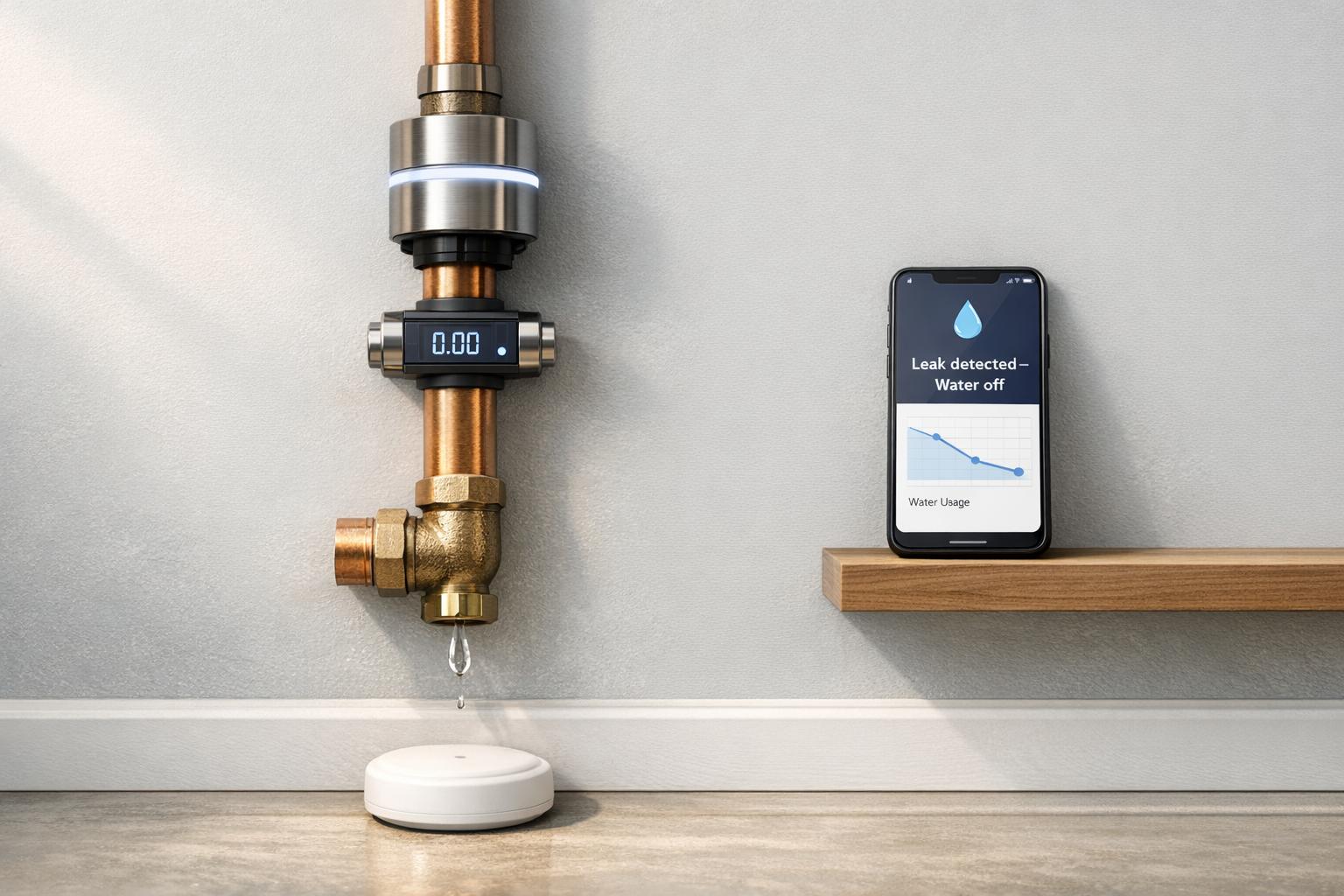
Smart leak detection systems are a practical way to prevent costly water damage and reduce wasted water. These systems use sensors, flow monitors, and automatic shut-off valves to detect leaks early and send real-time alerts to your smartphone. They can save you thousands in repair costs, lower water bills, and even qualify you for insurance discounts.
Key Highlights:
- Early Detection: Identifies leaks before they cause major damage.
- Cost Savings: Prevents repair costs of up to $23,000 and reduces water bills.
- Automatic Shut-Off: Stops water flow immediately when a leak is detected.
- Real-Time Alerts: Sends notifications via text, email, or app to keep you informed.
- Insurance Benefits: Some providers offer premium discounts for installing these systems.
Why It Matters:
Leaks can waste up to 900 billion gallons of water annually in the U.S., and mold can grow within 24–48 hours of water exposure. Smart leak detectors protect your home, conserve water, and provide peace of mind.
To maximize their effectiveness, professional installation and regular plumbing maintenance are recommended.
How Smart Leak Detection Systems Work
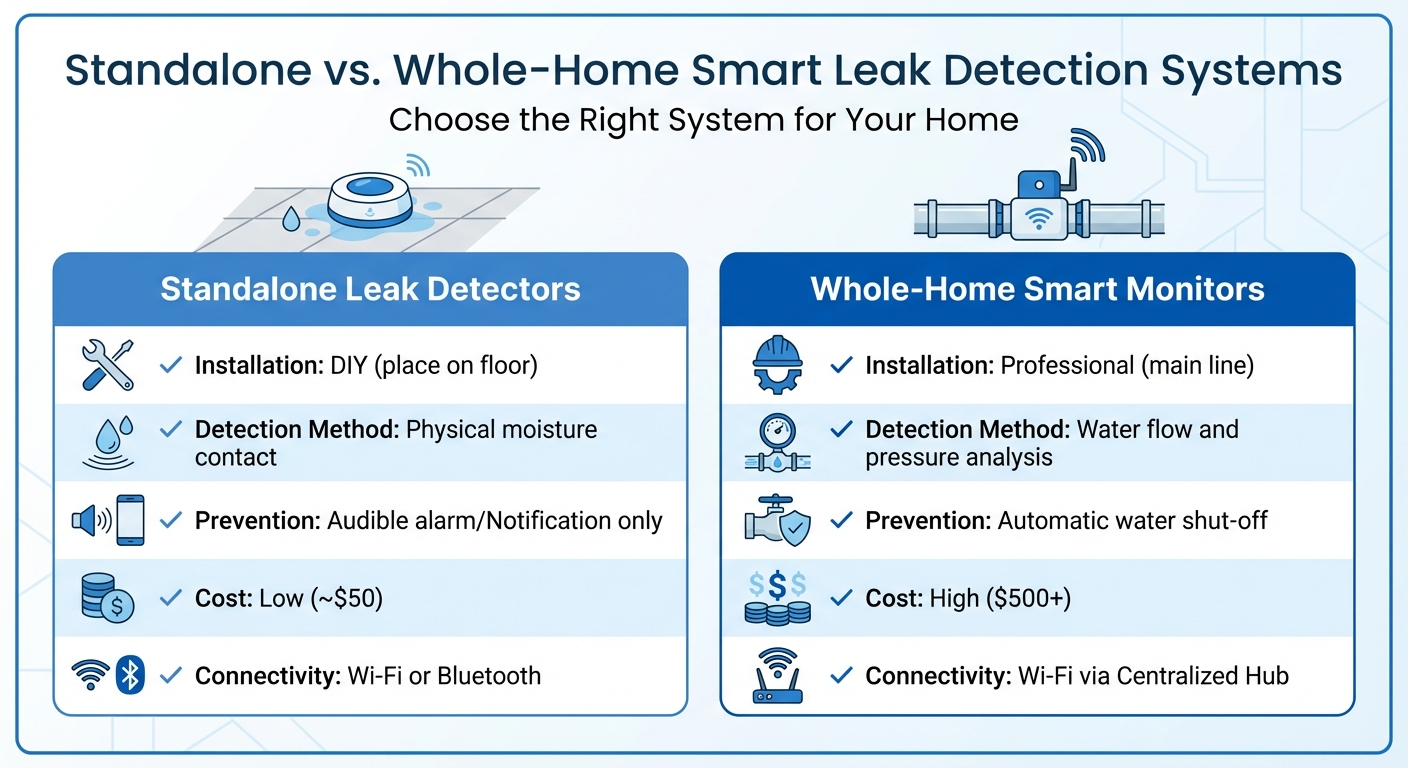
Smart Leak Detection Systems Comparison: Standalone vs Whole-Home Monitors
Smart leak detection systems use a mix of sensors, valves, and connectivity to detect water issues early, protecting your home from costly damage. These components work together to provide a safeguard against leaks.
Core Components and Technology
At the heart of these systems are conductivity sensors. These small devices have metal prongs that detect moisture. When water touches the prongs, it completes an electrical circuit, triggering an alert. Placing these sensors under washing machines, near water heaters, or beneath sinks – common leak-prone areas – maximizes their effectiveness.
Flow sensors are another key element. They monitor water volume and pressure to identify unusual usage patterns. Using either mechanical turbines or ultrasonic waves, flow sensors analyze water behavior to spot leaks. Some advanced systems feature a 7-day "Learning Mode" to understand your household’s typical water usage, enabling them to take proactive actions like shutting off water automatically.
Temperature sensors add another layer of protection. These use thermistors or thermocouples to monitor sudden temperature drops that could lead to frozen pipes. If indoor temperatures fall below 45°F, the system sends an alert. This early warning helps prevent pipe bursts, which can lead to expensive repairs.
Perhaps the most critical feature is the automatic shut-off valve. This valve integrates into your main water line or fits over an existing quarter-turn valve. When a leak is detected, the valve immediately stops the water flow, even if you’re not home. This rapid response minimizes potential damage and repair costs. All components communicate via Wi-Fi, ensuring instant alerts.
| Feature | Standalone Leak Detectors | Whole-Home Smart Monitors |
|---|---|---|
| Installation | DIY (place on floor) | Professional (main line) |
| Detection Method | Physical moisture contact | Water flow and pressure analysis |
| Prevention | Audible alarm/Notification only | Automatic water shut-off |
| Cost | Low (~$50) | High ($500+) |
| Connectivity | Wi-Fi or Bluetooth | Wi-Fi via Centralized Hub |
These components work together to provide continuous, real-time monitoring and protection.
Real-Time Monitoring and Mobile Alerts
With its advanced network of sensors, the system offers real-time monitoring to ensure immediate alerts. Some monitors even conduct daily "Health Tests", checking for leaks as small as one drop per minute by temporarily isolating the water line for pressure testing. This level of precision helps identify issues before they escalate.
"FloSense™ proactively monitors your home’s plumbing for any signs or leaks or unusual water usage. As soon as it identifies a potential leak based on unusual activity, FloSense™ triggers an alert to your smart phone… as well as the automatic shutoff feature." – Moen Solutions
Mobile apps allow users to stay in control, no matter where they are. These apps let you monitor water pressure, flow rate, and temperature in real-time. You can even manually shut off your water supply remotely or pinpoint specific fixtures – like a toilet, shower, or dishwasher – that may be causing unusual water use. Professional installation services, like those from ALL Plumbing Services, ensure these systems are set up for peak performance in your Charleston home.
To reduce false alarms during activities like filling a pool or washing a car, many systems include a "Sleep Mode" that temporarily disables alerts. Additionally, some insurance providers, such as Mercury Insurance, offer discounts of up to 8% for homeowners who install automatic water shut-off devices.
sbb-itb-998eb83
Benefits of Smart Leak Detection Systems
Smart leak detectors are a game-changer when it comes to protecting your property and avoiding costly repairs. By identifying leaks before they escalate, these systems save you time, money, and stress.
Early Detection and Damage Prevention
Smart leak detectors excel at spotting hidden moisture problems before they spiral into full-blown disasters. Once water damage becomes visible, repair costs can skyrocket. These systems take a proactive approach by sending instant alerts to your smartphone, allowing you to act quickly. This rapid response can stop mold growth – something that can start within just 24–48 hours – and help you avoid hefty remediation expenses.
Take the case of a family in Windermere, Florida, back in 2025. Their water bill suddenly tripled, prompting them to call Brightwater Plumbing. Using electronic leak detection, technicians discovered a hidden slab leak under their kitchen island. Thanks to early detection, they avoided an estimated $15,000 in additional water and structural damage. This example highlights how smart systems not only prevent extensive damage but also cut repair and utility costs significantly.
Lower Repair and Utility Costs
Early detection doesn’t just save your property – it saves your wallet, too. The sooner leaks are addressed, the less damage they cause, which directly reduces repair and utility expenses. For instance, catching a leak early can save up to $23,000 in repair and remediation costs.
The financial toll of undetected leaks goes beyond repairs. A toilet with a stuck fill valve, for example, can waste 4,300 gallons of water daily, adding $1,400 to your monthly water bill. Underground leaks from broken distribution lines are even worse, wasting 648,000 gallons a month and costing up to $7,200. Smart leak detection systems monitor water usage in real-time, identifying these silent leaks before they lead to massive bills.
| Leak Type | Estimated Water Waste | Potential Monthly Cost |
|---|---|---|
| Leaking Toilet (Worn Flapper) | 860 gallons / month | Up to $10 / month |
| Leaking Toilet (Stuck Fill Valve) | 4,300 gallons / day | Up to $1,400 / month |
| Underground Leak (Broken Line) | 648,000 gallons / month | Up to $7,200 / month |
Beyond savings, many insurance companies reward homeowners with premium discounts for installing smart leak detectors. Considering that water damage accounts for roughly 24%–25% of all U.S. household insurance claims, with the average claim costing $12,514 between 2017 and 2021, these systems can significantly reduce both claim frequency and severity. That means lower insurance costs and better protection for your home.
Safety and Water Conservation
The benefits of smart leak detection go beyond dollars and cents. These systems also enhance safety and conserve water. In the U.S., household leaks waste nearly 900 billion gallons of water annually, which breaks down to about 180 gallons per week for the average family – enough to run over 300 loads of laundry.
"Smart leak detectors can play a crucial role in preventing water waste that can occur when leaks go unnoticed for extended periods of time." – Jack Hope, Owner, Hope Plumbing, Heating & Cooling
Integration with Modern Plumbing Upgrades
Compatibility with Tankless Water Heaters and Repiping
Smart leak detection systems work seamlessly with modern plumbing upgrades to safeguard your home. When used with tankless water heaters, these systems can identify issues like internal component failures or connection leaks. While tankless water heaters don’t store water – reducing the risk of major flooding – they still have vulnerable spots, such as heat exchangers and supply lines, where leaks can develop.
By combining integrated flow monitoring with the built-in sensors of tankless water heaters, you get an extra layer of protection. This dual monitoring setup keeps tabs on water flow and pressure, catching potential problems that a single system might miss.
For those undergoing repiping, adding a whole-house shutoff valve during the installation of new PEX or copper pipes is a smart move to protect your investment. Professional installers often rely on tools like electronic detection and thermal imaging to ensure the new piping system is functioning perfectly – without the need to tear into walls unnecessarily. These upgrades enhance the early detection capabilities discussed earlier, offering long-term security.
"Smart systems that integrate shut-off valves, tankless water heaters, or sump pumps require precise calibration; a minor installation error can cause leaks or reduced functionality."
These advanced systems highlight the importance of professional installation and ongoing maintenance.
ALL Plumbing Services‘ Installation and Maintenance

ALL Plumbing Services, based in Charleston, SC, takes these integrations to the next level by offering expert installation of smart leak detection systems alongside advanced plumbing upgrades. Their technicians evaluate your home’s water pressure and pipe materials to ensure everything works smoothly before installation. If your home has older plumbing, adjustments may be necessary to safely incorporate smart technology.
They provide a range of options, from battery-powered sensors for localized leak monitoring to whole-house systems connected to your main water line. Installation costs vary, with basic detection systems typically priced between $150 and $400, while more advanced setups using acoustic sensors or thermal imaging can range from $500 to $1,000. For homes with plumbing systems older than 15 years, ALL Plumbing Services recommends annual inspections to check water pressure and ensure shutoff valves are functioning properly.
To keep your smart systems running smoothly, they also offer maintenance plans. These include regular testing, software updates, and sensor battery replacements. Routine upkeep is crucial, as even the most advanced smart leak detector needs proper calibration to remain effective.
Pros and Cons of Smart Leak Detection Systems
Comparison Table: Pros and Cons
Smart leak detection systems offer a mix of benefits and challenges, making it essential to weigh both before deciding to invest. While they provide solid protection against water damage and potential savings, they require an upfront financial commitment and ongoing maintenance.
| Pros | Cons |
|---|---|
| Early Detection: Spots leaks early, like pinhole leaks, which could save up to $23,000 in repair and mold remediation costs. | High Upfront Costs: Systems range from $350 to $700, with installation adding $375 to $600 or more in labor fees. |
| Automatic Shut-off: Automatically halts water flow when a leak is detected, even if you’re not home. | Installation Complexity: Professional installation might involve cutting and soldering pipes, while DIY setups require at least 4.5 inches of clearance on both sides of the valve. |
| Cost Savings: Helps reduce water bills by catching hidden leaks and may lower insurance premiums. | Technical Dependencies: These systems need reliable Wi‑Fi and power; without them, remote alerts won’t work. |
| Remote Monitoring: Sends real-time notifications through push alerts, texts, or emails, enabling action from anywhere. | Maintenance Requirements: Battery-powered sensors need regular checks and replacements to maintain functionality. |
| Health Protection: Prevents mold growth – mold can start forming within 24 to 48 hours of water exposure – and reduces asthma and allergy risks. | Physical Limitations: Sensors need precise placement; sloped floors can cause water to flow away from sensors, leaving leaks undetected. |
| Insurance Benefits: Some insurers offer discounts or reduced deductibles for homes equipped with smart shut-off valves. | Connectivity Range: Wi‑Fi-based systems may struggle to connect with remote sensors in large homes or basements. |
Experts agree that smart leak detection systems are a worthwhile investment for the peace of mind they provide and the potential to avoid costly repairs. To maximize their effectiveness, ensure your home has strong Wi‑Fi coverage, enough valve clearance for installation, and a power outlet within 10 feet of your main water line. These considerations can help you decide if this technology is the right fit for your home.
Conclusion and Next Steps
Key Takeaways
Smart leak detection systems do more than just protect your home – they save you money and reduce stress. By catching leaks early, they help avoid expensive water damage claims and minimize the risk of mold and mildew. They also cut down on repair costs, conserve water, and may even qualify you for insurance discounts. As Tommy Stricklin, Chief Water Specialist at Springwell Water, explains:
"Smart water leak detectors are a small investment with a big payoff".
These systems go beyond financial savings. With real-time smartphone alerts and automatic shut-off features, they provide constant monitoring and peace of mind. Whether you’re at work, on vacation, or asleep, the system ensures your home is protected around the clock. Plus, by conserving water, you’re contributing to efforts that benefit both your local community and the environment.
How ALL Plumbing Services Can Help
To take full advantage of these systems, it’s essential to work with experts who understand your home’s unique needs. ALL Plumbing Services offers professional installation and maintenance for homes in the Charleston area. Their team carefully places sensors in high-risk areas – like under sinks, near water heaters, and around appliances such as dishwashers and washing machines. They also integrate automatic shut-off valves with your main water line for comprehensive protection. If you’re tackling other plumbing projects, like installing a tankless water heater or repiping your home, they can seamlessly add leak detection enhancements at the same time.
"Trust us to give our professional recommendations on the best actions to avoid future problems, and never worry that we’re trying to sell you a product or a service you don’t need." – ALL Plumbing Services
For a personalized assessment and solution, call 843-761-8002. With over 30 years of experience serving Charleston, James Island, and Moncks Corner, ALL Plumbing Services offers 24/7 emergency support and guarantees satisfaction on all their technology-driven plumbing solutions.
FAQs
Do I need a whole-home monitor or just spot sensors?
When deciding between leak detection options, think about your specific needs. A whole-home monitor is perfect if you’re looking for broad coverage to detect leaks throughout your entire house. On the other hand, spot sensors are better suited for keeping an eye on specific appliances or areas that are more likely to experience leaks. Assess the areas you want to protect and the level of coverage you need before making your choice.
Will it still protect my home if Wi-Fi or power goes out?
Smart leak detection systems with offline protection can guard your home even during Wi-Fi or power outages. These systems operate using preset thresholds to identify leaks. However, keep in mind that notifications won’t reach you until Wi-Fi is back online. To ensure continuous operation, make sure the system remains powered.
Where should sensors and the shut-off valve be installed?
To protect your home from potential water damage, it’s smart to install sensors in areas where leaks are most likely to occur. Common spots include around water heaters, under sinks, and along water supply lines. Pair these sensors with a shut-off valve installed on the main water supply line. When a leak is detected, the valve automatically cuts off the water flow, minimizing damage and saving you from expensive repairs.