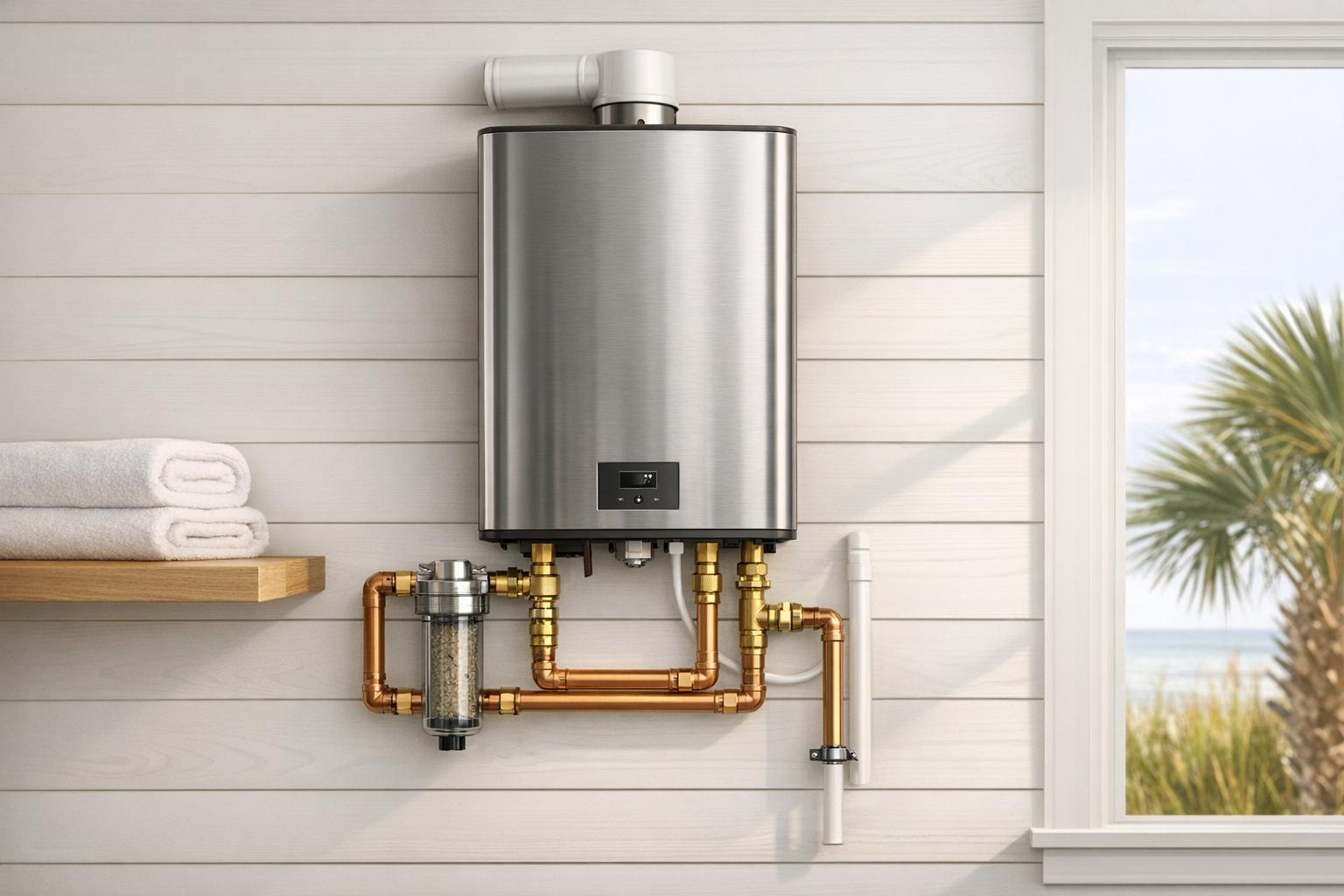
Tankless water heaters are a smart choice for Charleston homeowners. These systems heat water on demand, save space, and are more energy-efficient than traditional tanks. They’re especially suited to Charleston’s coastal conditions, as they resist corrosion from salty air and high humidity. With lifespans of 20+ years, tankless units also reduce maintenance and replacement costs.
Here are the top 5 brands to consider:
- Rinnai: Known for reliability, energy efficiency (up to 0.98 UEF), and durability in humid climates. Offers models with flow rates up to 11 GPM and freeze protection.
- Navien: High-efficiency systems (up to 0.96 UEF) with stainless steel components to withstand corrosion. Features like ComfortFlow® ensure consistent water temperatures.
- Rheem: Offers gas and electric options with flow rates up to 11 GPM. Durable designs resist rust and include water-saving features.
- A. O. Smith: Energy-efficient models with advanced scale prevention technology to handle Charleston’s hard water. Includes options for recirculation and freeze protection.
- Eccotemp: Locally based in Summerville, SC, this brand designs systems for Lowcountry conditions. Offers portable and whole-home models with app-enabled controls.
Why these brands work for Charleston:
- They handle salty, humid air and hard water effectively.
- Compact designs save space in older homes.
- Energy efficiency reduces operating costs by up to 30–40%.
Quick Tip: Regular maintenance, like annual descaling, ensures peak performance and extends the lifespan of your system. For professional installation or servicing, consult a licensed technician familiar with Charleston’s unique climate challenges.
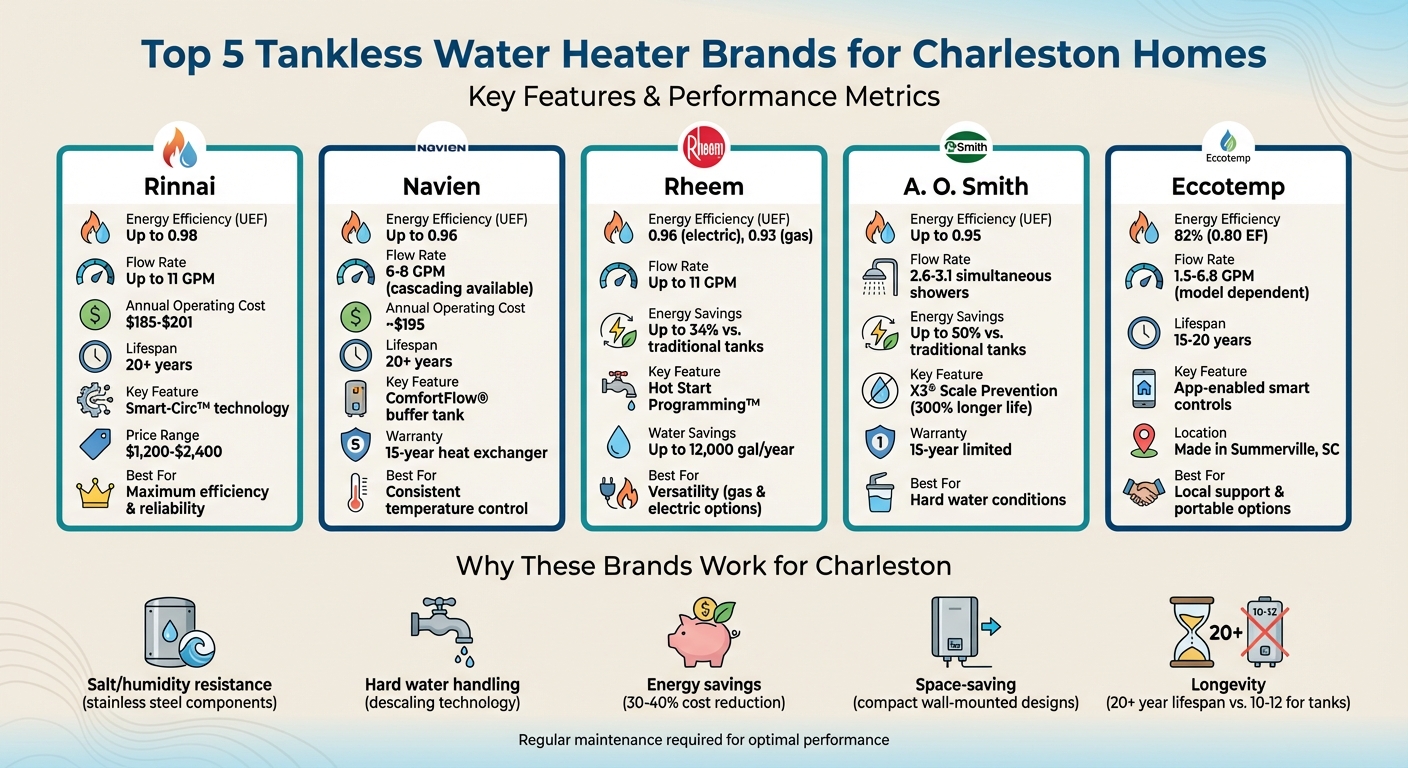
Top 5 Tankless Water Heater Brands Comparison for Charleston Homes
1. Rinnai
Rinnai, a company with a century of experience, stands out for its reliability and efficiency, especially with its tankless water heaters designed to handle Charleston’s unique climate. As the first major brand to assemble tankless water heaters in the U.S., Rinnai has proven its ability to balance performance and durability in challenging conditions.
Energy Efficiency
The SENSEI RX Series from Rinnai boasts an impressive efficiency rating of up to 0.98 UEF. This is achieved through dual heat exchangers that use condensing technology to capture more heat from exhaust gases. For homeowners, this translates to annual operating costs of about $185–$201, a significant drop compared to the $626 typically incurred with a standard 50-gallon electric tank. The Smart-Circ™ Intelligent Recirculation technology further enhances efficiency by learning your household’s hot water usage patterns and delivering hot water on demand, eliminating unnecessary energy waste. To make the initial investment more appealing, ENERGY STAR® rebates and local utility incentives are often available, helping offset the purchase price, which ranges from $1,200 to $2,400.
Durability in Humid Conditions
Charleston’s coastal environment, with its high humidity and salt air, demands equipment that can endure tough conditions. Rinnai units are built to commercial-grade standards, making them highly durable in these settings. Outdoor-rated models include added corrosion resistance for installations exposed to the elements. Many Rinnai systems also feature freeze protection, capable of operating in temperatures as low as -22°F indoors and -4°F outdoors when properly powered and supplied with gas. With a lifespan of up to 20 years – twice that of traditional tank water heaters – Rinnai systems offer long-term savings by reducing replacement costs.
Flow Rate (GPM)
Rinnai offers a range of models with flow rates from 5 to 11 GPM, catering to households with varying hot water needs. Charleston’s mild incoming water temperatures, typically between 65°F and 70°F, allow these units to perform efficiently year-round. For larger households or homes with multiple hot water demands, selecting a model with a higher GPM rating is crucial. Consulting a professional can help ensure you choose the right unit for your household.
Suitability for Charleston’s Water Quality
Charleston’s water quality necessitates annual descaling to prevent mineral buildup and maintain peak performance. While indoor installations offer added protection against salt air, outdoor-rated models are available for homes where indoor installation isn’t an option. Using a certified Rinnai PRO for installation not only ensures proper sizing and setup but also provides an additional 4 years of labor coverage if the unit is registered within 90 days.
sbb-itb-998eb83
2. Navien
Navien offers high-efficiency tankless water heaters designed to handle Charleston’s coastal environment. Their patented NaviTech™ stainless steel heat exchangers and burners are built to resist corrosion, a critical feature for the humid, salt-heavy air of the Lowcountry.
Energy Efficiency
Navien’s condensing models achieve up to a 0.96 uniform energy factor, operating at 96% efficiency. This is made possible by dual stainless steel heat exchangers that reclaim heat from exhaust gases. The result? Lower annual operating costs – around $195 compared to $319 for a standard 50-gallon tank. Additionally, cooler exhaust temperatures allow for cost-effective venting materials like Schedule 40 PVC or polypropylene. Navien’s ComfortFlow® system, which includes a buffer tank and recirculation pump, ensures consistent water temperatures and eliminates the dreaded "cold water sandwich" effect. These features make Navien a smart choice for energy-conscious homeowners in coastal areas.
Durability in Humid Conditions
Charleston’s climate demands water heaters that can withstand constant exposure to moisture and salt. Navien’s stainless steel components are rigorously tested for reliability in such conditions. The dual stainless steel heat exchangers come with a 15-year warranty, reflecting the brand’s commitment to durability. Additionally, some models are specifically designed for outdoor installation, addressing the unique challenges posed by coastal environments. With a longer lifespan than traditional tank water heaters, Navien’s tankless systems are well-suited for Charleston’s demanding climate.
Flow Rate (GPM)
Navien units are built for performance, offering high flow rates to meet varying household needs. Their high-BTU models can deliver up to 199,900 BTU/h, ensuring reliable hot water even during winter when groundwater temperatures dip to 50°F. For homes requiring 6–8 GPM, Navien’s cascading feature activates a secondary unit once the first reaches 80% capacity, ensuring steady hot water supply. The NaviSizer tool is available to help homeowners select the right model based on factors like the number of bathrooms and local groundwater conditions.
Suitability for Charleston’s Water Quality
Navien’s design also takes Charleston’s moderately hard water into account. To maintain peak performance and prevent mineral buildup, annual descaling is recommended. Unlike traditional tanks that can accumulate rust and scale over time, Navien’s tankless systems heat water directly as it flows through, preserving water quality. Proper installation by a licensed contractor is essential for safe operation, valid warranties, and correct gas line and venting connections. For added convenience, the optional NaviLink™ Wi-Fi system allows homeowners to monitor energy usage and adjust water temperatures remotely via smartphone.
3. Rheem
Rheem tankless water heaters are designed to deliver dependable performance, with features that cater specifically to Charleston’s unique climate. Their condensing models use dual heat exchangers, where a secondary exchanger preheats water by capturing heat from exhaust gases. This not only improves efficiency but also allows for lower-cost PVC venting options. Gas-powered units can be up to 34% more efficient than traditional 50-gallon storage tank systems, while high-efficiency models like the ThermaForce™ line can help homeowners cut energy costs by as much as 32% annually.
Energy Efficiency
Rheem’s electric models feature self-modulating technology, which ensures energy is used only as needed. Residential options boast UEF ratings of up to 0.96 for electric models and 0.93 for gas models. Their Hot Start Programming™ keeps the unit primed for five minutes after use, minimizing cold water bursts and reducing waste. Additionally, some models include water-saving settings that can conserve up to 1,000 gallons of water annually. These features make Rheem a strong choice for energy-conscious households in humid climates.
Durability in Humid Conditions
Rheem water heaters are built to handle Charleston’s humid, coastal environment. Select electric models, such as the RTEX-08 and RTEX-13, feature durable polymer shells that resist rust and corrosion. Larger units are equipped with powder-coated shells and galvanized steel backplates for added protection against environmental wear. Many models also include stainless steel heat exchangers, which help prevent corrosion and extend the unit’s lifespan – an essential consideration for Charleston’s Lowcountry conditions. For outdoor installations, Rheem offers models designed to withstand the elements, freeing up indoor wall space and eliminating the need for additional venting.
Flow Rate (GPM)
With flow rates reaching up to 11 gallons per minute, Rheem units can easily handle the demands of a busy household – think three showers, a dishwasher, and a washing machine running at the same time. The IKONIC and RTGH series deliver between 9.5 and 11.2 GPM, making them perfect for homes with multiple bathrooms. Recirculation models offer additional water savings, potentially reducing water usage by up to 12,000 gallons per year. Rheem’s compact design, including side-to-side clearance, allows for installation in tight spaces like closets or small utility rooms, a practical feature for historic Charleston homes.
Suitability for Charleston’s Water Quality
Charleston’s mineral-rich water requires regular maintenance to keep tankless systems running efficiently. Routine flushing and annual descaling are recommended to maintain performance and longevity. Proper sizing is also key – since Charleston’s incoming water temperatures typically range from 65-70°F, units should be chosen based on peak fixture usage rather than home size. For homes in salt-air environments, such as Sullivan’s Island or Isle of Palms, indoor installations are preferred. However, outdoor-rated models with corrosion-resistant features are available for added flexibility.
4. A. O. Smith
A. O. Smith tankless water heaters are designed to bring energy efficiency and reliability to homes in Charleston. The Adapt®+ Premium Condensing line even received the 2025 Silver Edison Award for Sustainable Consumer Product Innovation. These heaters only activate when a tap is opened, eliminating standby energy loss. Gas tankless models can cut energy use by up to 50% compared to traditional tank units, while premium condensing models boast a Uniform Energy Factor (UEF) of up to 0.95 – far exceeding standard models.
Energy Efficiency
A. O. Smith uses advanced condensing technology with dual heat exchangers that recycle heat from exhaust gases, boosting efficiency. Many of their ENERGY STAR® certified models qualify for federal tax credits and local utility rebates, which is a big win for Charleston homeowners. According to the U.S. Department of Energy, tankless water heaters can be up to 34% more efficient than traditional models, especially in homes using less than 41 gallons of water daily. The X3® Scale Prevention Technology is another standout feature, extending the heater’s lifespan by up to 300% by preventing mineral buildup.
Table: Key Features of A. O. Smith Models
| Feature | Non-Condensing (Adapt® NC) | Standard Condensing (Adapt® SC) | Premium Condensing (Adapt®+) |
|---|---|---|---|
| UEF | ~0.82 | Up to 0.95 | Up to 0.95 |
| Heat Exchanger | Copper | Dual Copper & Stainless Steel | Single Heavy-Duty Stainless Steel |
| Scale Prevention | X3® Technology available | X3® Technology available | X3® Technology available |
| Recirculation | Accessory pump required | Accessory pump required | Integrated pump |
Durability in Humid Conditions
Charleston’s warm, humid climate often poses challenges for appliances, but A. O. Smith models are built to thrive in these conditions. Their tankless units are ideal for outdoor installations, saving indoor space and simplifying venting requirements. All models come with built-in freeze protection, making them suitable for coastal environments. Non-condensing units, in particular, use high-temperature metal venting to reduce corrosion risks. Plus, the X3® Scale Prevention system helps homeowners save up to $200 annually in maintenance costs by managing mineral buildup automatically.
Flow Rate (GPM)
A. O. Smith sizes its units to meet simultaneous water demands, making them practical for Charleston households. For instance, the Adapt XE Premium Condensing model can handle up to 3.1 showers at once, while mid-range options like the ATI-510U are capable of supporting 2.6 simultaneous showers. Thanks to Charleston’s warmer climate, these units achieve even better flow rates compared to colder regions. Customer feedback reflects their reliability, with the ProLine® XE series earning a 4.5/5 rating from 41 reviews, and the Adapt®+ Premium Condensing line achieving a flawless 5.0/5.
Suitability for Charleston’s Water Quality
Charleston’s hard water makes water filtration systems and X3® Scale Prevention Technology essential features. This system alters the chemical properties of scale, allowing it to pass through the heat exchanger without sticking, which prevents performance issues. For homes with heavy water usage – like those running multiple showers and laundry at the same time – the Adapt®+ Premium Condensing models include integrated recirculation pumps for instant hot water. Additionally, all gas tankless models come with a 15-year limited warranty that covers scale-related issues for X3®-equipped units. These features make A. O. Smith a top choice for Charleston homes dealing with mineral-rich water.
5. Eccotemp
Eccotemp, a family-owned company based in Summerville, SC, designs tankless water heaters with a deep understanding of the Lowcountry’s humid climate and specific water conditions. With its local roots, the brand has become a trusted choice for Charleston homes. Eccotemp is recognized as the top global seller of portable tankless water heaters, with over 250,000 customers and thousands of 5-star reviews on platforms like Amazon, Home Depot, and Lowe’s.
Energy Efficiency
Eccotemp water heaters are designed to heat water only when needed, avoiding the energy losses that come with traditional tank heaters. Their spark ignition system operates solely on demand, using fuel only during active operation. For example, the 45HI-LP whole-home model boasts an energy efficiency rating of 82% and an energy factor of 0.80. Thanks to Charleston’s warmer groundwater temperatures, these units require less energy to heat water to the desired temperature. Additionally, the Eccotemp app offers smart scheduling features, including "Eco-Mode", allowing users to turn the system off during work hours or vacations, which can lead to noticeable savings on utility bills. Built for longevity, these units can last 15 to 20 years – nearly twice as long as traditional tank heaters.
Durability in Humid Conditions
Eccotemp’s expertise in Lowcountry manufacturing ensures their products are built to handle Charleston’s environmental challenges. For example, the Luxé Portable series features Tri-Coat Pearl White Paint, specifically designed for humid coastal climates. Brass water and gas connections help protect against corrosion in moisture-heavy air. To combat the effects of mineral-rich coastal water, Eccotemp includes EZ-Flush descaling kits and internal bypass lines in select models. Regular descaling, recommended twice a year, prevents mineral buildup that could reduce efficiency. The EZ-Flush System Descaling Kit, priced at around $169, helps maintain optimal heat transfer and performance.
Flow Rate (GPM)
Eccotemp offers a range of flow rates, from 1.5 GPM for portable units to 6.8 GPM for whole-home systems. For instance, the SH12-A series delivers 4.0 GPM, making it suitable for one to two fixtures at a time. The SH22 series provides 6.8 GPM, allowing for simultaneous use, such as two showers and a kitchen sink. Builder Series models cater to higher demands with flow rates between 6.5 and 7.0 GPM. Most models activate heating at a low minimum flow rate of just 0.5 GPM, ensuring consistent hot water even for low-flow fixtures. The SH22 series has earned an impressive average rating of 4.8 out of 5, with users praising its app-enabled temperature control. To choose the right model, calculate your peak GPM needs: a typical shower uses about 2.5 GPM, while a dishwasher requires around 1.5 GPM.
Suitability for Charleston’s Water Quality
Given Charleston’s mineral-rich water, regular descaling is key to maintaining performance. The Eccotemp mobile app helps by providing maintenance reminders and tracking real-time energy usage. Luxe series models feature stainless steel or copper heat exchangers that resist corrosion, further demonstrating Eccotemp’s commitment to addressing coastal water challenges. With proper care, these units can reliably serve Charleston homes for 20 years or more.
Why These Brands Work Well for Charleston Homes
Charleston’s coastal setting presents unique challenges for water heaters, and brands like Rinnai, Navien, Rheem, A. O. Smith, and Eccotemp have features that cater to the region’s specific needs.
The humidity and salt-laden air in Charleston accelerate corrosion, especially in exposed areas. Preferred Home Services highlights how salt in the air can speed up the wear and tear on water heaters. To combat this, these brands incorporate durable materials like stainless steel heat exchangers, which are more resistant to corrosion. Their compact, wall-mounted designs also allow for indoor installation, offering extra protection from the elements. These features help ensure reliable performance in Charleston’s challenging environment.
Charleston’s moderately hard water can lead to mineral buildup, a common issue for traditional water heaters. Tankless systems, however, heat water only as needed, reducing the risk of scaling. Julia Mason from Atlantic Plumbing Services notes:
"Rinnai is a trusted name… built to last with quality materials, perfect for Charleston’s humid conditions".
With regular maintenance, these systems can outlast traditional tank models, providing years of dependable service.
Another consideration for Charleston is the need for significant temperature increases. Holy City Heating & Air explains that local groundwater temperatures often start at around 50°F, requiring a rise of 70°F to reach comfortable levels. These brands excel in delivering consistent hot water, even for multiple fixtures running simultaneously. Most models can handle 6–8 gallons per minute (GPM), which is ideal for typical Charleston homes. Additionally, they can cut water heating costs by 30% to 40%.
Whether it’s a historic downtown home with limited space or a modern suburban property, these brands offer solutions that fit Charleston’s diverse housing styles. By addressing the area’s environmental and performance demands, these tankless water heaters provide a reliable and efficient choice for homeowners in the Lowcountry.
Professional Installation and Maintenance with ALL Plumbing Services
Getting your plumbing system installed correctly and keeping up with maintenance is key to ensuring it runs smoothly. With 40 years of experience, ALL Plumbing Services knows how to handle Charleston’s unique challenges, like hard water and coastal humidity. Their certified technicians bring the expertise needed to keep your system in top shape.
They specialize in expert sizing, code-compliant installations, and routine maintenance to catch potential problems early. As one satisfied customer, Matt W., shared:
"He gave me real, meaningful advice on additional improvements I could make to our home’s plumbing without making the experience feel uncomfortable or pushy."
For Charleston residents dealing with hard water, regular upkeep is crucial. Flush your system annually, check and replace the anode rod every 1–2 years, and keep your unit set to 120°F to reduce wear and tear. If your home has a high mineral content, adding a water softener can cut down on maintenance and extend the life of your system. These small steps go a long way in maintaining efficiency and durability.
ALL Plumbing Services also offers year-round inspection plans, using advanced diagnostics to detect leaks or venting issues before they become major problems. Their commitment to quality is backed by a 100% satisfaction guarantee, along with free estimates for new installations.
For those looking to save energy, they suggest high-efficiency models and insulation upgrades. These simple adjustments can significantly improve energy retention, especially in Charleston’s humid climate – helping you save money while staying eco-friendly.
Conclusion
Switching to a tankless water heater can provide Charleston homeowners with dependable hot water, better energy efficiency, and a compact design that fits seamlessly into most homes. These systems are reported to be 24% to 34% more energy-efficient than traditional storage tank heaters, potentially saving up to $3,500 over their lifespan.
That said, Charleston’s unique conditions – like hard water, coastal humidity, and colder groundwater temperatures in winter – make professional installation and maintenance critical. Skilled technicians can ensure your unit is properly sized, handle necessary gas or electrical upgrades, and install venting that meets safety codes. To ensure consistent performance, opt for a system capable of managing a 70°F temperature rise.
Routine maintenance is key, especially in the Lowcountry. Annual flushing helps prevent mineral buildup, keeps the system running efficiently, and ensures your warranty remains valid. As Energy.gov highlights:
"Tankless heaters can be 24-34% more efficient than conventional storage tank water heaters, depending on your water usage".
FAQs
What are the advantages of installing a tankless water heater in Charleston’s coastal climate?
Installing a tankless water heater in Charleston’s coastal climate comes with some great perks. For starters, these systems deliver hot water on demand, so you’re only heating water when you actually need it. This can lead to noticeable energy savings and lower utility bills over time. Plus, tankless models are built to cut down on standby heat loss, making them more efficient than traditional water heaters.
Another big win? Their compact and durable design handles Charleston’s humid, salty air much better. They’re less likely to suffer from corrosion or wear, which means they last longer and perform reliably, even in tough coastal conditions. Choosing a tankless water heater means you’ll have a steady supply of hot water while keeping maintenance low and reducing energy waste.
How can I determine the right tankless water heater flow rate for my home?
To determine the right flow rate for your tankless water heater, start by estimating your household’s peak hot water demand. Add up the flow rates (measured in gallons per minute, or GPM) for all the fixtures and appliances you might use simultaneously. For instance:
- Showers typically use 1.5–2.0 GPM
- Kitchen faucets range from 1.0–2.2 GPM
- Washing machines consume about 1.5–3.0 GPM
To get accurate numbers, check the manufacturer’s specifications or manuals for each fixture. Once you’ve confirmed the flow rates, total them up to calculate your maximum demand. This figure will help you choose a tankless water heater that can keep up with your household’s needs without running out of hot water.
Don’t forget to factor in your local water temperature. If your incoming water is colder, the heater will need to work harder to reach your desired temperature. Make sure the unit you select can handle both the required flow rate and the heating demands for your area.
How can I maintain my tankless water heater to ensure it lasts longer in Charleston?
To keep your tankless water heater working smoothly and lasting longer, regular upkeep is a must. One critical step is descaling the unit once a year. Charleston’s hard water can lead to mineral buildup, which impacts efficiency and can even harm the system. Flushing the heater with a descaling solution, like vinegar or a commercial cleaner, helps clear out these deposits and keeps the system running effectively.
Beyond descaling, it’s important to routinely check and clean filters, venting, and lines to catch any blockages or early signs of wear. Key components like the heat exchanger, burners, and valves should also be inspected to ensure everything is functioning properly and safely. Staying on top of maintenance not only boosts energy efficiency but also lowers the chances of unexpected breakdowns – an essential part of keeping your Charleston home running smoothly.