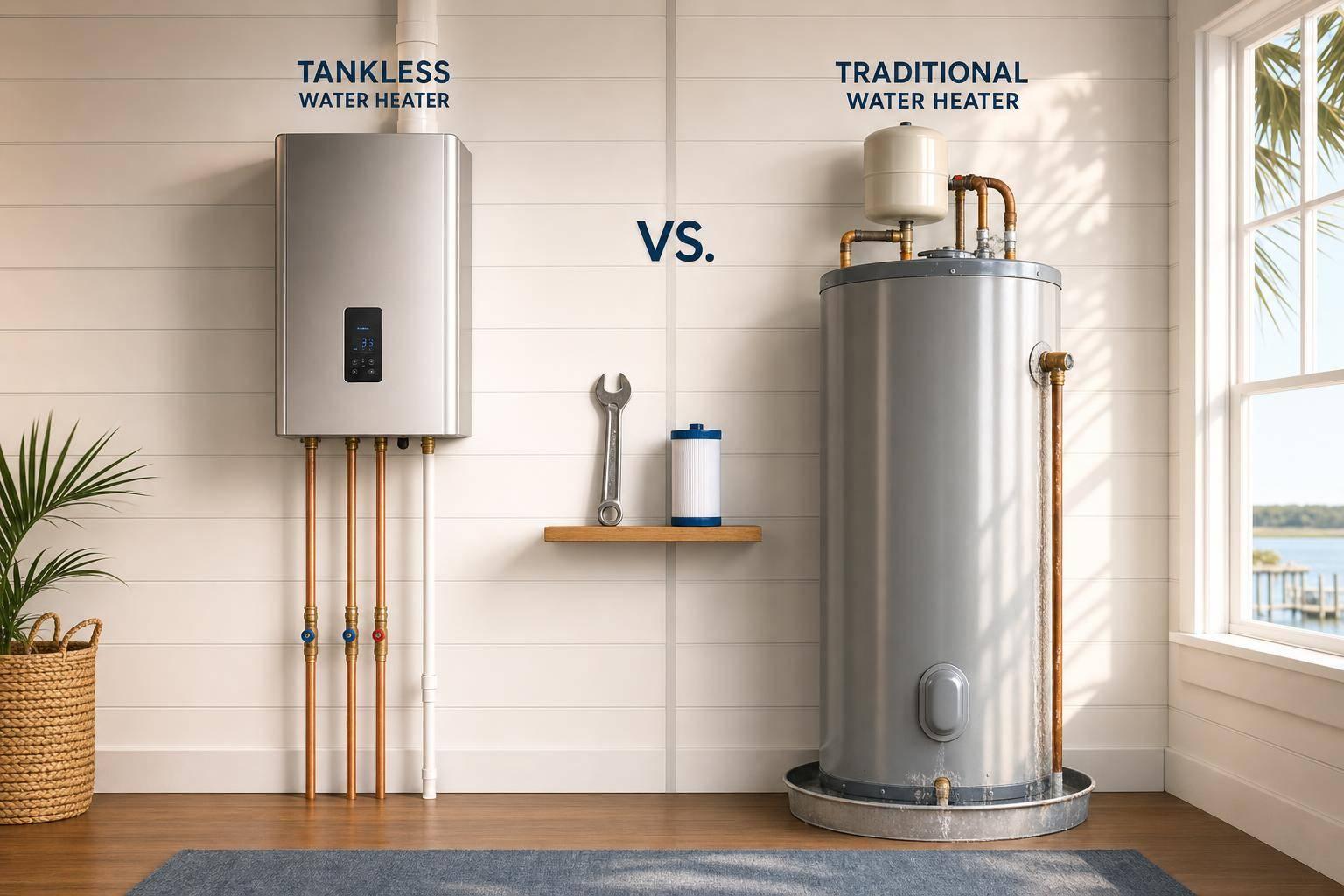
If I live in Bluffton, the better water heater usually comes down to upfront cost, hot water demand, hard water, and coastal wear. A tankless unit can last up to 20 years, uses less energy, and saves space. A tank model costs less to install, but it often lasts only 8–12 years and can wear out faster near salt air and humidity.
Here’s the short version:
- Choose tankless if I want lower monthly energy use, long service life, and steady hot water.
- Choose a tank model if I want a lower install price and a simple swap.
- Hard water matters for both. Tankless units need descaling every 12–18 months. Tank units need a flush about once a year.
- Home size matters. A small condo may do fine with one compact unit. A large waterfront home may need two tankless units or a larger gas setup.
- Electric tankless can be tough on power panels. Some units need multiple 50-amp circuits.
- In Bluffton, warm incoming water helps tankless performance, but salt air and humidity can wear down metal parts.
If I had to sum it up in one line: tankless fits long-term savings and space savings, while a tank model fits lower first cost.
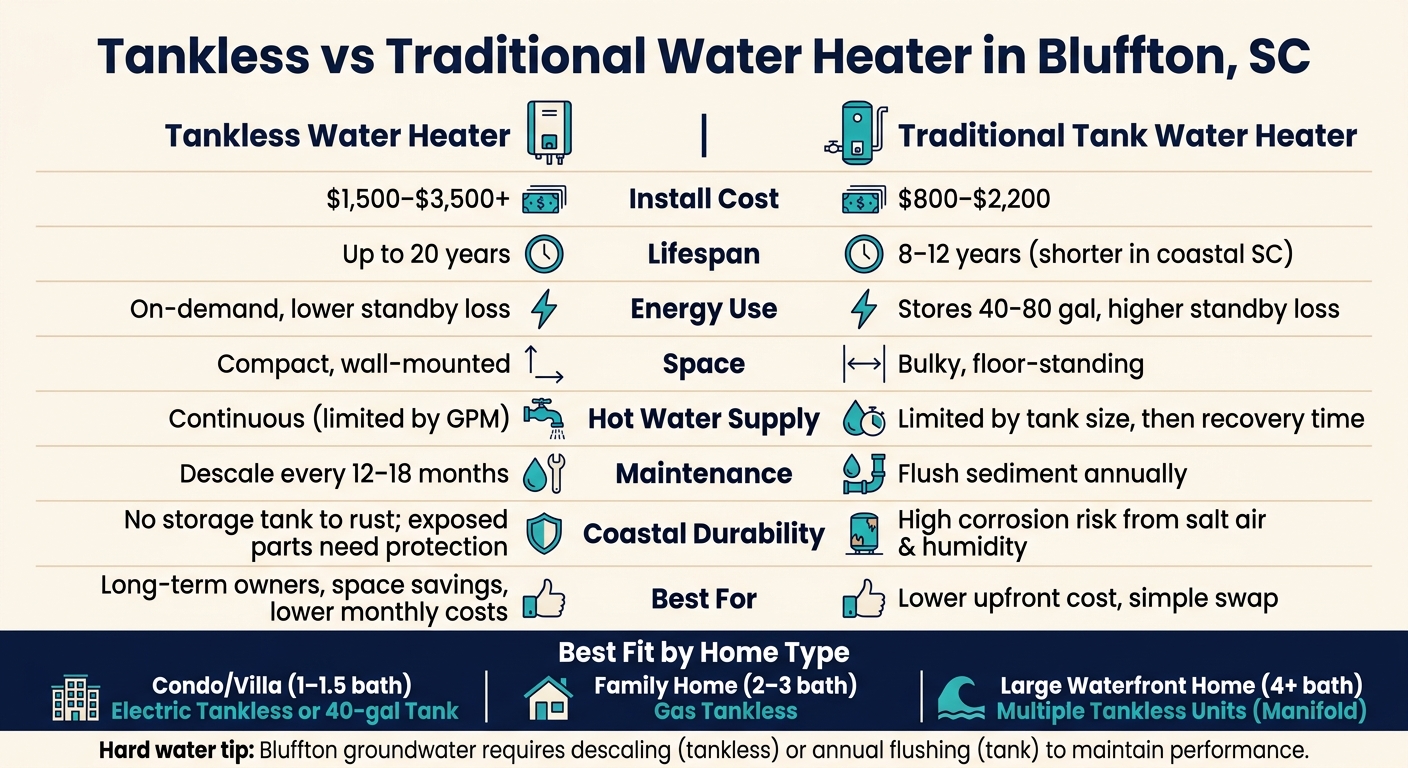
Tankless vs Traditional Water Heater: Bluffton SC Comparison
Quick Comparison
| Feature | Tankless | Tank Water Heater |
|---|---|---|
| Install cost | $1,500–$3,500+ | $800–$2,200 |
| Life span | Up to 20 years | About 8–12 years |
| Energy use | Lower due to on-demand heating | Higher due to stored hot water |
| Space needed | Small, wall-mounted | Larger, floor-standing |
| Hot water supply | Continuous, but limited by flow rate | Limited by tank size |
| Service needs | Descale every 12–18 months | Flush about yearly |
| Bluffton coastal wear | No storage tank to rust, but parts still need protection | Tank and outer parts can corrode faster |
For me, the main question is simple: How much hot water do I use at one time, and how long do I plan to stay in the home? That usually points to the right pick fast.
sbb-itb-998eb83
2. Side-by-Side Comparison for Bluffton Homes
These local conditions show up most clearly in cost, upkeep, and day-to-day hot water performance.
| Feature | Tankless | Traditional Tank |
|---|---|---|
| Installed Cost | $1,500–$3,500+ | $800–$2,200 |
| Lifespan | Up to 20 years | 8–12 years (shorter in coastal SC) |
| Energy Efficiency | High – heats only on demand | Lower – standby heat loss |
| Space | Compact, wall-mounted | Bulky, floor-standing (40–80 gal) |
| Hot Water Output | Continuous, limited by flow rate (GPM) | Limited to tank capacity |
| Maintenance | Descaling every 12–18 months | Annual sediment flushing |
| Coastal Durability | No tank to corrode; exposed parts still need protection from humidity and salt air | High risk of exterior tank corrosion |
Installed cost, lifespan, and maintenance
For upfront cost, a standard tank water heater is usually the lower-priced pick. Installed, most 40- to 50-gallon gas or electric models land between $800 and $2,200. Tankless systems usually run $1,500 to $3,500 or more. On top of that, gas line changes, venting, electrical work, permits, and haul-away fees can add $50 to $300 to either setup.
Where tankless starts to pull ahead is service life. With proper care, a tankless unit can last up to 20 years. That’s much longer than a standard tank, especially in coastal conditions where salt air and humidity speed up corrosion on metal exteriors and connections.
Upkeep matters with both types, just in different ways. Tank units need a yearly flush to clear out sediment before it cuts heating output. Tankless units need descaling every 12 to 18 months so mineral buildup doesn’t clog the heat exchanger.
See our water heater options and tankless systems for model-level details.
Energy use, space, and hot water output
A tank water heater keeps 40 to 80 gallons hot all day, whether you use that water or not. That standby heat loss is a big reason tankless systems often cost less to run each month. In Bluffton, warmer incoming water also means less energy is needed to heat it, which gives tankless another edge.
Space is another easy place to spot the difference. A wall-mounted tankless unit can open up floor space in a utility closet, garage, or crawl space. A tank unit, by comparison, takes up a lot more room.
Hot water performance depends on how your home uses water. Tankless gives you a continuous supply, but if several fixtures run at once, an undersized unit will show its limits fast. A properly sized tank can handle that same demand until the stored hot water is gone, then it needs recovery time. That’s why sizing matters so much. For tankless, it affects flow rate. For tank systems, it affects recovery time. Home size and fixture demand are the next things to look at.
3. Which System Fits Different Bluffton Homes
Once you compare cost and performance, the next step is simple: look at the home itself. Layout, daily hot water use, and how long you plan to stay in the property often point to the better pick.
Where tankless water heaters work best in Bluffton
Tankless units make the most sense in smaller homes with lighter daily demand, especially when the owner plans to keep the home for years. In homes that use 41 gallons or less of hot water per day – a common pattern in 1- to 2-bath condos and smaller Bluffton villas – tankless systems are 24%–34% more energy efficient than storage tanks.
Even in homes with heavier use, they still have an edge. For properties using about 86 gallons per day, tankless systems are still 8%–14% more efficient.
There is one big practical issue to check first: electrical capacity. Electric tankless units often need multiple 50-amp circuits, and that can push a standard 200-amp panel pretty hard. If your Bluffton home is all-electric and doesn’t have a gas line, the price of a panel upgrade needs to be part of the math before you move ahead. A pro can spot those setup problems before they turn into an expensive surprise.
Where a traditional tank water heater makes more sense
A storage tank still works well when the main goal is keeping the upfront price down or when the current setup doesn’t make a tankless switch easy. In many cases, it’s a more direct replacement, with no need for new venting, gas line changes, or electrical panel work.
That said, the downsides are hard to ignore. Standby heat loss can push monthly energy bills higher, the unit takes up more room, and Bluffton conditions can be rough on tanks placed in garages or crawl spaces, where corrosion may happen faster. Traditional tanks usually last 8–12 years.
Matching system type to small homes, waterfront homes, and light commercial use
The best fit usually comes down to two things: how many bathrooms the property has and how often hot water is used at the same time. A home with one shower and a dishwasher is one thing. A big waterfront house with back-to-back showers, laundry, and a soaking tub is a whole different ballgame.
| Property Type | Bathrooms | Recommended System | Key Reason |
|---|---|---|---|
| Condo or villa | 1–1.5 | Electric tankless or 40-gal tank | Space-saving or budget-friendly |
| Standard family home | 2–3 | Gas tankless (high flow) | Continuous hot water for back-to-back showers |
| Large waterfront home | 4+ | Multiple tankless units (manifold) | Handles higher simultaneous demand in large homes |
| Rental property | 1–2 | Traditional storage tank | Lower upfront replacement cost |
| Light commercial | Restrooms/breakroom | Small tankless unit | Hot water only when needed |
For larger multi-story waterfront homes, one tankless unit often won’t cut it. If several showers or appliances run at the same time, you may need two tankless units in a manifold setup or one high-capacity gas model sized for the home’s total flow demand.
If that sizing is off, you’ll feel it fast. Hot water can swing from steady to frustrating when demand outpaces the unit. That’s why professional sizing matters before any purchase is made.
Even the right system can underperform if local water quality causes buildup or if the unit wasn’t sized the right way. Next, water quality and sizing shape how long either system performs well in Bluffton.
4. Hard Water, Lowcountry Utility Costs, and Proper Sizing
How hard water affects maintenance and lifespan
Bluffton’s groundwater contains calcium and magnesium. Over time, those minerals can chip away at performance and shorten a water heater’s lifespan. In a storage tank, sediment drops to the bottom and makes the system work harder. In a tankless unit, mineral buildup forms inside the heat exchanger, which can restrict flow and cut heat transfer until the system overheats or shuts down entirely.
That means maintenance isn’t optional. Traditional tanks need annual flushing, while tankless units need descaling every 12 to 18 months, depending on water hardness and household use. Adding a tankless unit to a whole-home water softener helps protect the heat exchanger and can support a longer service life.
Water quality is only one piece of the puzzle. Bluffton’s climate and local utility costs also shape how efficiently a system runs.
Bluffton climate and local utility costs
Bluffton’s warmer inlet water gives tankless systems a bit of a head start. Because the incoming water starts warmer, the unit doesn’t need to make as big a temperature jump, which helps output and efficiency. But that upside only goes so far if the system isn’t sized the right way.
Fuel type also plays a big role. Gas-fired tankless units usually provide higher flow rates, which makes them a strong fit for larger Bluffton households. Electric tankless models can work well in smaller spaces, but operating costs depend on local electricity rates. Either way, tankless systems avoid standby heat loss, which gives them an efficiency edge over storage tanks.
Why professional sizing and installation matter
A lot can go wrong with sizing. Tankless units are sized by GPM and the required temperature rise, while traditional tanks are sized by storage capacity and recovery rate. If a tankless unit is too small, it may struggle when two showers are running and the dishwasher starts mid-cycle. If it’s too large, you may spend more than needed and end up paying for gas line or electrical panel upgrades you didn’t need in the first place.
Installation matters just as much. A pro looks at venting, gas capacity, electrical load, and code compliance before the unit goes in. In coastal South Carolina, location inside the home also matters. Salt air and humidity can speed up corrosion on metal parts, especially in garages or crawl spaces.
If you’re planning water heater installation or replacement in the Lowcountry, it’s smart to get a professional assessment before buying a unit. That step can help you avoid an expensive mismatch.
With water quality, utility costs, and sizing covered, the last part comes down to how your home uses hot water.
5. How to Choose the Right Water Heater in Bluffton
When tankless is the better fit
After you sort out size and water quality, the last call comes down to one thing: how your home uses hot water day to day.
Tankless systems make the most sense for long-term owners who want lower operating costs, more floor space, and a steady supply of hot water without keeping it stored in a tank. They’re also a smart fit if your household tends to run out of hot water during busy times, or if you own a vacation property where a tank could still leak while no one’s home.
Hard water is a big deal here. If you go tankless, pair the system with water softening or routine service to help limit scale buildup.
If you’re in the home for a shorter stretch or watching the upfront budget closely, a storage tank may still give you better value.
When a storage tank is the better fit
A storage tank usually makes more sense when the upfront price matters more than long-term efficiency. It’s often easier to replace if you’re swapping out a home’s current tank setup. It can also work well for households with steady, lower hot water use.
In Bluffton, older tanks should usually be replaced earlier because coastal corrosion can shorten their service life.
From there, the next move is to confirm the right size and installation plan before replacement.
Next steps and service options
Once you compare cost, demand, and water quality, the right system usually comes into focus. Base the choice on your budget, how long you plan to own the home, your hot-water use, and the condition of your water supply.
If your current unit is leaking or failing, an emergency plumber can stop damage fast. If you’re planning a water heater installation Bluffton project, proper sizing and installation help you avoid ending up with a system that’s too small, too large, or just wrong for the house.
FAQs
Which water heater is better for my home size?
A tankless water heater often makes more sense in smaller homes or tight utility areas because it mounts on the wall and frees up floor space. It can also work well for larger households since it provides endless hot water.
For very large waterfront homes with heavy simultaneous demand, a standard tank water heater may make more sense upfront. The right choice comes down to your household size, daily hot water use, and how much space you have.
Will hard water shorten my water heater’s life?
Yes. Hard water can shorten your water heater’s lifespan because calcium and magnesium can build up inside the system. Over time, that buildup can clog heat exchangers and other parts, cut efficiency, and put more strain on the unit.
For tankless water heaters, regular descaling and routine maintenance help limit damage. A water softener or filtration system can also reduce mineral buildup and help protect your unit, especially in coastal Bluffton.
Do I need an electrical or gas upgrade?
It depends on the water heater you pick and what your home already has in place.
Tankless gas models may need proper venting and a gas line that can handle the extra demand. Electric tankless units can also be a heavier lift, since they often need enough electrical capacity to support the added load.
Traditional tank water heaters usually call for fewer changes. That said, if your current setup is older or undersized, you may still need a few updates to get a safe, code-compliant install and solid day-to-day performance.